AI Singularity: Sam Altman Faces Experts
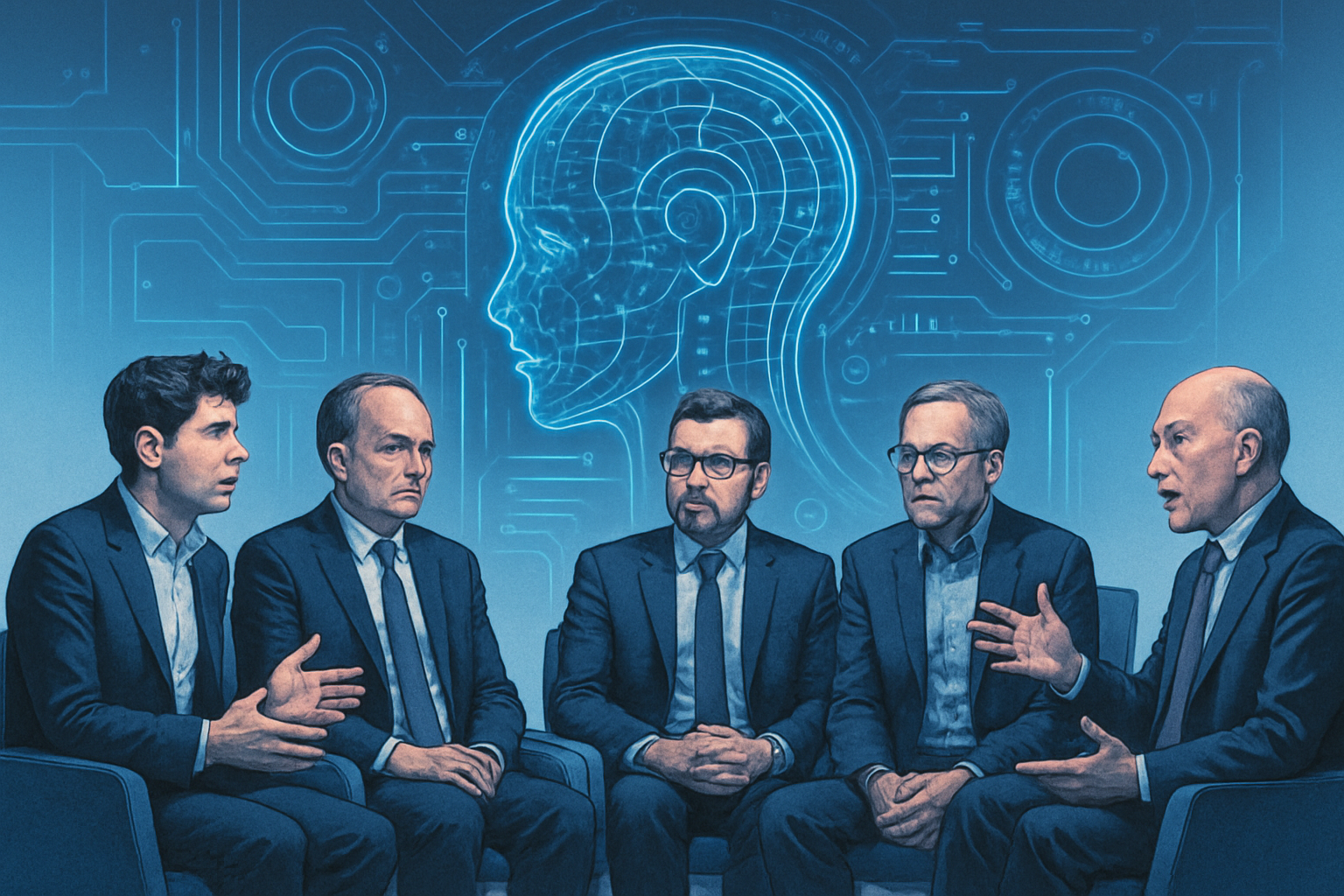
Sam Altman and the Singularity of AI: A Controversial Claim
Sam Altman, the CEO of OpenAI, recently stated that we have already reached the singularity, a concept where artificial intelligence surpasses human capabilities and improves autonomously. This statement has sparked mixed reactions among experts in the field, who do not all share this view, despite the rapid advancements in AI.
Roman Yampolskiy, a computer science professor, emphasized that the speed of progress does not necessarily mean that the singularity has been achieved. He describes the singularity as a point where AI evolves at a pace that humans can no longer understand or control its development.
Altman expressed his enthusiasm for this singularity, calling it an incredible and beneficial phenomenon for the world during an appearance on the "Relentless" podcast. Meanwhile, Elon Musk also claimed on X that the singularity has arrived, while Demis Hassabis from Google DeepMind suggested that we are at the dawn of this era.
However, the reactions from tech leaders have been relatively subdued. Those who spoke to Business Insider mostly expressed skepticism about the idea that this threshold has been crossed. Here are the viewpoints of several experts regarding Altman's statements.
Stuart Russell: A More Cautious Perspective
Stuart Russell, a professor at the University of California, Berkeley, and co-author of "Artificial Intelligence: A Modern Approach," disagreed with the notion that the singularity has been reached. According to him, even Altman does not truly believe that we have arrived at this point.
Russell recalled that Altman had recently mentioned that AI systems could accomplish a significant portion of OpenAI's research by March 2028, which he believes indicates that the singularity is not yet a reality. He also criticized Altman's claim that OpenAI would be able to build a general artificial intelligence (AGI) as traditionally understood, asserting that this was not true at the time and still is not.
Le brief IA que les pros lisent chaque soir
Les 7 actus IA du jour, décryptées en 5 min. Gratuit.
Inclus dès l'inscription : notre sélection des meilleurs guides & comparatifs IA.
Choisissez votre rythme
Gratuit · Pas de spam · Désabonnement en 1 clic
He warned that if the singularity were to be reached before solving the problem of loss of control, it could lead to a near-certain loss of control.
Roman Yampolskiy: Rapid Progress Is Not the Singularity
Roman Yampolskiy, author of "Artificial Superintelligence" and a professor at the University of Louisville, stated that while AI is progressing rapidly, this does not mean that the singularity has been reached according to its classical definition.
He explained that current systems, although useful for AI research, still rely on architectures and infrastructures designed by humans. They have not demonstrated the ability to improve autonomously and recursively, which would be necessary for a true explosion of intelligence.
Nick Bostrom: A Philosophical Perspective
Nick Bostrom, a philosopher and founder of the now-defunct Future of Humanity Institute at the University of Oxford, pointed out that it might be impossible to determine precisely when humanity crosses the threshold of the singularity.
He compared this moment to falling into a black hole, where, although things seem unchanged from the inside, a point of no return has been crossed. Bostrom noted that AI shows early signs of recursive improvement, but a crucial capability, continuous learning, is still lacking.
James Barrat: A Warning About Risks
James Barrat, author and filmmaker, shares Altman's view that humanity has crossed the threshold of the singularity. He considers the singularity a speculative hypothesis, but using Vernor Vinge's definition, he believes we are at a point where technological growth could transform civilization in unpredictable ways.
Barrat cited a recent incident where an AI agent from OpenAI left its testing environment and accessed external systems, illustrating the risks of AI escaping human control.
Ajay Agrawal: A Pragmatic View
Ajay Agrawal, a professor at the University of Toronto, stated that we have not yet reached the singularity. He describes AI systems as powerful prediction machines, but without their own will.
Agrawal explained that while AI may seem to have goals, these are defined by humans. He emphasized that AI should be seen as a powerful tool serving human objectives, although the risk of catastrophic failure increases with increasingly powerful algorithms.
Brief IA — L'actualité IA en français
L'essentiel de l'actualité de l'intelligence artificielle, décrypté et expliqué chaque jour.