SoftBank Abandons Plan to Acquire SK Hynix for 1 Trillion
SoftBank, led by Masayoshi Son, has abandoned a project to acquire SK Hynix for $1 trillion. No formal offer was made to SK Square, the largest shareholder of the South Korean manufacturer with 20% of the capital. The merger was intended to secure the Japanese group's material supplies and give it greater control over its production costs.
Regulatory and Financial Obstacles
HBM is among the technologies that South Korea considers fundamental for the country. Therefore, a foreign acquisition requires prior approval from the government. SK Group was not willing to initiate this process.
SoftBank's financial resources posed another obstacle. In its consolidated accounts as of September 30, 2026, the group reported having 5.39 trillion yen in cash, equivalent to about $33.7 billion. This amount represented only 3.4% of the proposed price. Additionally, SoftBank recorded a net loss of $7.01 billion in one quarter.
The Group Already Controls Arm
The industrial scope considered would have combined SK Hynix's factories with SoftBank's holdings. The group already controls Arm, which designs architectures, as well as the chip manufacturer Ampere. It also finances OpenAI's models and is developing electrical infrastructures with SB Energy. The acquisition would have thus brought Arm, OpenAI, and SK Hynix closer together within this framework.
Le brief IA que les pros lisent chaque soir
Les 7 actus IA du jour, décryptées en 5 min. Gratuit.
Inclus dès l'inscription : notre sélection des meilleurs guides & comparatifs IA.
Choisissez votre rythme
Gratuit · Pas de spam · Désabonnement en 1 clic
The Korean manufacturer held 50% of the global HBM market in the second quarter. It also supplies a significant portion of the modules integrated into Nvidia accelerators. SoftBank had studied the case with Wall Street banks.
Valued at $575.6 billion on November 20, SK Hynix's market capitalization represented a base that the proposed price multiplied by 1.7. The theoretical premium amounted to 570 trillion won, equivalent to $424.4 billion.
Memory Alone Is Not Enough to Manufacture an Accelerator
Even with SK Hynix, SoftBank would not have had complete industrial autonomy: no single supplier covers the entire hardware chain. Silicon etching requires external foundries, while operators remain dependent on specialists in advanced packaging and graphics processor designers. Nevertheless, the availability of memory remains a condition for deploying computing servers.
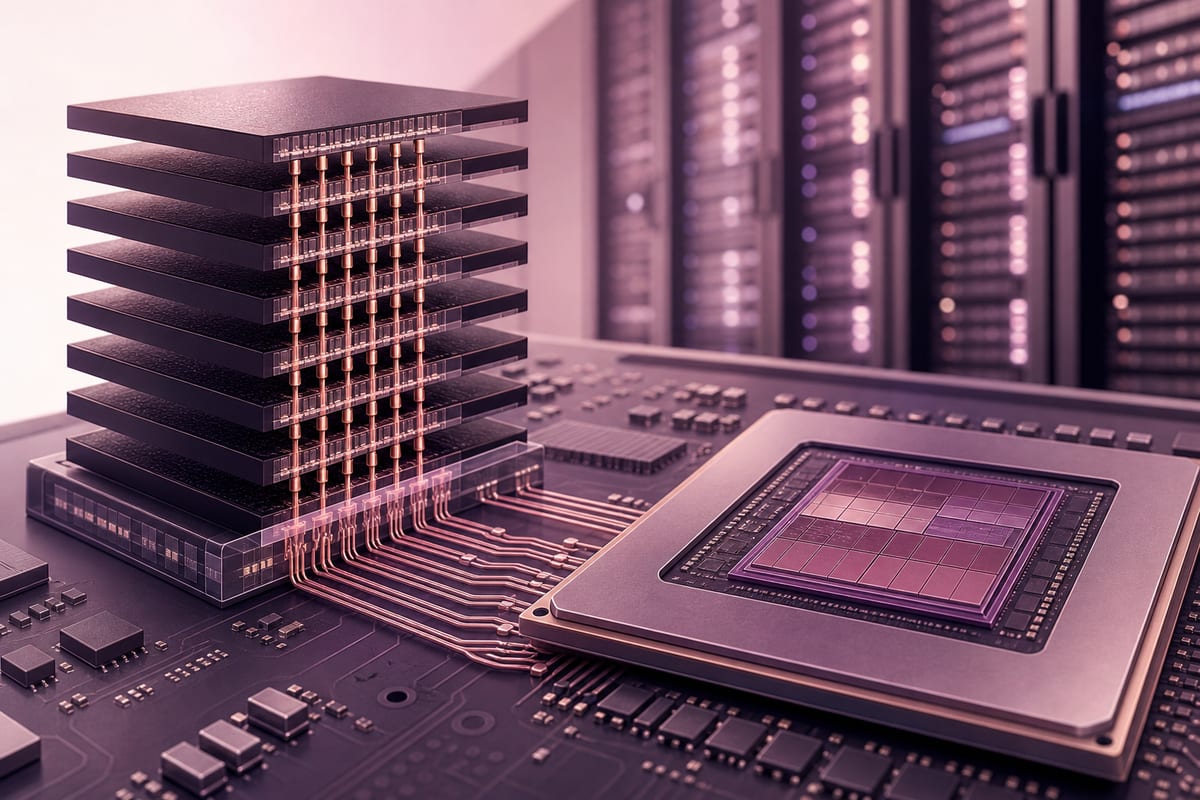
Graphics processors can be hindered by the wait for data from traditional RAM. HBM, or high bandwidth memory, addresses this limitation by stacking DRAM chips connected by TSV microconnections to the processor. This arrangement shortens the electrical path of signals and increases transfer throughput. It also limits the thermal dissipation of accelerator cards.
The validation of HBM4 modules will serve as a technical indicator over the next four quarters. The ramp-up of packaging lines at foundries is another point to monitor. The extent of the reduction in memory needs per request due to model quantization remains to be measured.
Brief IA — L'actualité IA en français
L'essentiel de l'actualité de l'intelligence artificielle, décrypté et expliqué chaque jour.