Poll: AI Pause Appeals on Both Sides of the Atlantic
A survey conducted by Public First across six countries shows that a plurality of adults prefer to pause advancements in AI. In each country, more than half fear at least a moderate risk that the technology could destroy humanity. Partisan divides remain limited outside the United States, where the splits are more pronounced, as public authorities and political actors are already adjusting their responses.
In the United States, the electorate is divided, while in the UK and Canada, 53% prioritize safety
Among American voters who supported Donald Trump in 2024, 44% favor a pause on advanced AI development, while 40% prefer to move forward. They are also more likely than Kamala Harris voters in 2024 to view alarmist rhetoric from AI lab employees as marketing. Nearly half of Trump voters believe that the United States should not fall behind, even at the cost of taking risks. In contrast, majorities in Canada and the UK, at 53%, choose to fall behind to prioritize safety. Across North America and Europe, respondents generally find the warnings from AI industry researchers to be quite credible, a trend confirmed when the hypothesis of a "marketing ploy" is proposed.
U.S. States: Enhanced controls and consideration of a "kill switch"
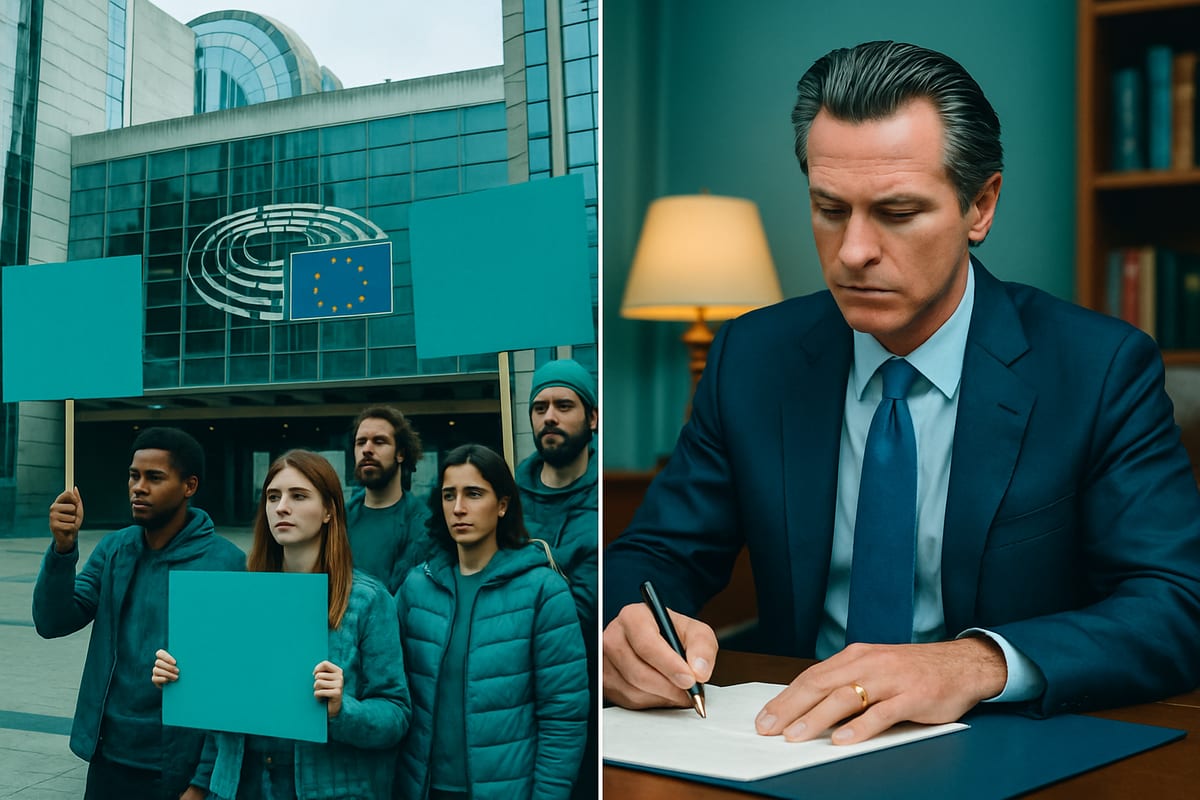
Several state leaders, both Republican and Democrat, are advocating for stricter regulation of AI. In California, where policymakers are also tightening rules amid growing voter distrust, Governor Gavin Newsom has signed an executive order aimed at accelerating the implementation of new oversight standards. State agencies are tasked with examining the need for a mandatory shutdown mechanism for the most advanced AI models.
Europe: Call for a pause, investment efforts, and citizen mobilization
The European Union established a regulatory framework for AI in 2024. Ursula von der Leyen expressed her support for a pause and stated in her annual address that if technology developers are clear, policymakers must be as well. She invited AI labs to discuss how the EU could support industry efforts to regulate development. At the same time, Brussels is preparing multi-billion euro investments in computing capacity and is trying to address what are considered low adoption rates, as the continent has very few providers of cutting-edge models, with Mistral cited as the main competitor. Civil society is also mobilizing: the Pause AI movement demonstrated in front of the European Parliament in Brussels. Its Belgian coordinator, Didier Coeurnelle, mentioned an internal estimate from Anthropic of over 10% probability of human extinction to illustrate his call for caution. Leaders, from American President Donald Trump to British Prime Minister Andy Burnham, are also seeking to address concerns related to AI.
Le brief IA que les pros lisent chaque soir
Les 7 actus IA du jour, décryptées en 5 min. Gratuit.
Inclus dès l'inscription : notre sélection des meilleurs guides & comparatifs IA.
Choisissez votre rythme
Gratuit · Pas de spam · Désabonnement en 1 clic
Industry and think tanks: Calls for slowing down, skepticism, and accusations of marketing
Leaders such as Dario Amodei, Sam Altman, and Elon Musk have recently put forward the idea of slowing down development. The debate has intensified in the United States after Donald Trump labeled AI alerts as a "HOAX," diminishing the prospect of an immediate bipartisan agreement. Other figures, including Jensen Huang and David Sacks, have downplayed the dangers and rejected the idea of new public regulations, accusing alarmists of exaggerating the risks. According to Neil Chilson from the Abundance Institute, the situation reflects a technological panic, with little damage observed and many fears projected, especially since in every country except Spain, at least one-third of respondents use AI little or not at all. He argues that fear currently outweighs experience, but that experience will eventually catch up. Conversely, some observers see certain alerts as promotional leverage: Max Junestrand, CEO of Legora, valued at over $5 billion, believes much of it is marketing amplifying proposed capabilities.
Overall results: A plurality for a pause and a majority fear of existential risk
In the six countries studied, about half of adults believe that AI developments should be paused to reduce risks, peaking at 51% in the UK and bottoming out at 45% in Germany. Conversely, between 30% and 40% indicate a desire to continue efforts to achieve significant benefits. The level of concern is high: more than one in two, and nearly two in three in the United States, France, the UK, and Canada, believe there is at least a moderate risk that AI could lead to the extinction of humanity. Overall, on both sides of the Atlantic, a plurality of adults opts for a suspension, while a majority considers an existential risk plausible.
Method: Six countries, over 2,000 respondents, and ±2.2 points of error
The survey was conducted from September 13 to 15 by Public First. More than 2,000 participants were consulted in the United States, Canada, the UK, France, Spain, and Germany. The overall margin of error is ±2.2 percentage points, and it is higher for smaller subgroups.
Brief IA — L'actualité IA en français
L'essentiel de l'actualité de l'intelligence artificielle, décrypté et expliqué chaque jour.