SpaceX: Massive AI Spending Raises Wall Street's Concerns
Le brief IA que les pros lisent chaque soir
Les 7 actus IA du jour, décryptées en 5 min. Gratuit.
Inclus dès l'inscription : notre sélection des meilleurs guides & comparatifs IA.
Choisis ton rythme
Gratuit · Pas de spam · Désabonnement en 1 clic
SpaceX: Colossal AI Spending, Wall Street on Alert
SpaceX's ambitions, driven by Elon Musk, are facing a complex financial reality. As the company continues to aim for the stars, its spending on artificial intelligence is reaching dizzying heights. In fact, SpaceX's AI bill is nearly on par with that of its rockets, causing some nervousness among Wall Street investors. This concern has manifested in a significant drop in SpaceX's stock, which fell by 11% in after-hours trading, despite overall financial performance exceeding expectations.
Over the past three months, SpaceX has invested nearly $16 billion in its AI infrastructure, a figure well above initial forecasts. This colossal amount surpasses Wall Street's expectations, which anticipated $13 billion, and represents more than double the spending of the previous quarter. These massive investments are intended to support Musk's futuristic vision, which envisions a space future dominated by AI. Despite a profit that exceeded expectations, investors remain worried about these astronomical expenditures.
The company recently raised a record $86 billion during its IPO in June. Its quarterly revenue surged by 92% compared to the previous year, reaching $7.8 billion, thus exceeding analysts' forecasts. SpaceX also managed to nearly halve its net loss, which now stands at $541 million. Additionally, the company reported a notable increase in revenue from its AI business, thanks to computing agreements with giants like Anthropic and Google.
"I know this sounds completely crazy"
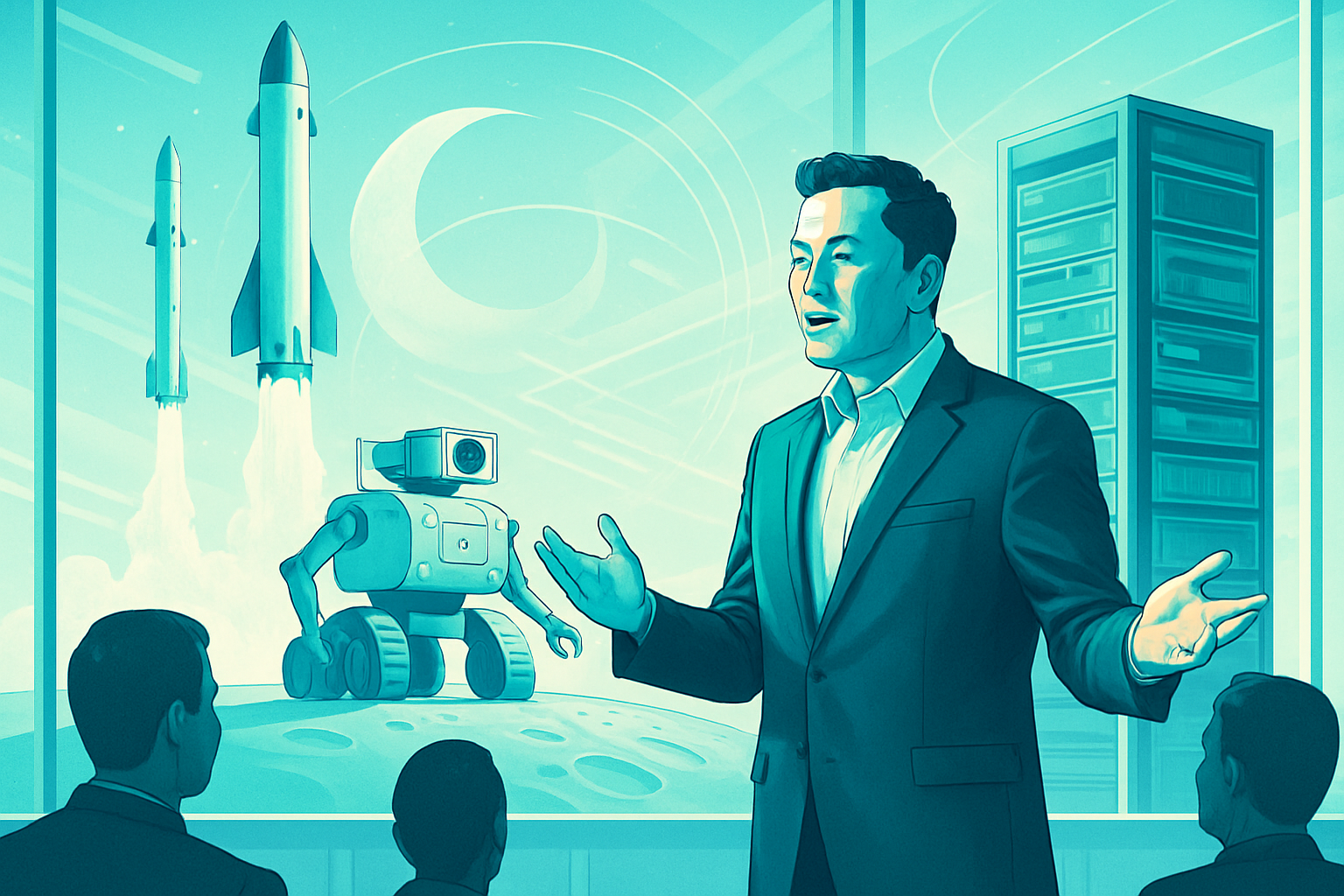
During a conference call with analysts, Elon Musk and other SpaceX executives defended these substantial expenditures, calling them necessary to achieve the company's ambitious goals. Musk discussed the potential of Starlink, SpaceX's connectivity venture, to provide bandwidth to humanoid robots, likely manufactured by Tesla, on Earth and beyond. He also mentioned the idea of using robots on the moon to enhance manufacturing, a vision that seems straight out of a science fiction movie.
Musk explained that building a mass accelerator on the moon could allow for the catapulting of objects into space, paving the way for a much larger space economy than that of Earth. According to him, such a device could multiply the efficiency of intelligence sent into space by a thousand or even a million times.
Extraordinary Ambitions for SpaceX
Elon Musk expressed his belief that SpaceX could generate $1 trillion in revenue as early as 2029, advancing the initial target set for 2031. He also announced that the company plans to launch its orbital data centers, dubbed Starmind, as early as next year. SpaceX's CFO, Bret Johnsen, indicated that overall capital expenditures are expected to remain stable for the next two quarters, which could bring annual spending to $65 billion. However, he emphasized that SpaceX's AI infrastructure is beginning to yield rapid returns on investment.
Johnsen clarified that, in terms of AI computing, SpaceX is capable of deploying capital in a way that achieves a return on investment in less than a year. UBS analysts have raised their revenue estimates for 2026 and 2027, noting that SpaceX's AI business is operating at full throttle.
The Rollercoaster of SpaceX's Stock
Investor nervousness regarding rising AI expenditures has added to the uncertainty surrounding SpaceX's stock price. It is now trading about 16% below its IPO price, following a notable decline last month. This volatility is expected to continue, with around $100 billion in stock set to be available for sale after the lock-up period expires for early investors and employees.
Despite this uncertainty, SpaceX's initial results as a public company show that its underlying business remains strong. Starlink's revenues, SpaceX's primary source of income, have significantly exceeded Wall Street's expectations. The company also reported an increase of over 108% in revenues from businesses and governments for Starlink in the last quarter.
SpaceX recently achieved two launches of its massive Starship rocket, a crucial element for Musk's vision of relocating data centers and manufacturing into orbit. Musk emphasized that even without Starship, SpaceX delivers more material into orbit than the rest of the world combined. He asserted that SpaceX's ingenuity makes its competitors unlikely to compete, whether on Earth or in space. "It's like, frankly, the New York Yankees playing against a minor league team," he stated, illustrating the company's confidence in its technological superiority.
Brief IA — L'actualité IA en français
L'essentiel de l'actualité de l'intelligence artificielle, décrypté et expliqué chaque jour.