SpaceX and Elon Musk Target the Moon to Produce AI Satellites
Le brief IA que les pros lisent chaque soir
Les 7 actus IA du jour, décryptées en 5 min. Gratuit.
Inclus dès l'inscription : notre sélection des meilleurs guides & comparatifs IA.
Choisis ton rythme
Gratuit · Pas de spam · Désabonnement en 1 clic
SpaceX and Its Lunar Ambitions for AI Satellites
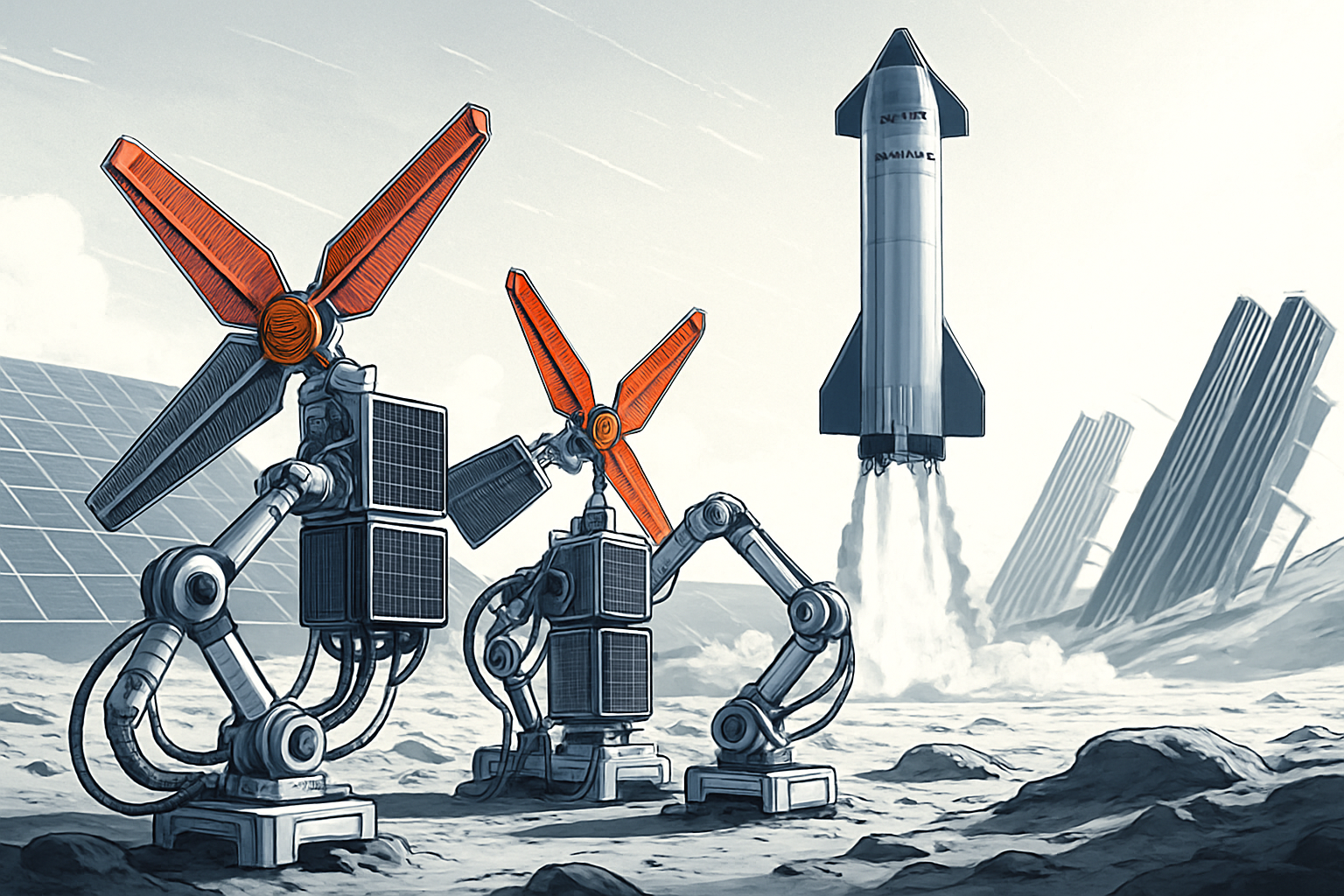
Elon Musk, the visionary behind SpaceX, is looking to take a bold new step by building factories on the Moon. The goal is to produce Starmind artificial intelligence satellites directly on lunar soil. To achieve this ambitious project, SpaceX plans to use robots transported by the Starship rocket. This announcement coincides with SpaceX's IPO, but it remains to be seen whether this timing is intentional or coincidental. Musk had previously shared this vision during the acquisition of xAI, his artificial intelligence company founded in 2023. According to him, while it may seem like science fiction, this project is indeed underway.
Production and Launch from the Moon
SpaceX envisions producing Starmind satellites on the Moon and launching them directly from its surface. To do this, the company plans to use mass drivers, powerful electromagnetic devices capable of propelling satellites into space. Additionally, SpaceX intends to manufacture solar panels and radiators on the Moon to provide the necessary energy for the satellites and dissipate the heat generated by their chips. The first models of Starmind, unveiled in June, measure 70 meters long and 20 meters high, with a computing capacity of 120 kilowatts. SpaceX aims to deploy up to one million of these satellites in low Earth orbit before expanding their presence beyond.
Computing Capacity and Lucrative Contracts
Musk claims that this approach could exponentially increase space computing capacity, up to one million times what is currently possible on Earth. SpaceX has already signed significant contracts with tech giants such as Anthropic, Google, and NVIDIA. The agreements with Anthropic and Google alone could generate around $26 billion (€22.5 billion) in annual revenue for SpaceX.
Optimus and Robotic Automation
However, some observers remain skeptical, questioning whether this project is just another recurring myth associated with Elon Musk. The humanoid robot Optimus, developed by Tesla since 2021, is expected to be the primary workforce on the Moon. Optimus is also intended to prepare for human settlement on Mars, another ambitious project of Musk's. This robot is described as the most complex product to industrialize in Tesla's history. Although no units have yet been deployed in the group's factories by early 2026, Tesla plans for a public rollout by the end of 2027. Optimus is expected to be transported by SpaceX's Starship, which recently successfully completed its thirteenth test flight without major incidents.
Technological Progress and Financial Results
Bret Johnsen, CFO of SpaceX, emphasized that Starship must improve its payload capacity by a factor of four and reduce launch costs by ten compared to the Falcon 9 rocket. Progress has been made in the production of Raptor engines, the construction of gigabays, and the activation of several launch pads at Starbase and Cape Canaveral. During its IPO in June, SpaceX raised $86 billion (€74.6 billion), reaching a valuation of $1.77 trillion (€1.535 trillion). The revenue for the last quarter stands at $7.8 billion (€6.8 billion), marking a 92% increase compared to the previous year, despite a net loss of $541 million (€469 million), down from the previous year.
Brief IA — L'actualité IA en français
L'essentiel de l'actualité de l'intelligence artificielle, décrypté et expliqué chaque jour.