Spotify, Netflix, and TikTok: AI Redefines Global Entertainment
Spotify, Netflix, and TikTok: AI Redefines Global Entertainment
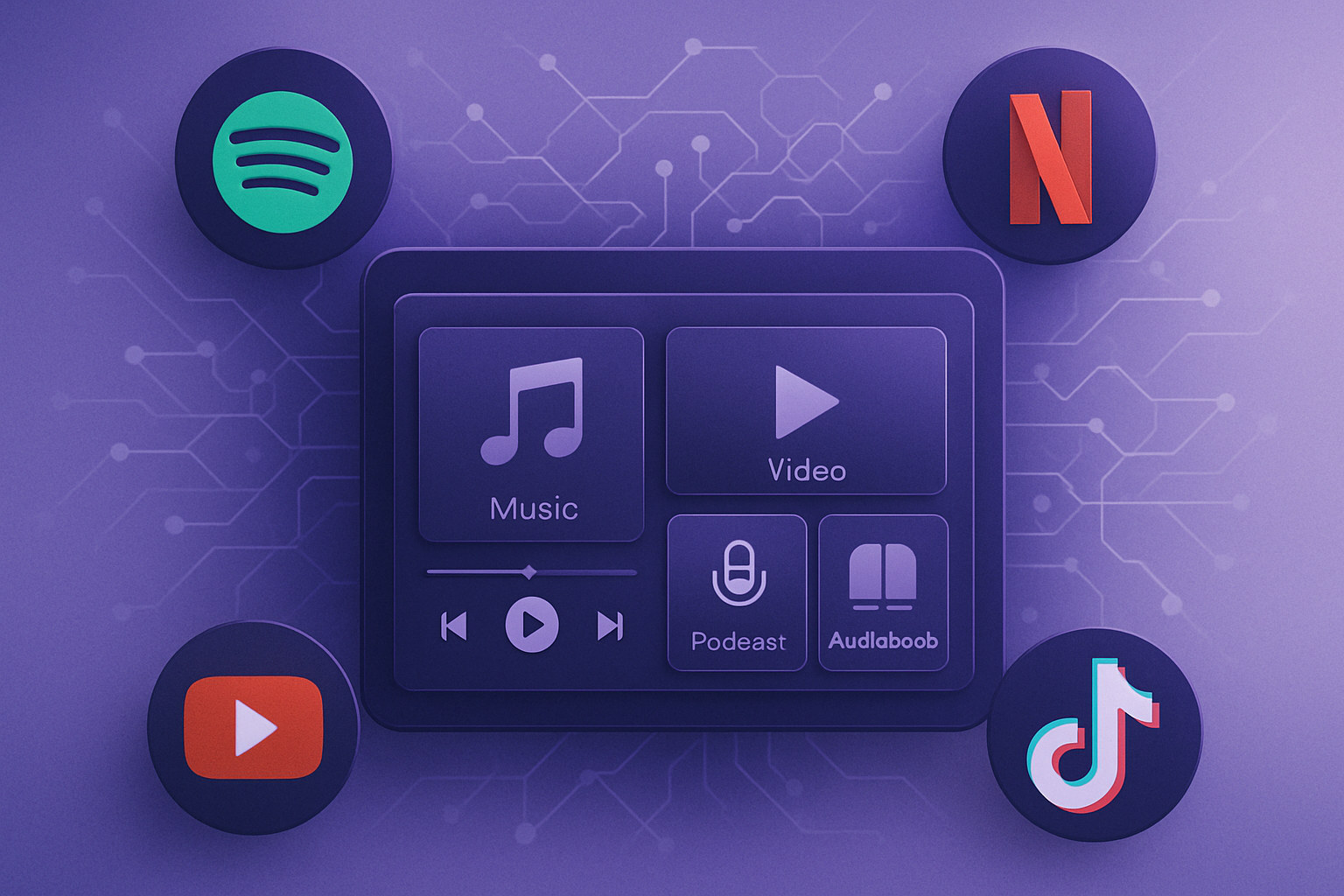
All major entertainment apps are starting to look alike, and it's no coincidence. For a decade, platforms have been vying to dominate a single format: music, video, podcasts, audiobooks. Today, powered by AI, they are competing for something bigger: to become the default app you turn to whenever you have time to kill, regardless of the type of content.
There are several reasons for this. The entertainment app market is reaching maturity, slowing growth and pushing companies to compete on time spent and revenue per user rather than new sign-ups. Additionally, today's creators often work across multiple formats, so it makes sense to provide a home for all their content, not just part of it.
AI adds a third reason. It makes it easier for a single company to effectively develop and manage multiple formats, and the broader the mix of content, the more time users spend in the app, which in turn increases advertising revenue and subscriptions.
Examples of Platform Convergence
Netflix is a clear example of this trend, having added games, live sports, and other events in recent years, as well as, more recently, short video clips and podcasts. The idea is to capture more user time, even when there isn't a series or movie they want to watch, and to find a way to fill the small moments of free time that people typically spend scrolling social media, playing casual games, or watching TikTok or Reels.
Spotify has also expanded its scope beyond its original concept of a music streaming platform. After adding podcasts, the company integrated support for video podcasts, social features like Q&As and comments, stories and messages, as well as different types of content like fitness courses, audiobooks, narrated magazines, and even physical book sales.
Meanwhile, YouTube, which was originally the home for long-form creator content, has evolved towards short-form content to compete with TikTok, while adding dedicated spaces for podcasts, gaming content, music, movies and TV, sports, news, shopping, and more. Now, you can watch free movies and TV shows, supported by ads; stream live content; or rent or buy shows and movies to add to your library. At this rate, integrating YouTube TV and YouTube Music into YouTube itself — and selling tiered access to the entire bundle — seems to be a matter of "when," not "if."
Even TikTok, widely known for its short videos, offers support for long-form content and other features, such as travel planning, shopping, local exploration, purchasing tickets for live events, and more. It even has its own standalone app for micro-dramas and another called TikTok Pro Events for sporting events — like the FIFA World Cup — as well as music festivals, and more.
Le brief IA que les pros lisent chaque soir
Les 7 actus IA du jour, décryptées en 5 min. Gratuit.
Inclus dès l'inscription : notre sélection des meilleurs guides & comparatifs IA.
Choisissez votre rythme
Gratuit · Pas de spam · Désabonnement en 1 clic
While there are still some differentiators between services today, there is an obvious trend toward convergence around a similar set of features focused on user access to content to watch, listen to, play, or buy.
The Role of AI in the Future of Entertainment
This is also where AI comes into play. With format no longer being a differentiator, the value these apps offer depends on their ability to connect users with what they want next.
AI facilitates content recommendations across formats, refining personalization while giving users more direct control over how those recommendations are made.
Spotify, for example, is testing a tool that will allow you to modify your Taste Profile, its AI-built model of your preferences. The company is also developing AI features that allow users to directly discuss with the AI what they want or create playlists of what they like — and not just music.
Netflix has made a similar case. Co-CEO Greg Peters told investors during the company's first-quarter call that new model architectures are improving personalization and allowing the team to iterate faster.
AI-assisted coding also accelerates the speed at which these companies can create and launch new content domains.
Moreover, generative AI can be used for content creation, although the topic remains controversial, as artists fear that AI tools may use their work for training purposes or even replace them. Netflix, for better or worse, has bet on AI, having recently acquired Ben Affleck's film production company for $587 million, for example.
YouTube has used generative AI to launch more tools for creators and improve its search engine, add conversational AI features, create playlists, and expand the reach of its content with automatic dubbing, among other things. Earlier this year, the company reported that over a million channels were using its AI creation tools and that 20 million consumers had used its AI-powered content discovery tool Gemini in December.
Alphabet CEO Sundar Pichai has presented AI as central to the YouTube experience for creators and viewers.
TikTok has assembled its own version, with an integrated AI chatbot, AI-powered video creation tools, AI-driven searches and recommendations, and AI-powered accessibility features.
All four also apply AI to their advertising systems, helping marketers write ads, target audiences, price placements, and measure results.
For consumers, this convergence means fewer reasons to switch apps. Whichever one you land on, it gains an advantage — more data on your habits, more loyalty — making it harder to leave even if prices rise or quality declines.
As the boundaries between music, video, podcasts, books, and games blur, the upcoming battle is no longer about which format will win, but which app will become the go-to place for entertainment, no matter what form it takes.
Brief IA — L'actualité IA en français
L'essentiel de l'actualité de l'intelligence artificielle, décrypté et expliqué chaque jour.