Stanford and Arc Institute: AI Designs Antibacterial Viruses
Le brief IA que les pros lisent chaque soir
Les 7 actus IA du jour, décryptées en 5 min. Gratuit.
Inclus dès l'inscription : notre sélection des meilleurs guides & comparatifs IA.
Choisis ton rythme
Gratuit · Pas de spam · Désabonnement en 1 clic
Stanford and Arc Institute: AI Designs Antibacterial Viruses
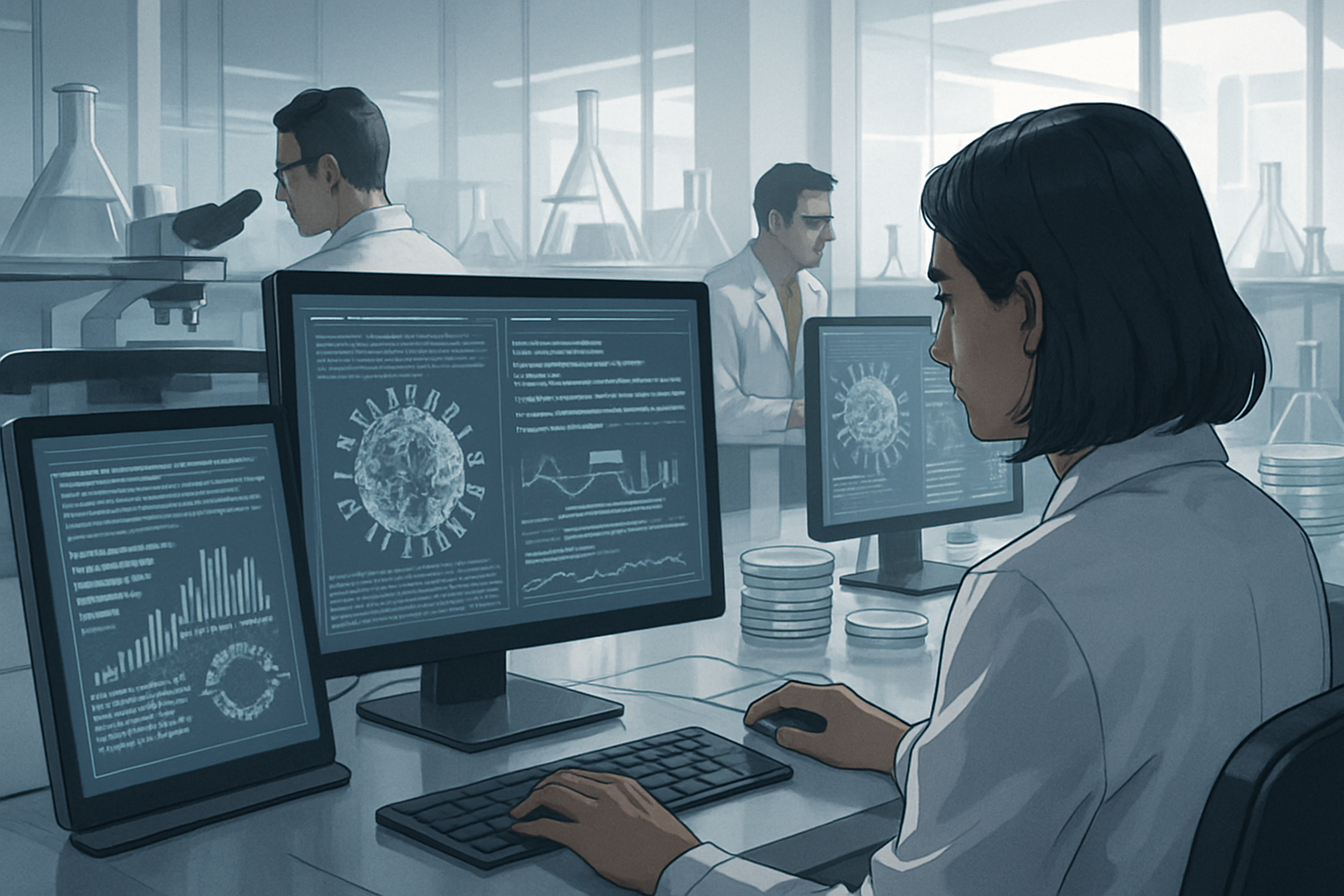
A team from Stanford University and the Arc Institute has used an AI model to design complete viral genomes from scratch, subsequently creating 16 functional viruses in the lab that do not exist in nature. This work, previously available only as a preprint, has now been peer-reviewed and published in the journal Science.
The New York Times reports new details, including the success rate. The model, called Evo, proposed 700,000 possible genomes. The team pursued only the most promising candidates, chemically synthesized 285 sequences in the form of DNA, and inserted them into bacteria. Sixteen of these sequences produced viruses capable of replication. The preprint mentioned 302 synthesized genomes.
The training process has also become clearer. Evo initially learned from about nine trillion nucleotides from millions of animals, plants, microbes, and viruses, identifying patterns that span the entire tree of life. Only then did a second round of specialized training follow, using the 11 genes of the Phi X-174 phage and about 15,000 of its closest relatives. For PhD student and co-author Samuel King, this seemed like the logical next step. "It was just the obvious next step," he said.
The resulting viruses were not mere weak copies. They proved to be as robust as natural viruses, with some replicating even faster than Phi X-174. "These are not just sickly versions of things that already exist," says Oliver Crook, a protein chemist at the University of Oxford who did not participate in the study. Patrick Cai, a synthetic biologist at the University of Manchester, calls this work a "significant milestone."
However, Crook tempers expectations. The AI did not invent anything fundamentally new. The viruses are very similar to natural species and rely on the same biology. The question remains whether Evo would also be effective with other groups of viruses. If so, the results could provide useful tools for medicine and biotechnology. "A lot of our science relies on viruses as technology," says Crook.
Why Current Safety Rules Do Not Cover This
A gap in biosafety regulation is now more visible than ever. The National Institutes of Health in the United States published a policy on high-risk life sciences research at the end of July. It prohibits experiments that make pathogens more dangerous. However, purely computational work, that is, the design of viral DNA on a computer, is not covered "unless it involves a concerning entity," the agency stated.
The problem is evident. With smallpox, this classification is clear. With a virus derived from an AI model, it is not. "What is the risk of something I have never seen before?" asks Moritz Hanke from the Johns Hopkins Center for Health Security. He notes a wide gap between the pace of research and the safeguards surrounding it. "There is just a huge lag." His scenario of misuse: "You could say, 'Hey, genomic language model, give me a modified flu genome to be more transmissible or more lethal.'"
The team took precautions on its own. During training, Evo received no data on viruses that infect humans, nor on related pathogens from animals, plants, or fungi. This means the model cannot generate these genomes in the first place. "We just wanted to be very cautious," says Brian Hie, a computational biologist at Stanford and co-author of the study. Hanke calls this "very commendable," especially since no official rule required it. "Because they are not getting any guidance from anywhere on what they should do," he says.
Original Article from September 21, 2025
A research team in California has used artificial intelligence to design functional viruses that kill bacteria, in what they describe as the "first generative design of complete genomes." The project marks a first step toward AI-designed life forms, according to a report from MIT Technology Review.
The work was carried out by scientists from Stanford University and the Arc Institute, a nonprofit organization. In a preprint article, they describe how an AI system proposed new genetic codes for viruses. The team then chemically printed 302 of these designs as strands of DNA and exposed them to E. coli bacteria. Sixteen of the AI-generated viruses successfully replicated and destroyed their bacterial hosts.
"It was quite striking, just to see that sphere generated by AI," said Brian Hie, who leads the lab at the Arc Institute where the viruses were created.
Evo Learns from Millions of Viral Genomes
At the heart of the project is an AI called Evo, which functions like a large language model but is trained on biology rather than text. Instead of learning from books and articles, Evo was trained on about two million genomes of bacteriophages. For this study, the researchers asked it to propose variants of phiX174, a simple bacteriophage containing only 11 genes and about 5,000 letters of DNA.
Jef Boeke, a biologist at NYU Langone Health, described the project as an "impressive first step" toward AI-designed life, even though the viruses themselves are not technically alive. He stated that the AI's performance was "surprising" and its designs "unexpected," with changes in the order and arrangement of genes that human scientists had not considered.
Not everyone is convinced. J. Craig Venter, who contributed to the pioneering work on synthetic DNA, called the method a "simple faster version of trial-and-error experiments." His lab has already created synthetic cells through a similar process, but with much slower manual research through the scientific literature.
Promises and Risks
The technology could have major applications. Doctors have long experimented with phage therapy as a treatment for multidrug-resistant bacterial infections. Viruses are also a key tool in gene therapy, where they deliver new genes into human cells. AI-designed viruses could make both approaches more effective.
But the risks are also clear. The team deliberately avoided training Evo on human pathogens. Nevertheless, Venter raised "serious concerns" about what could happen if the same approach were used on dangerous viruses like smallpox or anthrax. "One area where I urge the greatest caution is any research on viral enhancement, especially when it is random, because you don't know what you're getting," he said.
Expanding the method to living cells is also much more complex. A bacterium like E. coli has about 1,000 times more DNA than phiX174. "The complexity would go from an already considerable level to far more than the number of subatomic particles in the universe," Boeke warned.
Despite this, Jason Kelly, CEO of Ginkgo Bioworks, argues that pursuing AI-designed cells should be a national priority. He envisions automated labs that could continuously test AI-generated genome designs, feeding the results back into the model. "This would be a scientific milestone on a national scale, as cells are the building blocks of all life," he said. "The United States should ensure that we achieve this first."
Brief IA — L'actualité IA en français
L'essentiel de l'actualité de l'intelligence artificielle, décrypté et expliqué chaque jour.