Stanford Revolutionizes E. coli Fight with AI Evo 2
Le brief IA que les pros lisent chaque soir
Les 7 actus IA du jour, décryptées en 5 min. Gratuit.
Inclus dès l'inscription : notre sélection des meilleurs guides & comparatifs IA.
Choisis ton rythme
Gratuit · Pas de spam · Désabonnement en 1 clic
AI-Generated Phages to Combat E. coli
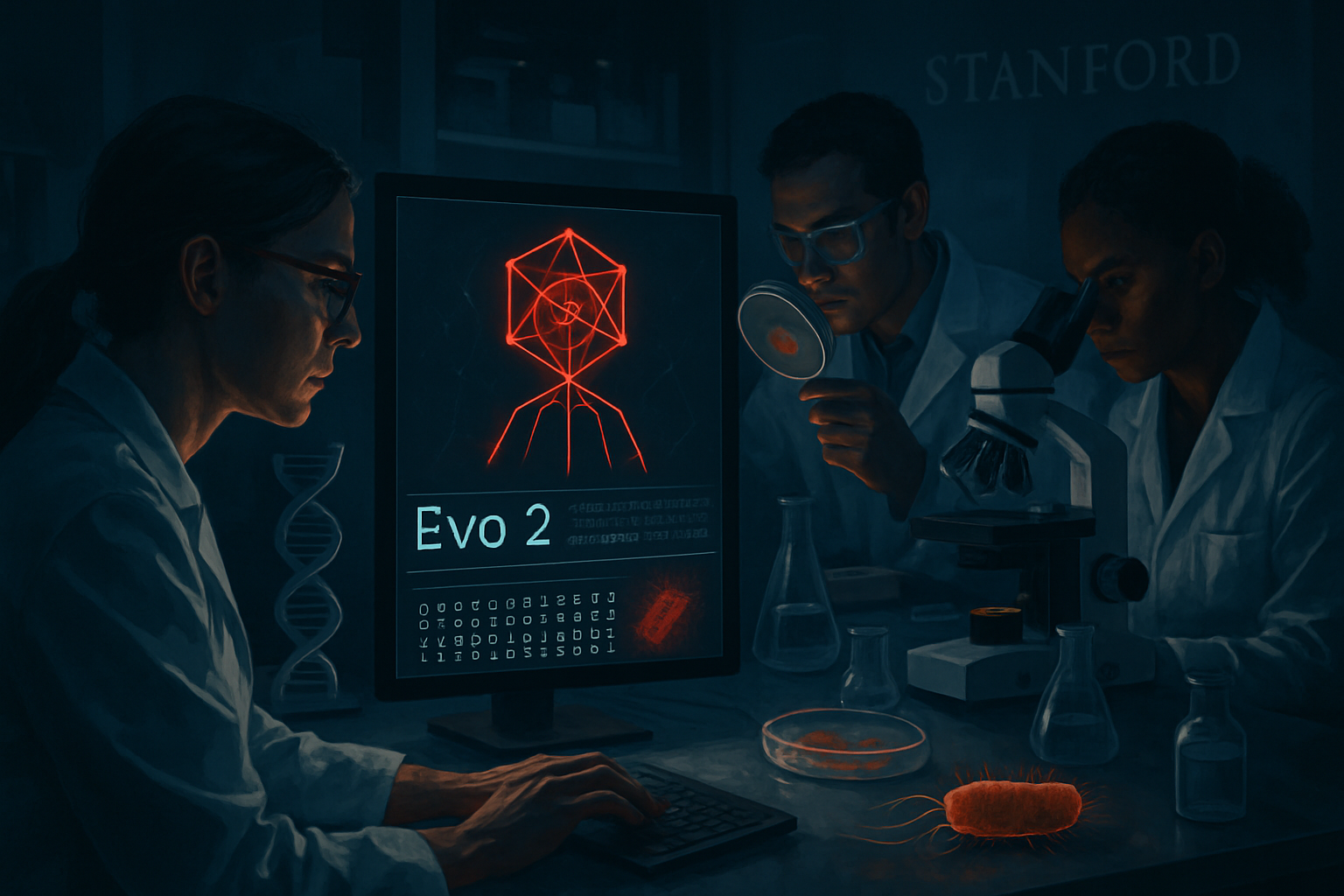
At Stanford University, a team of researchers has successfully synthesized nearly 300 phages using DNA sequences generated by the AI model Evo 2. After rigorous laboratory testing, this group was narrowed down to 16 phages that demonstrated particularly effective activity against the E. coli bacterium. This advancement marks an important milestone in the use of artificial intelligence for synthetic biology.
The project focuses on the bacteriophage ΦX174, a well-studied virus. Brian Hie, an assistant professor of chemical engineering and a recipient of a Dieter Schwarz Foundation fellowship, led the development of Evo 2. He collaborated with Samuel King, a graduate student in bioengineering, who handled the practical experiments described in their publication.
Generation of Phage Genomes by Evo 2
Evo 2 is capable of generating new DNA sequences from a small portion of an existing phage genome. The researchers instructed the model to produce a complete genome of ΦX174 in one go, without any further human intervention. This process allowed for the creation of thousands of candidate genomes, from which the team selected those to be chemically synthesized and tested in the lab.
The choice of ΦX174 as a model is explained by its relatively small size, with a genome of less than 6,000 base pairs, compared to the 3 billion base pairs of the human genome. Brian Hie emphasized that even with a DNA sequence of 5,400 characters, gene-by-gene interpretation remains a complex challenge.
Some phages generated by Evo 2 showed better performance than the original ΦX174 during laboratory tests. The project aims to determine whether an AI model can create viable viral genomes in their entirety, rather than simply proposing local modifications to the DNA.
Optimization Before DNA Synthesis
Samuel King developed a computational framework to reduce the number of candidate genomes sent for synthesis. This system evaluated characteristics derived from ΦX174 and similar phages before the team chose the options to test in the lab.
DNA synthesis imposes practical constraints. The researchers generated genomes with Evo 2, evaluated them according to their design criteria, and then chemically synthesized the selected candidates to identify which ones performed best in the lab.
King explained that one of the key steps in the design framework was to determine what characteristics the genomes should possess, based on ΦX174 and related phages. The framework included several steps: generating genomes with Evo 2, evaluating them according to design criteria, selecting optimal candidates, chemical synthesis, and laboratory testing.
Brian Hie noted that this framework allowed for a reduction in synthesis costs by focusing resources on the most promising candidates. Although Evo 2 generated thousands of possibilities, computational evaluation, chemical synthesis, and laboratory trials were necessary to identify viable phages.
Phage Mixtures to Counteract Bacterial Resistance
The researchers opted for a mixture of several phages targeting E. coli, as bacteria can develop resistance to a single treatment. Brian Hie explained that using phage mixtures makes it more difficult for bacteria to develop resistance to the entire treatment.
“If bacteria acquire resistance to a single phage, it’s the end for the drug,” he stated. “But with several genetically distinct phages in a mixture, it becomes harder for bacteria to resist the entire cocktail.”
A cocktail containing the 16 selected phages quickly overcame resistance in E. coli, which was immune to the native ΦX174. Hie mentioned that similar work could target phages against methicillin-resistant Staphylococcus aureus (MRSA) and Pseudomonas aeruginosa, a major cause of resistant infections acquired in hospitals.
Evo 2 Open-Sourced to Broaden Research
Evo 2 has been released as open-source software, allowing researchers worldwide to download the model and use it to design genomes. This openness has sparked discussions about safety and security, as malicious actors could potentially modify the tool.
However, Brian Hie emphasized that existing pathogens pose a greater risk, as they are more easily accessible and reproducible. He also asserted that AI-based systems can support responses to natural pandemics and provide defense options against human-made biological threats.
Samuel King described the impact of this research in terms of scientific creativity: “One of the most rewarding parts of this project is the creativity that Evo 2 enables. New doors in science are now opened thanks to what we can do with these models.”
The next phase of the project aims to extend Evo 2 to longer and more complex DNAs. Hie is collaborating with researchers from Stanford and other institutions to develop additional designs for bacteriophages. Small bacterial genomes could also become a target for the model, supporting the production of chemicals, medicines, or fuels by engineered microbes. Hie framed the remaining technical work around two key questions: “The biggest open questions for me are how to achieve greater genetic novelty and how to gain better control over the outcomes?”
Brief IA — L'actualité IA en français
L'essentiel de l'actualité de l'intelligence artificielle, décrypté et expliqué chaque jour.