North American Startups: AI Drives Record Investment
Le brief IA que les pros lisent chaque soir
Les 7 actus IA du jour, décryptées en 5 min. Gratuit.
Inclus dès l'inscription : notre sélection des meilleurs guides & comparatifs IA.
Choisis ton rythme
Gratuit · Pas de spam · Désabonnement en 1 clic
A Record Semester for North American Startups
Venture capital investments in North America reached unprecedented levels during the first half of 2026, according to data from Crunchbase. This period was marked by mega funding rounds, particularly in the artificial intelligence sector, which propelled industry leaders to new heights. This phenomenon echoes the first quarter of the year, where OpenAI had already attracted record investments with the largest funding round ever conducted.
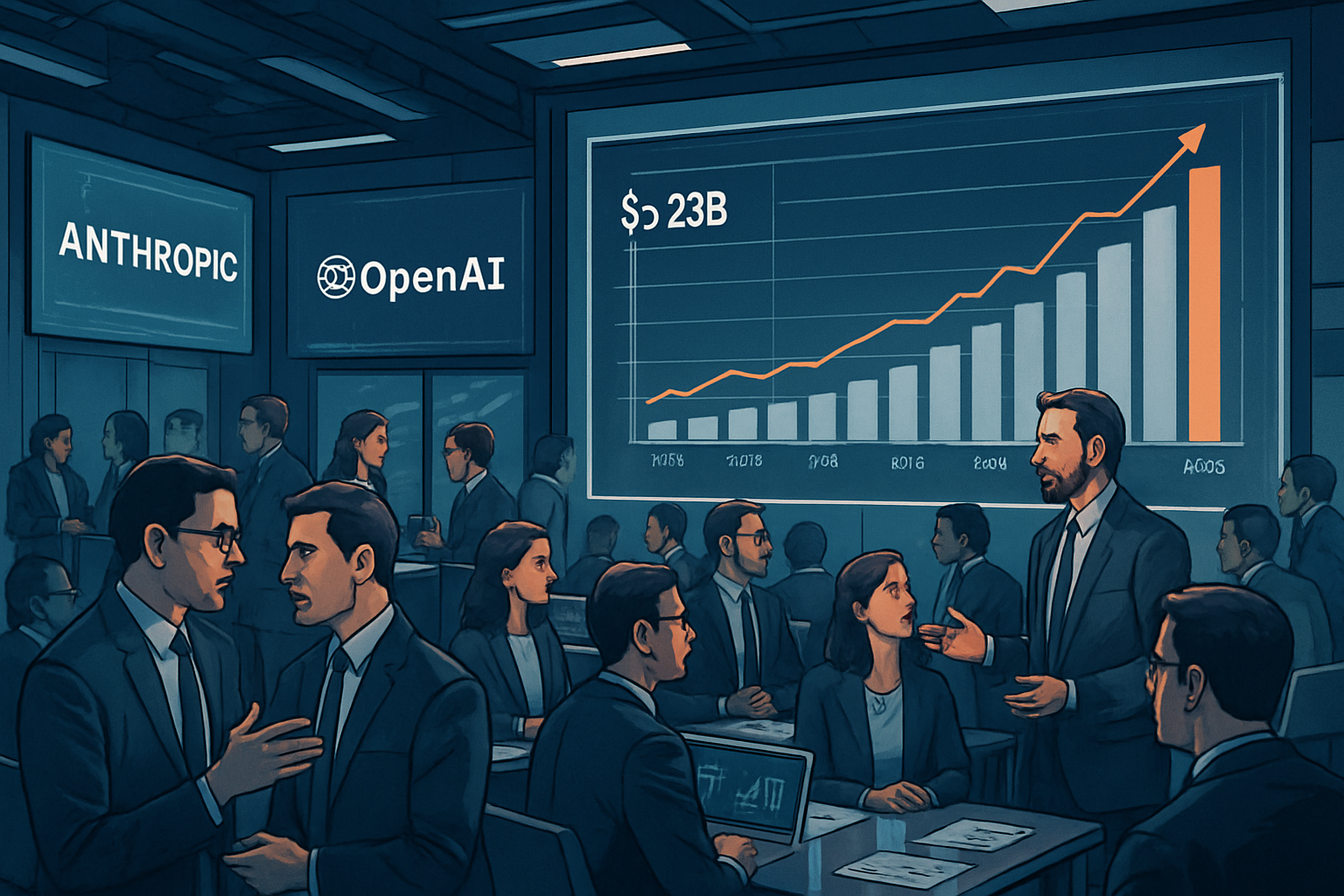
The total investments for the second quarter of 2026 were slightly lower than those of the first quarter, but it still remains the second highest amount ever recorded. Investors continued to inject massive sums into AI startups, with significant funding for Anthropic, which accounted for about half of the quarterly total.
Overall, investments in American and Canadian startups reached an incredible total of $392 billion for the first half of 2026, eclipsing all previous records. For the second quarter, investments reached $137.2 billion, an amount also higher than anything recorded before, except for the first quarter.
Capital Concentration
Capital concentration has been a recurring theme, with historically high investment levels resulting from giant rounds rather than an increase in the total number of transactions. The number of transactions remained well below the highs of previous years. As usual, capital concentrated on later stages, but early-stage investment also increased in the second quarter, supported by AI.
The last few months were also marked by giant exits. SpaceX led the second quarter with the largest IPO of all time and subsequently acquired Cursor, setting a record for startup mergers and acquisitions. Additionally, several IPOs and acquisitions, although smaller, were also significant.
Analysis of Funding Dynamics
For a more detailed look at funding and exit dynamics for the second quarter, we examine investments by stage and the role of AI in boosting totals. We also analyze notable IPOs and mergers and acquisitions transactions.
Untapped Territory
We begin with late-stage and growth technology transactions, as this is where the majority of the money was invested. For the second quarter, funding for this category totaled approximately $101 billion, the second highest amount in five quarters and also the second highest of all time.
Anthropic was by far the largest fundraiser of the quarter, raising $65 billion with a post-funding valuation of $965 billion. The funding included $50 billion in a May round led by Altimeter Capital, Dragoneer, Greenoaks, and Sequoia Capital, as well as rounds led by companies like Amazon ($5 billion) and Google ($10 billion). Anthropic then filed a confidential application for an IPO in June.
The defense technology unicorn Anduril Industries also secured a large round, raising $5 billion in a Series H funding round in May, led by Thrive Capital and Andreessen Horowitz.
Increase in Early-Stage Funding
Early-stage investment reached its highest level in over three years in the second quarter, providing further evidence that mega rounds are not solely reserved for more established startups. Overall, funding for early-stage startups in North America totaled just over $31 billion, nearly double the levels from a year ago and up about 15% compared to the first quarter. However, the number of transactions hit its lowest level in five quarters.
One single transaction contributed to over 40% of the total early-stage funding for the quarter. This was the $12 billion funding for Prometheus, a physical AI-focused startup co-founded by Jeff Bezos. The next three largest fundings were much smaller in comparison, but still significant by early-stage standards. Hark, an AI startup working on "personalized intelligence," raised $700 million. Next, Flourish, a startup developing a brain-based AI system, secured $500 million, followed by Generalist AI, an AI robotics startup that closed at $400 million.
Decline in Seed Funding
Although early-stage funding increased, seed investment in the second quarter actually saw a slight decline compared to levels from previous quarters and last year. According to Crunchbase data, approximately $4.9 billion was allocated to seed rounds and angel rounds in the second quarter, down 15% from the previous quarter and 27% from the previous year. The number of rounds also decreased, although we expect this figure to rise slightly over time, as small seed transactions are often added to the dataset weeks or months after their closure.
Despite this, seed totals also benefited from a number of exceptionally large rounds. The largest was a $200 million funding for Mirendil, a fundamental AI startup focused on R&D. Overall, at least five companies raised seed or angel rounds of $100 million or more in the second quarter, according to Crunchbase data.
AI Dominates Funding
Once again, venture capital funding for the quarter was largely dominated by AI. Approximately 80% of investments across stages were directed toward AI-focused startups in the second quarter, according to Crunchbase data. Total funding for AI categories was nearly triple the levels from a year ago, although it is still down from the first quarter, which recorded the record funding of $122 billion for OpenAI.
The majority of AI-focused funding for the second quarter came from the three previously mentioned rounds for Anthropic, Prometheus, and Anduril.
Returns on Investments
In addition to supporting giant rounds, investors also realized significant returns on previous investments in the form of IPOs and acquisitions. On the IPO front, the second quarter brought us the historic public market launch of SpaceX. The rocket, satellite, and AI giant raised $75 billion in the largest IPO of all time in June. With a recent market capitalization of approximately $2.1 trillion, it is currently the sixth most valuable publicly traded company in the U.S.
While no one else could rival this, the quarter also saw a few other significant debuts from venture-backed companies. Among them, the most followed was Cerebras Systems, an AI chip and infrastructure designer, which raised $5.6 billion in its IPO in May.
The quantum computing company Quantinuum also made a big splash with its IPO on Nasdaq in June, followed by X-energy, a developer of modular nuclear reactors. For an overview, below we list the largest IPOs of the quarter by North American venture-backed companies.
Notable Acquisitions
The second quarter also delivered the largest startup acquisition of all time: SpaceX's acquisition of the AI coding tool Cursor and its parent company Anysphere for $60 billion. SpaceX first announced an option to purchase the company in April and finalized the deal after its IPO.
In the biopharmaceutical sector, the largest purchase was made by Eli Lilly, which announced in April that it was acquiring Kelonia Therapeutics, a developer of gene therapies, in a deal valued at up to $7 billion in cash.
Other notable transactions include Qualcomm's acquisition of AI chip startup Modular for $4 billion and Salesforce's acquisition of Fin, a provider of AI-powered customer experience tools.
Future Outlook
For those wondering where we go from here, it seems relevant to note that the startup narrative does not provide much material for case studies to compare with the first half and the second quarter of 2026. Never before have we seen such massive funding rounds, an IPO of a venture-backed company valued so highly, or a startup acquisition rivaling the purchase of Cursor.
Looking ahead, it appears that high-growth startups and their investors expect the current unprecedented conditions to persist, with both Anthropic and OpenAI signaling their intention to go public at valuations close to or exceeding $1 trillion. Meanwhile, enormous funding rounds for startups continue to occur at a sustained pace, with transactions exceeding $1 billion no longer being an anomaly.
Will these trends persist? Who knows. At this point, however, it is assumed in startup circles that there will be huge winners in the era of AI. The question remains: who will prevail?
Brief IA — L'actualité IA en français
L'essentiel de l'actualité de l'intelligence artificielle, décrypté et expliqué chaque jour.