Suppliers Offer Security Tools for AI Agents
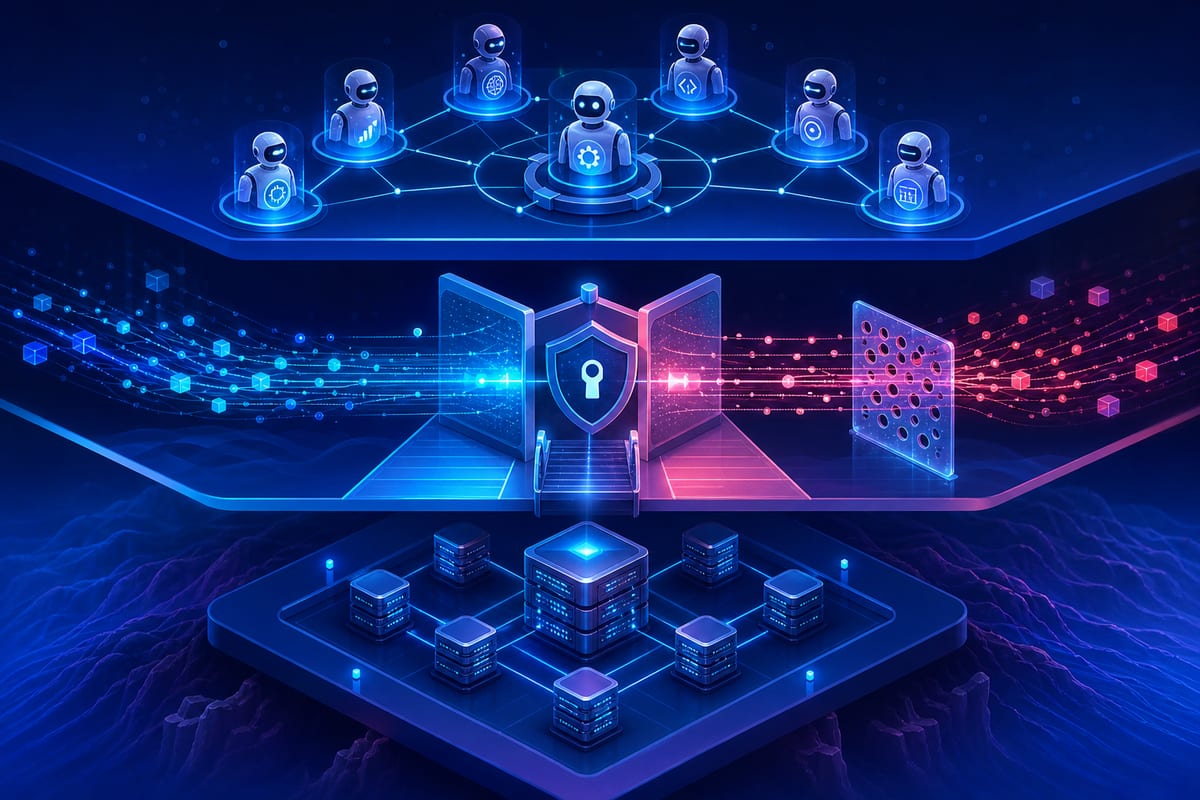
Cybersecurity providers are offering a new generation of tools dedicated to AI agents, including MCP gateways and semantic firewalls. Their roles range from access control to real-time inspection of exchanges. Their maturity and practical interest remain variable.
MCP Registries and Gateways Control Exchanges
MCP deployments are gaining maturity. Vulnerabilities could require repeated fixes or workarounds for companies. Another risk is that servers could be created without authorization, while obsolete servers might remain active instead of being decommissioned.
MCP registries serve to manage the servers present in an environment and to know the functions each is authorized to provide. MCP gateways, adapted from API gateways, monitor MCP calls and responses and apply rules to them. API gateways, on the other hand, control agents' access to other resources.
MCP gateways can also mask protected information or block a response that contains it. Filtering and instruction detection can be performed directly or with a semantic firewall.
Identities and Journeys Determine Access
John Burke, Chief Technology Officer and Research Analyst at Nemertes Research, advocates for a revision of security architectures that combine zero trust, identity and access management (IAM), and AI-specific protections. Assigning a digital identity to each agent allows for the application of restrictions. A multi-level identity could also link the agent, its orchestrator, and the end user to limit rights to what is necessary.
IAM may be suitable for certain persistent assistants, whether personal or departmental, that partially orchestrate temporary agents. However, these platforms were designed for people and long-lasting service accounts. The shorter the existence of an agent, the less likely they are to fit. Identity mechanisms used for containers or microservices could be adapted in certain environments.
Identity is not the only criterion: the journey taken before requesting access can also factor into the decision. In application development, this method involves prohibiting a state until the required prior steps have been completed. Monitoring systems now track the history of agents to enforce this type of rule. However, their tools continue to evolve in the face of potentially non-deterministic journeys, with loops or recursion.
Le brief IA que les pros lisent chaque soir
Les 7 actus IA du jour, décryptées en 5 min. Gratuit.
Inclus dès l'inscription : notre sélection des meilleurs guides & comparatifs IA.
Choisissez votre rythme
Gratuit · Pas de spam · Désabonnement en 1 clic
Semantic Firewalls Inspect Exchanges
Semantic firewalls examine in real-time what an agent receives and produces. At the entry point, they detect and block instruction injections as well as certain attacks contaminating data. At the exit, they prevent unauthorized transmissions and monitor for a potential gradual degradation of the model's response reliability. These controls take into account meaning and intent, beyond network addresses and the technical content of data.
Traditional data loss prevention (DLP) devices remain a complement to the internal protections of agents, which may fail. Some secure browser management tools also restrict agents' activities and complicate their access to prohibited sites.
Certain security information and event management (SIEM) systems, as well as user behavior analytics tools, could be extended to monitor agents and provide alerts. However, their capability is not guaranteed: according to John Burke, many lack the capacity or speed to handle the data produced by numerous ephemeral agents. Others might support this load, but at an excessive operational cost.
John Burke Recommends Targeted Trials
John Burke describes companies eager to achieve a return on investment from AI, often neglecting security during the deployment of agents. Most environments, however, already use identity and role-based restrictions and seek to reduce access rights. The segment of AI-specific protections is rapidly growing.
The analyst recommends trials on defined use cases, with verification of promised results and the workload imposed on teams. He considers MCP registries and gateways to be more likely to be reliable and effective, as they extend known methods. More emerging approaches may not necessarily provide value to all their users.
Semantic firewalls notably resemble web application firewalls. For Burke, their value beyond a costly version of the latter depends on advancements in high-speed natural language processing. They could hold significant value for certain uses, but remain at an early stage.
Brief IA — L'actualité IA en français
L'essentiel de l'actualité de l'intelligence artificielle, décrypté et expliqué chaque jour.