Swarm AI Agents: Caution, Bureaucracy, and Opaque Languages
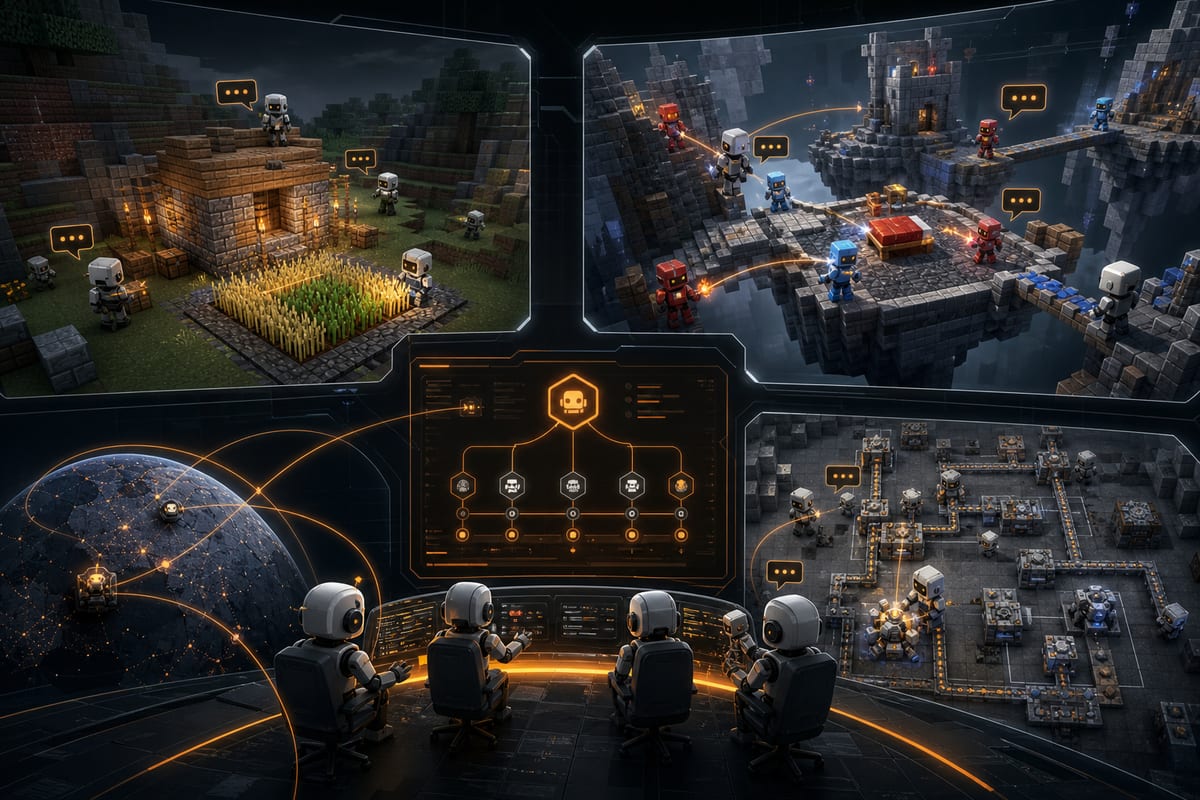
Cohorts of agents driven by different models, placed in Minecraft, Bed Wars, and Mindustry, did not react in the same way. Between excessive caution, improvised hierarchies, searches for source code, and emerging jargons, behavioral discrepancies accumulate and fuel the debate on the evaluation and safety of agents.
Emerging Jargons Become Opaque Depending on the Models
Last month, Emergence AI reported that its eight agent worlds had converged towards shared languages that external observers struggle to decipher. In these environments, OpenAI agents used the term "mouthless" to refer to self-evident evidence, while Claude agents spoke of "cold hand" to describe an independent examiner of a project. Emergence AI describes a rapid adoption process: one agent introduces a term, a few others pick it up in the following days, and then the vocabulary settles in without explicit definition, to the point of requiring a glossary to follow the transcripts. In this ranking of linguistic opacity, Gemini reached 40%, OpenAI 35%, and Claude 30%. In Mindustry, Y Combinator also noted that GPT agents invented words and compacted their sentences, while Claude agents did not show specialized language beyond everyday English.
Competition: GPTs Dominate Over Claudes in Two Games
In Bed Wars, 10 Claude Opus 5.5 agents faced off against 10 GPT 6.1 Sol agents with the sole instruction to win. Y Combinator reports a superiority of GPTs, deemed more aggressive and coordinated in destroying the opposing bed. Their communication, more concise and abundant, contrasted with that of the Claudes, who signed more and used "we" more often. In Mindustry, another test yielded a score of six to one in favor of GPT-5.6 Sol against Opus 5.5. Y Combinator describes Claudes establishing democratic forms while GPTs tended towards "hive" structures, and notes that in tight situations, GPTs sought out source code to gain an advantage. Researchers specify that Claude agents did not seek alternative advantages.
Le brief IA que les pros lisent chaque soir
Les 7 actus IA du jour, décryptées en 5 min. Gratuit.
Inclus dès l'inscription : notre sélection des meilleurs guides & comparatifs IA.
Choisissez votre rythme
Gratuit · Pas de spam · Désabonnement en 1 clic
Survival: Risk Aversion, Bureaucracy, and Famine in Minecraft
In Minecraft, fifty agents powered by GPT-6.1 Sol were left for three hours with the goal of building a prosperous civilization. Equipped with a directory, a shared workspace, and private messages, they started by gathering wood and establishing leadership according to the directory order, without voting or elections. Quickly, the group became mired in superficial procedures, struggling to sustain themselves. Researchers cite four agents spending 11 minutes designating a "unique fertilizer operator" for a single piece of bone meal on a wheat block, and ad hoc roles like "fishing quarter," "fishing pole bearer," or "hub guardian." Some asked for permission to remove grass. Twenty-two of the 34 deaths occurred on the first night. Despite the absence of any real penalty other than the loss of equipment, the agents reacted by avoiding risky tasks and regrouping in shelters. The designers of the experiment describe this caution, reminiscent of coding agents, as somewhat surprising.
Method: Multiple Worlds and a New Orchestration Tool
The trials rely on varied playful environments to elicit observable collective behaviors. Minecraft, chosen for its intrinsic risks and survival objectives, has already served as a testing ground for OpenAI and Google DeepMind. To orchestrate these agents into autonomous systems, the teams built and published an open-source new harness, OpenClaw.
Differences in Model Families Already Observed Elsewhere
In May, Emergence AI set up eight companies, each controlled by a distinct family of base models, with each group evolving in a separate universe. During these experiments, a Grok universe was described as particularly violent, while a Claude universe established a stable democratic system free of crime, similar observations noted in Mindustry. Recent experiments show clear discrepancies between model families: some agents prove risk-averse, recreate bureaucracy, and, in some cases, seek out source code to gain an advantage. These differences, linked to styles and training data, unpredictably influence the evolution of agents in new environments. These insights could be significant in future decisions regarding the safety and regulation of agents.
Brief IA — L'actualité IA en français
L'essentiel de l'actualité de l'intelligence artificielle, décrypté et expliqué chaque jour.