Taste Labs Leverages 1,000 Experts to Teach AI About "Taste"
Le brief IA que les pros lisent chaque soir
Les 7 actus IA du jour, décryptées en 5 min. Gratuit.
Inclus dès l'inscription : notre sélection des meilleurs guides & comparatifs IA.
Choisis ton rythme
Gratuit · Pas de spam · Désabonnement en 1 clic
The San Francisco startup claims to train models to assess the quality of visual creations with the help of a network of around 1,000 specialists. It is already marketing a brand API and, through one of its investors, claims revenues in the tens of millions of dollars. Its founder, Thais Castello Branco, aims to extend this approach to writing, music, and cinematography.
A Brand API Already Launched and Significant Reported Revenues
Taste Labs has launched a brand API designed to ingest a company's website and systematize its visual components into a set of actionable rules. This rulebook can be integrated into graphic design tools to generate new content while adhering to existing guidelines. The company also offers a tool for researching coherent brand systems, for example, to produce an identity described as "dreamy" with palettes evoking clouds and sunsets. According to Veronica Orellana, a partner at CRV, Taste Labs is already recording tens of millions of dollars in revenue and, thanks to these results and a clear vision, would not need to raise additional funds in the short term. The company also states that it has 30 full-time employees.
Collaborations with Leading Labs Without Name Disclosure
Thais Castello Branco claims that Taste Labs collaborates with most major leading labs on various projects, although she does not specify their names. She cites as an example a request to evaluate a model for its web gaming capabilities, identify shortcomings, and then recommend data that could address those issues. The company maintains the confidentiality of these partners while presenting this type of intervention as representative of its scope of action.
The Methodological Bet: Quality Taxonomies and Criteria of Greatness
To address areas where quality depends on context and interpretation, Taste Labs develops quality taxonomies. Designs are broken down into measurable elements, starting with media such as product websites, presentations, and brochures. The company describes an execution by subcomponents, such as code visualization, anticipating interactions, as well as the choice of fonts, colors, spacing, and alignments. It claims that a panel of experts can largely converge on the appreciation of these elements and that the central goal is to formulate criteria of greatness. The approach aims to be an alternative to simple data aggregation, seeking to improve quality assessment in subjective areas.
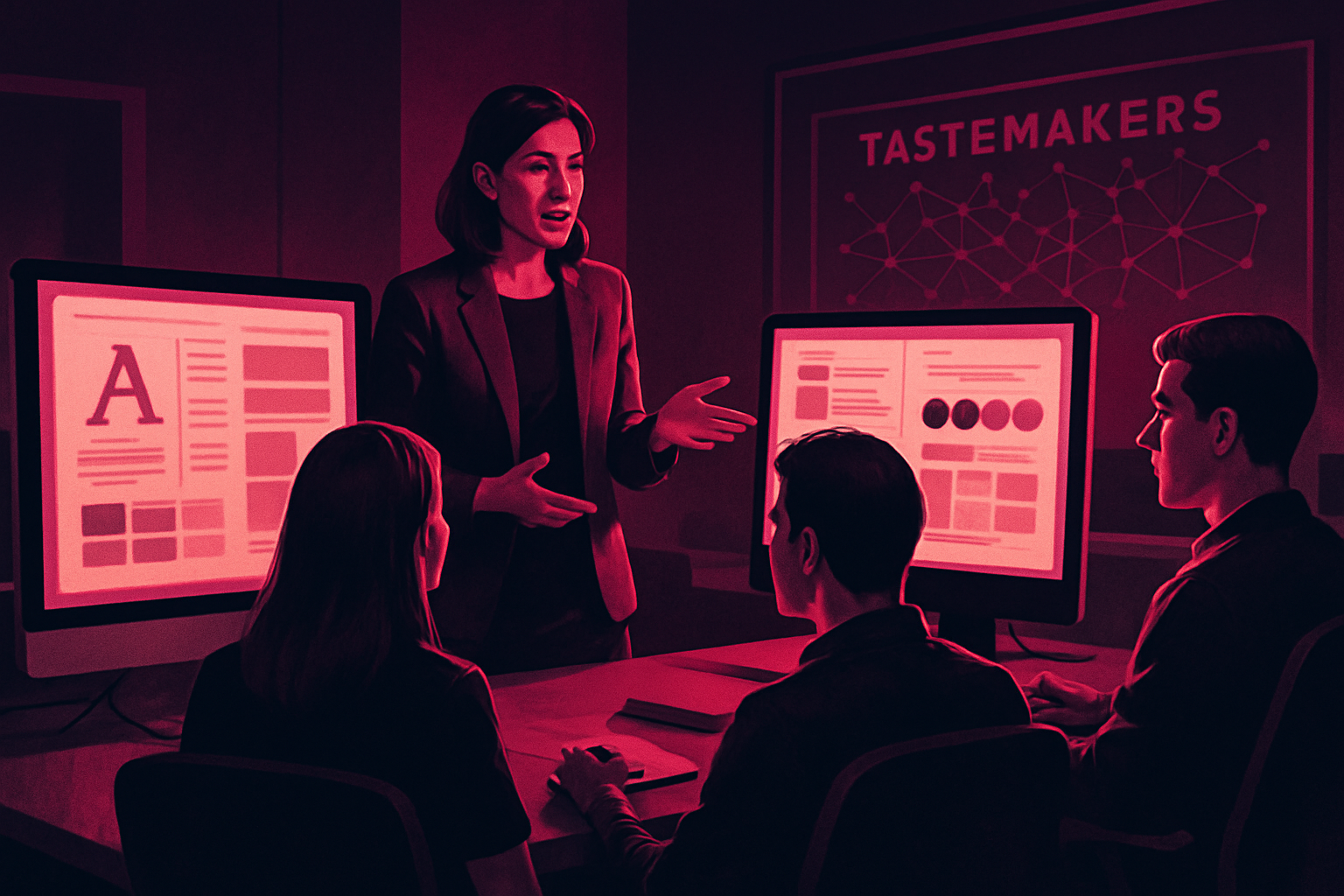
1,000 Tastemakers to Judge and Annotate What is "Good"
A network of around 1,000 Tastemakers, contractual workers from creative disciplines, trains the models by producing examples, explaining their choices, and evaluating AI outputs. Some evaluators also assess the work of other Tastemakers to refine the data. Artistic director Whitney Bolin, who has worked for Adobe and Adidas, describes tasks where design and style are broken down into observable elements such as typography, movement, color, and textures. She emphasizes that each evaluation requires deep reflection and is not reduced to a simple numerical score.
An Initial Focus on Visual Design Before Other Creative Arts
Taste Labs is initially focusing its efforts on visual design in an ecosystem already transformed by Figma and the rapid advancement of tools like Claude Code and Cursor. The company gives the example of a recipe website where its choices would place the recipe near the top, in contrast to a generative AI proposal favoring more introductory text. The company plans to extend the approach to writing, literary fiction, music, and cinematography.
Between the Ambition to Formalize Taste and Questions About Its Legitimacy
Taste Labs' thesis asserts that taste involves recognizing patterns that can be learned by models, while current AI lacks the guidance to distinguish quality data, producing mediocre results. Researchers point out that AI excels in objective tasks but struggles with subjective ones, which motivates the search for shared criteria. The company argues that high-quality preferences can enhance fields like creative writing and architecture, while acknowledging the magnitude of the task of indexing creativity. This ambition raises questions about the appropriateness of allowing AI to define greatness and the ultimate logic where human creative tasks would be handled by systems. The headquarters in Silicon Valley and San Francisco is accompanied by projected use cases, such as the idea that a well-known brand could use the API to ensure consistency in colors and fonts in generated productions.
Founder’s Background and Funding
At 29 years old and originally from São Paulo, Thais Castello Branco cites Christopher Nolan films and City of God among her influences. After graduating from the University of Chicago, she worked at Heinz Kraft developing products such as pickles, desserts, plant-based foods, and a burger sauce. She participated in the creation of Exa, focused on a search engine for AI agents, before founding Taste Labs last October. The company has raised $18.5 million from venture capital funds.
Brief IA — L'actualité IA en français
L'essentiel de l'actualité de l'intelligence artificielle, décrypté et expliqué chaque jour.