TBC bets on cultured neurons to accelerate AI video on AWS
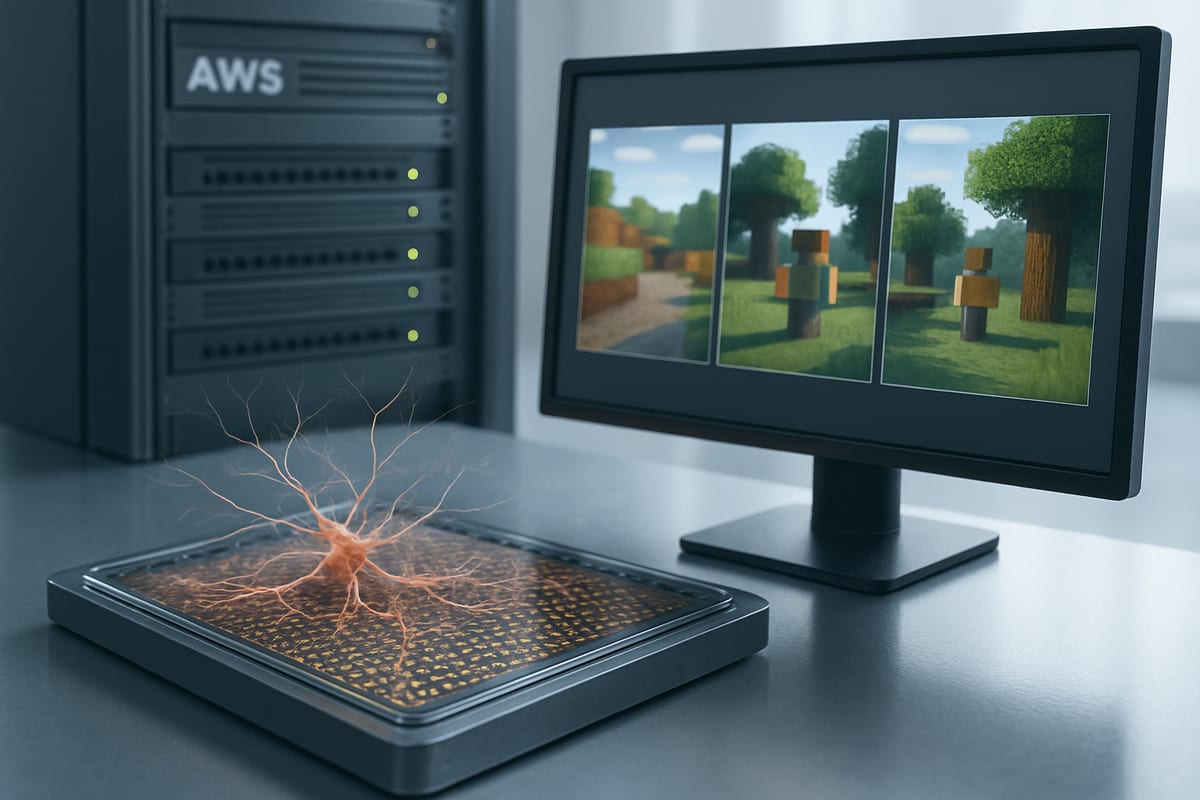
Biological Computing Co. wants to sell a text-to-video model via AWS, touted as five times faster and 80% cheaper thanks to a fine overlay derived from neural cultures. The method has shown gains in tests around Minecraft, but details of the commercial product remain limited.
Commercial Promises Remain Undocumented
For the commercial version of the model, the company provides no information about the initial model, hardware configuration, resolution, duration of sequences, or quality assessment methods. The claims of "five times faster" and "80% cheaper" translate to the same reduction if GPU time is reduced to one-fifth. It is not established that the biological detour surpasses numerical methods like distillation or caching. No controlled comparisons on the same base model with these techniques have been published.
What is Announced on the AWS Side and Availability
TBC is partnering with Amazon Web Services to market a text-to-video model. Execution is planned on AWS Trainium chips, with a service via Amazon SageMaker AI and distribution through AWS Marketplace. At this stage, access is through early registration, and this is the first commercial product resulting from TBC's development.
A Lightweight Overlay Claimed to be Faster and Cheaper
The company presents a performance gain of five times and an 80% reduction in inference cost attributed to a small software layer derived from measurements on nerve cells. The starting open-source model is not named. The overlay would add less than 0.1% to the model size, operates on standard AI infrastructure, and requires neither biological hardware nor new client-side workflows. Neurons are not involved during inference.
Measured Cortical Cells to Design Adapters
TBC cultivates cortical neurons on chips with 4,096 electrodes, stimulates precise points, and records the propagation and extinction of activity. Metrics such as the range and duration of signals are used to build software adapters. For experiments, images are translated into patterns of electrical pulses sent to the culture; excitation propagates locally and then fades, a behavior recorded and formalized in a Neural Dynamics Adapter. A second component converts these patterns into intermediate representations usable by the AI model. At inference, the adapter is a fixed mathematical transformation, with no cell involved.
Le brief IA que les pros lisent chaque soir
Les 7 actus IA du jour, décryptées en 5 min. Gratuit.
Inclus dès l'inscription : notre sélection des meilleurs guides & comparatifs IA.
Choisissez votre rythme
Gratuit · Pas de spam · Désabonnement en 1 clic
Oasis Case: Model Structure and Training
The Oasis model, with approximately 600 million parameters, generates Minecraft scenes frame by frame and suffers from error accumulation over time. The adapter designed by TBC has about 156,000 parameters without altering the base architecture. It was trained on Minecraft sequences, with the main model receiving a slight adjustment in parallel with a low learning rate.
Reported Results on Oasis and External Testing
According to the company, the integration of the adapter maintains edge sharpness and spatial stability for a longer duration. In ten test videos, the differential entropy measure shows about 19% better than the original, 15% better than a similarly sized adjustment, and 5% better than a LoRA. By increasing the adapter size by about 3% of parameters, it is possible to go from around two to just under ten frames per second due to the reduction in the number of steps per frame. An independent trial conducted in July by Bluesky Compute reported inference costs nearly 4.4 times lower and a higher proportion of consistent videos by a factor of three compared to the original model.
Identity, Funding, and Ambitions of TBC
TBC, formerly Biological Black Box, was founded by neurosurgeons Alex Ksendzovsky and Jon Pomeraniec. The company raised $25 million in February 2026. It has chosen generative video as its first application and plans to tackle world models next, with the prospect of ultimately combining neurons and silicon. Its products are designed to operate on standard AI infrastructures.
The Claim and Its Evaluation Limits
The thesis put forward by the company is that laboratory neurons reveal algorithms that are difficult to design otherwise. It is not established that this approach surpasses widespread numerical methods, due to the lack of controlled comparisons on the same base model. Given the available information, it is not possible to assess the general scope of this thesis.
Brief IA — L'actualité IA en français
L'essentiel de l'actualité de l'intelligence artificielle, décrypté et expliqué chaque jour.