Tesla Rolls Out FSD 15 with AI-Generated Road View
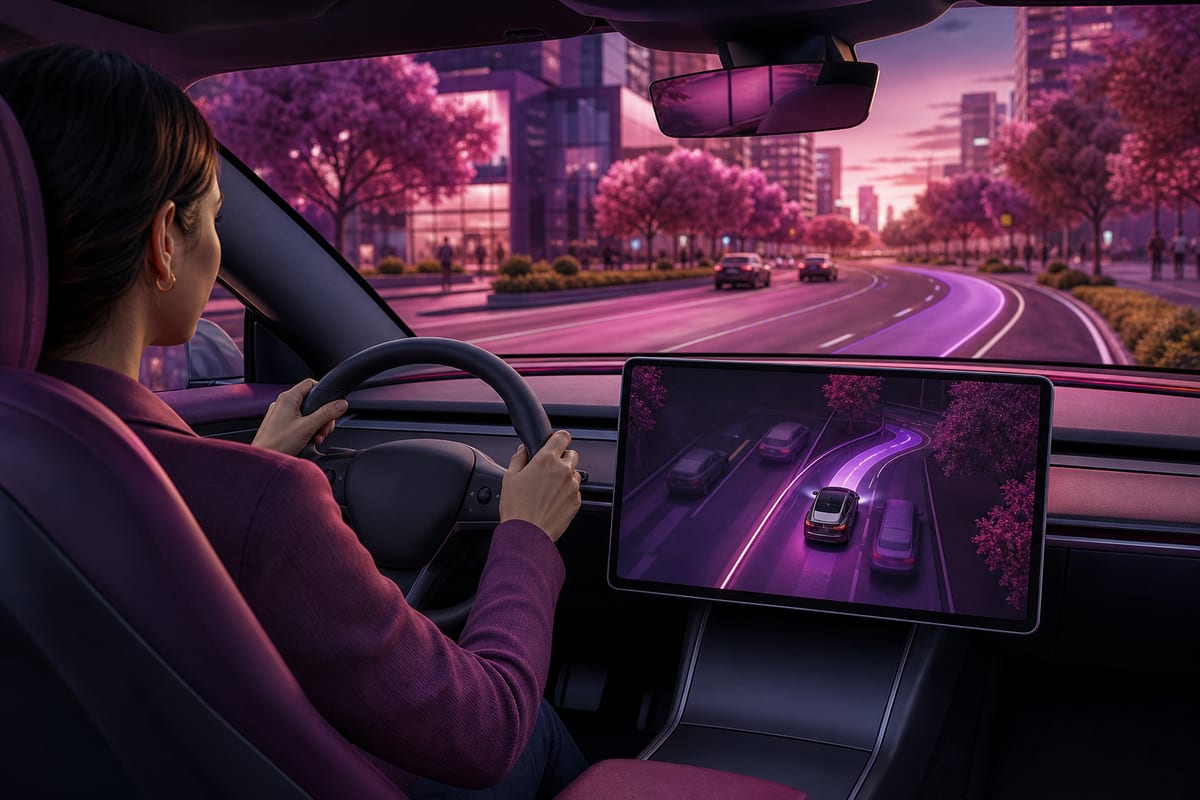
Tesla begins the rollout of FSD 15, which introduces Reality View, a real-time road representation generated by artificial intelligence. The company also claims a 25-fold improvement for critical situations, a figure it links to the critical intervention rate.
Supervision Remains Mandatory for Drivers
Full Self-Driving remains a supervised system: road monitoring is still the responsibility of the driver. Attention control more frequently accepts wearing a hat or sunglasses. It is also less strict when faster driving profiles are selected.
Access to Reality View requires the latest Tesla hardware. The displayed image arrives about one second after the actual situation. Elon Musk announces that this delay will soon be reduced by 35%.
Reality View Represents Upcoming Maneuvers
A virtual camera located above the vehicle provides the perspective for Reality View. Drivers can examine and control the actions planned by the FSD; upcoming turns are also visible. This unified representation replaces the previously separate signals from models, with an overall lower computational consumption.
Elon Musk specifies on X that this AI-generated video production does not use any game engine and occupies only half of an AI4 TRIP accelerator. According to him, the device combines a broadcasting model with a reduced version of a global Tesla model. Some drivers have compared this rendering to GTA VI, which was launched just a few days earlier.
Le brief IA que les pros lisent chaque soir
Les 7 actus IA du jour, décryptées en 5 min. Gratuit.
Inclus dès l'inscription : notre sélection des meilleurs guides & comparatifs IA.
Choisissez votre rythme
Gratuit · Pas de spam · Désabonnement en 1 clic
Tesla announced the update on Saturday on X, and then its Super Intelligence account shared the complete details. The company attributes the reported progress in critical interventions to its enhanced vision encoder. Common to FSD, Robotaxi, and the Optimus robot, this encoder has been trained with millions of videos sourced from the Internet.
FSD Retains More Driving Habits
For the initial and final segments of trips, navigation learns from route preferences observed in the fleet. Tesla plans to generalize this learning to the entire journey in upcoming versions of FSD 15. For parking, the system utilizes the individual driver's history, while the map can suggest multiple locations.
Near a radar, the FSD can now reduce its speed. If the driver cancels this behavior twice in the same location, the vehicle records their preference and will no longer slow down there.
Detection, Bike Racks, and Cybercabs
Tesla claims to have improved its entire end-to-end driving network. Detection has progressed for road signs, animals, especially small ones, debris, chains, and potholes, as well as for water accumulations, including deep ones. Speed is also managed more naturally near schools and when weather conditions deteriorate.
The Bike Rack Mode allows the use of FSD when a bike rack or similar equipment is installed on the hitch. However, this mode disables reverse driving as well as the Autopark and Summon functions.
Alongside this update, Tesla has begun transporting passengers aboard Cybercabs. The company also plans to manufacture these vehicles in Berlin.
Brief IA — L'actualité IA en français
L'essentiel de l'actualité de l'intelligence artificielle, décrypté et expliqué chaque jour.