The Rise of AI Further Weakens Global Finance
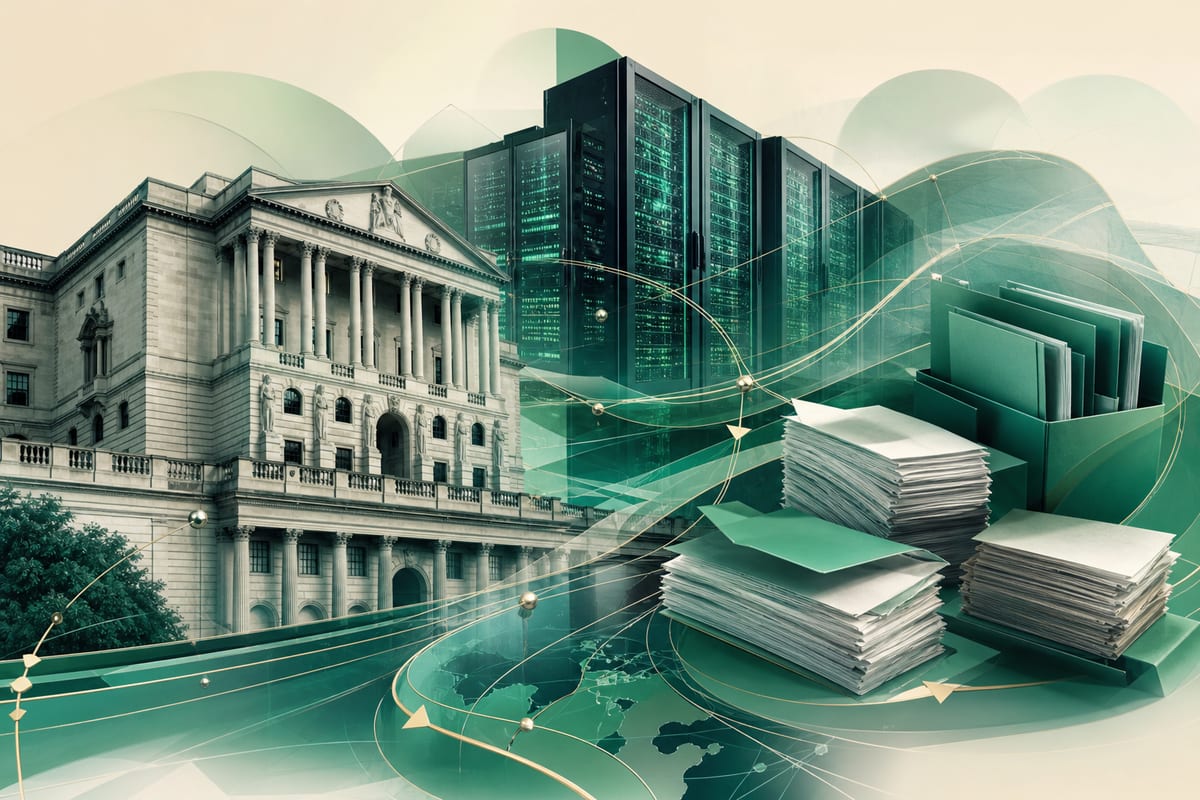
The Bank of England warned on Thursday that the financial circuits supporting the rise of AI are further destabilizing the global finance system. It considers these arrangements increasingly complex, opaque, and circular, as concerns about sector debt resurface in the markets.
Risk Transfers and Bank Capital
Lenders have begun redistributing their exposure to AI. According to sources familiar with the operations, Citi and JPMorgan are offering loan portfolios linked to the sector: some banks are looking to manage their risks, while others aim to free up lending capacity. Some transactions involve synthetic risk transfers: the receivables remain on the bank's balance sheet, but investors bear the potential losses. Hyperscalers, on the other hand, are already utilizing off-balance-sheet debt movements.
In the UK, however, the central bank considers institutions to be sufficiently capitalized to maintain their lending even in the face of a much more severe recession. Its review of prudential rules, completed on Thursday, includes a reduction in Tier 1 capital requirements for large UK banks by about 50 basis points of risk-weighted assets. The Financial Policy Committee warns, however, that a much larger easing could create instability.
AI Financing Concerns the Bank
Hyperscalers, a small group of tech companies operating vast data centers, have financial ties estimated by the Bank at around $4 trillion. According to the Bank's estimates, their bond issuances are expected to exceed $305 billion this year, accounting for nearly 8% of global investment-grade bond issuances. For next year, JPMorgan strategists anticipate $450 billion in investment-grade debt linked to AI, up from $368 billion in 2026.
The AI brief the pros read every evening
The 7 best AI stories, the essentials in 5 min. Free.
Included when you join: our pick of the best AI guides & comparisons.
Choose your rhythm
Free · No spam · Unsubscribe in 1 click
Some financing arrangements create direct links between companies in the sector: one company provides funds to another in exchange for commitments on future revenues. For the Bank, this circularity complicates the identification of risks, a concern also expressed by the IMF in October. Katharine Braddick, head of the Bank's regulatory body, explained to reporters that supervisors want to prevent a decline in AI valuations from reaching the banks.
The central bank believes these circuits facilitate the transmission of tensions between markets. It also cites rising interest rates and sovereign debt as additional pressures. For its Financial Policy Committee, these developments increase the risk that multiple vulnerabilities could materialize simultaneously.
Agents, Failures, and Encryption: Cyber Risks
Recent outages at Google Cloud and Microsoft have demonstrated that a failure at one provider can impact many businesses simultaneously. The Bank also reports an increase in cyber risk, as cutting-edge AI has continued to advance since July, particularly in the area of agents and open-weight models. Recent incidents show, according to the Bank, how difficult it is to prevent an autonomous agent from acting against the intentions of its developers or users.
The Bank also emphasizes that open-weight models are cheaper to operate and that their protections can be more easily removed, which could benefit attackers. In the longer term, quantum computing could undermine widely used encryption mechanisms; thus, transitioning to cryptography capable of withstanding such threats is a priority in its view. The institution is establishing a Systemic Resilience Council, bringing together officials and industry representatives to coordinate its response.
Brief AI — AI news in French
The essentials of artificial intelligence news, decoded and explained every day.