Thrive Holdings and OpenAI: $2 Billion for AI in Business
Le brief IA que les pros lisent chaque soir
Les 7 actus IA du jour, décryptées en 5 min. Gratuit.
Inclus dès l'inscription : notre sélection des meilleurs guides & comparatifs IA.
Choisis ton rythme
Gratuit · Pas de spam · Désabonnement en 1 clic
An Impressive Fundraising Round for Thrive Holdings
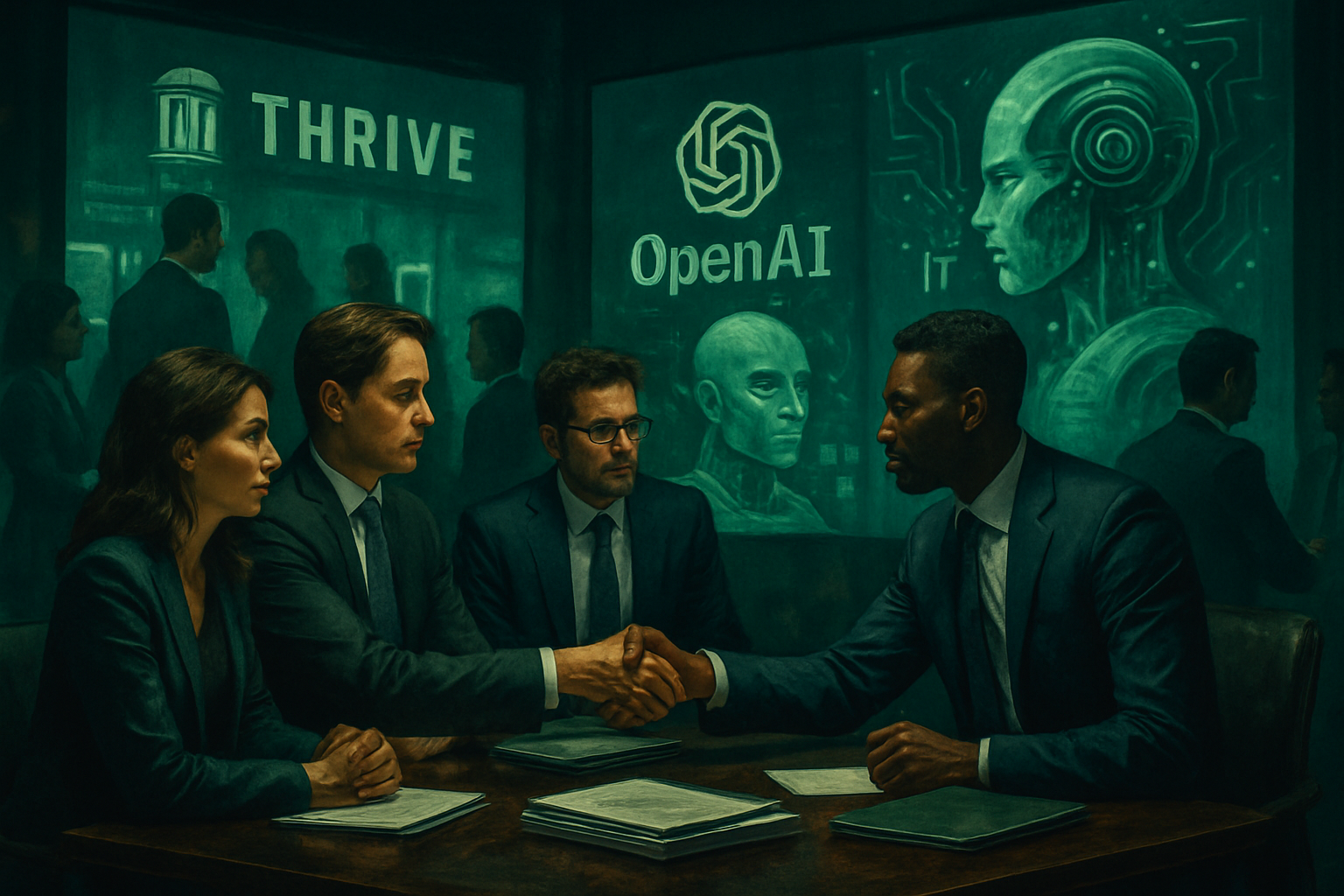
Thrive Holdings recently succeeded in raising a colossal $2 billion in a funding round, propelling its valuation to $12 billion. Among the investors participating in this round are prestigious names such as SoftBank, D1 Capital Partners, and Altimeter Capital. This capital injection reflects investors' confidence in Thrive's potential to transform businesses through artificial intelligence.
A Strategy for Integrating AI into Businesses
Thrive Holdings stands out with its unique business model, which involves acquiring traditional companies, particularly in the accounting sector, and integrating AI solutions to optimize their processes. So far, the company has focused on the accounting and information technology sectors. However, part of the recently raised funds will be used to explore new horizons, particularly in the field of physical assets. This expansion is made possible by the close relationship Thrive maintains with OpenAI, a major player in the field of artificial intelligence.
The Importance of OpenAI in Thrive's Strategy
Thrive Holdings is actually an offshoot of Thrive Capital, which is one of OpenAI's main investors. In December 2025, OpenAI took a stake in Thrive Holdings, thereby strengthening their strategic partnership. This agreement has also allowed OpenAI employees to work directly with Thrive's companies, facilitating the rapid adoption of AI in their operations.
A Business Model That Attracts Investors
Thrive Holdings' success in integrating AI has led to the creation of a thriving business model, attracting the attention of investors. Companies like The Deployment Company and Ode, in partnership with OpenAI and Anthropic, illustrate this trend. These firms, backed by several billion dollars, specialize in assembling elite engineering teams that help businesses integrate AI solutions into their processes.
Thrive Holdings' Achievements
Thrive Holdings has already demonstrated its effectiveness by integrating AI into over 70 companies through its platforms. The company primarily relies on two pillars: Current, which encompasses more than 50 accounting firms and employs over 2,000 professionals, and Shield, which focuses on information technology with around 20 companies under its wing.
The results are impressive: Current's self-improving tax agents, dubbed TaxAI, have processed over 7,000 tax returns with an accuracy of 98%, reducing preparation times by more than 30% in participating firms. Meanwhile, Shield has seen its AI products accelerate the resolution times for support requests by a factor of 36, while doubling the number of customized AI agents deployed last month.
A New Platform for Regulatory Services
With the recently raised funds, Thrive plans to launch a third platform dedicated to regulatory services for the built environment. This initiative aims to simplify the processes necessary for the approval, construction, certification, and maintenance of physical assets. A spokesperson for Thrive described this platform as essential for overcoming local, technical, and regulatory constraints that often hinder infrastructure projects in the United States.
The Potential Impact of AI on Infrastructure
According to Anuj Mehndiratta, a founding member of Thrive Holdings, the United States needs to modernize its critical infrastructure, but these projects are often hindered by various complexities. This concerns sectors such as data centers, manufacturing, healthcare, energy, water, and transportation. Mehndiratta emphasizes that AI will not replace fieldwork or professional judgment, but it can alleviate manual tasks such as research, report writing, permit preparation, and compliance tracking.
Kareem Zaki, also a founding member of Thrive, stated that AI, in collaboration with experts and practitioners, could reduce regulatory bottlenecks while maintaining high safety standards. He added that this could be done more efficiently, at a lower cost, and more quickly, which is crucial for ambitious infrastructure projects.
Brief IA — L'actualité IA en français
L'essentiel de l'actualité de l'intelligence artificielle, décrypté et expliqué chaque jour.