AI Costs More Than Salaries in Some Companies
The Illusion of the Economy through AI Automation
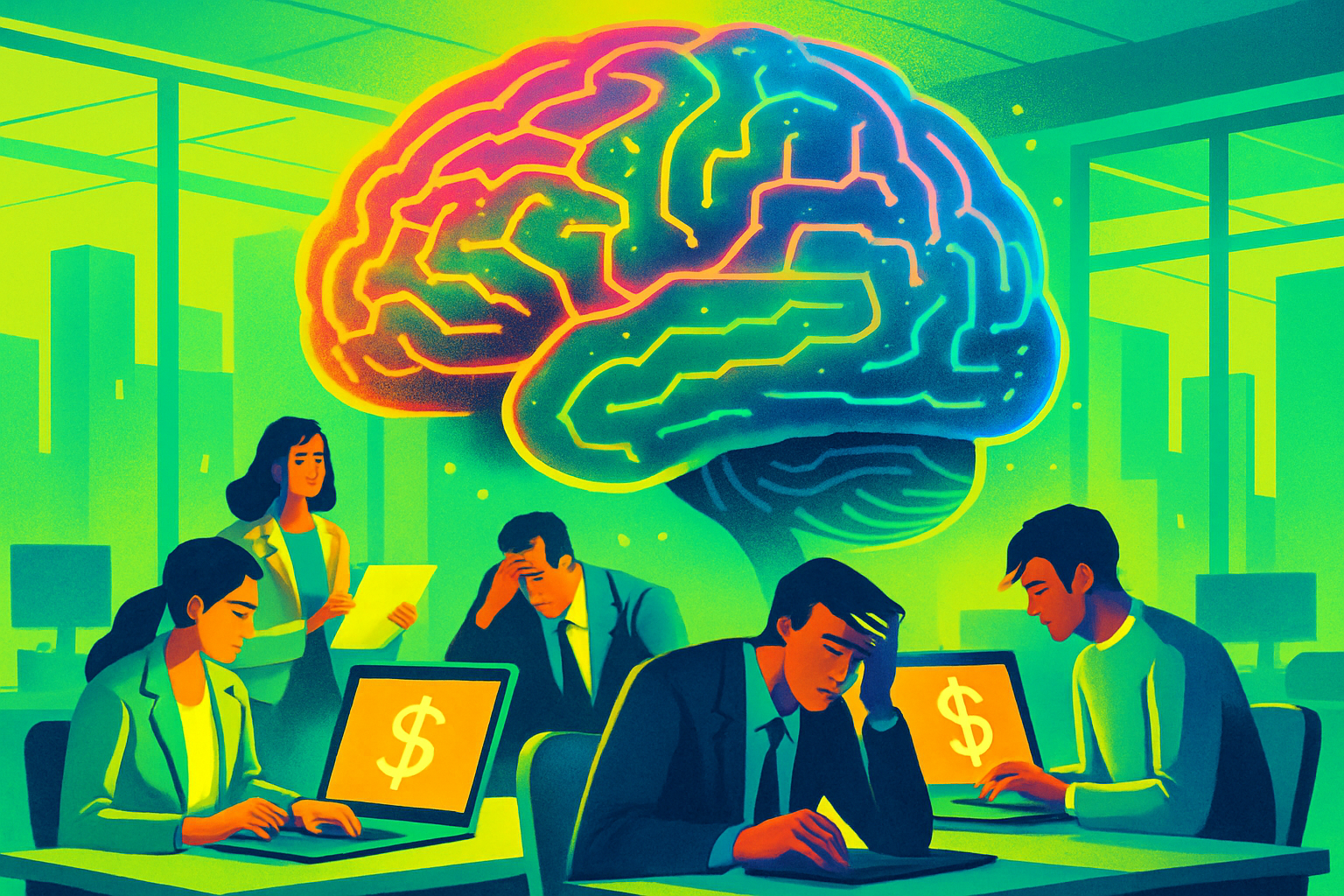
In the business world, the introduction of artificial intelligence (AI) promised to reduce costs by automating tasks. However, some companies are discovering that expenses related to AI can exceed the salaries of their employees. This paradox arises from the increasing number of queries and the intensive use of AI models, which, far from reducing costs, can cause them to skyrocket. Organizations must therefore reevaluate their approach to AI to avoid uncontrolled spending.
A Token Bill That Exceeds Salaries
AI task automation allows for rapid production, but each interaction with an AI model consumes tokens, which are billed. As the use of these technologies intensifies, the bill increases rapidly. Some companies, as revealed by an Axios survey, find that the cost of AI queries exceeds that of human salaries. Bryan Catanzaro from Nvidia highlights that, for some teams, AI has become more expensive than personnel.
In the field of software development, engineers use AI agents to continuously generate code, often without supervision. This leads to an explosion in the number of queries and associated costs, turning the question of productivity into a financial challenge.
The Uncontrolled Drift of AI Usage
The internal competition to maximize AI usage, often referred to as "tokenmaxxing," drives some engineers to consume an excessive number of tokens, sometimes seen as a performance indicator. The New York Times reports that some heavy users spend over $150,000 per month on tokens, even exceeding their own salaries. This phenomenon highlights the lack of safeguards in certain companies.
Le brief IA que les pros lisent chaque soir
Les 7 actus IA du jour, décryptées en 5 min. Gratuit.
Inclus dès l'inscription : notre sélection des meilleurs guides & comparatifs IA.
Choisissez votre rythme
Gratuit · Pas de spam · Désabonnement en 1 clic
Companies like Uber have already exhausted their annual AI budget by using tools like Claude Code, according to The Information, illustrating how quickly usage can spiral out of control without oversight. Managerial pressure exacerbates this phenomenon, particularly at Meta, where AI usage is integrated into performance evaluations. Giants like Google and Microsoft also encourage this adoption, with an increasing share of code generated by AI models.
Necessary Trade-offs to Control Costs
The cost structure of companies is undergoing a transformation. Once centered on human resources, expenses are becoming increasingly variable and dependent on AI usage. "Compute" is becoming a strategic but unpredictable budget line. AI providers, such as OpenAI and Anthropic, are benefiting from this surge in consumption. Anthropic has even raised its prices, reflecting the increase in demand.
In light of this situation, companies are groping for solutions. Jensen Huang, CEO of Nvidia, has suggested the idea of offering token quotas as a competitive advantage, equivalent to a portion of salary.
The Hidden Risks of AI Automation
Beyond costs, the actual effectiveness of AI automation is being called into question. Errors can occur, as demonstrated by incidents at Meta or Amazon. Studies suggest that the forced use of these tools can slow down teams instead of helping them.
The main issue is therefore to properly regulate the use of AI. Without clear governance, productivity gains can be offset by skyrocketing costs and increased complexity. Companies must now balance technological power with disciplined usage to prevent AI from becoming more expensive than the human teams it was supposed to replace.
Brief IA — L'actualité IA en français
L'essentiel de l'actualité de l'intelligence artificielle, décrypté et expliqué chaque jour.