Toyota Aims for 400,000 Robots and 1 Trillion Yen by 2028
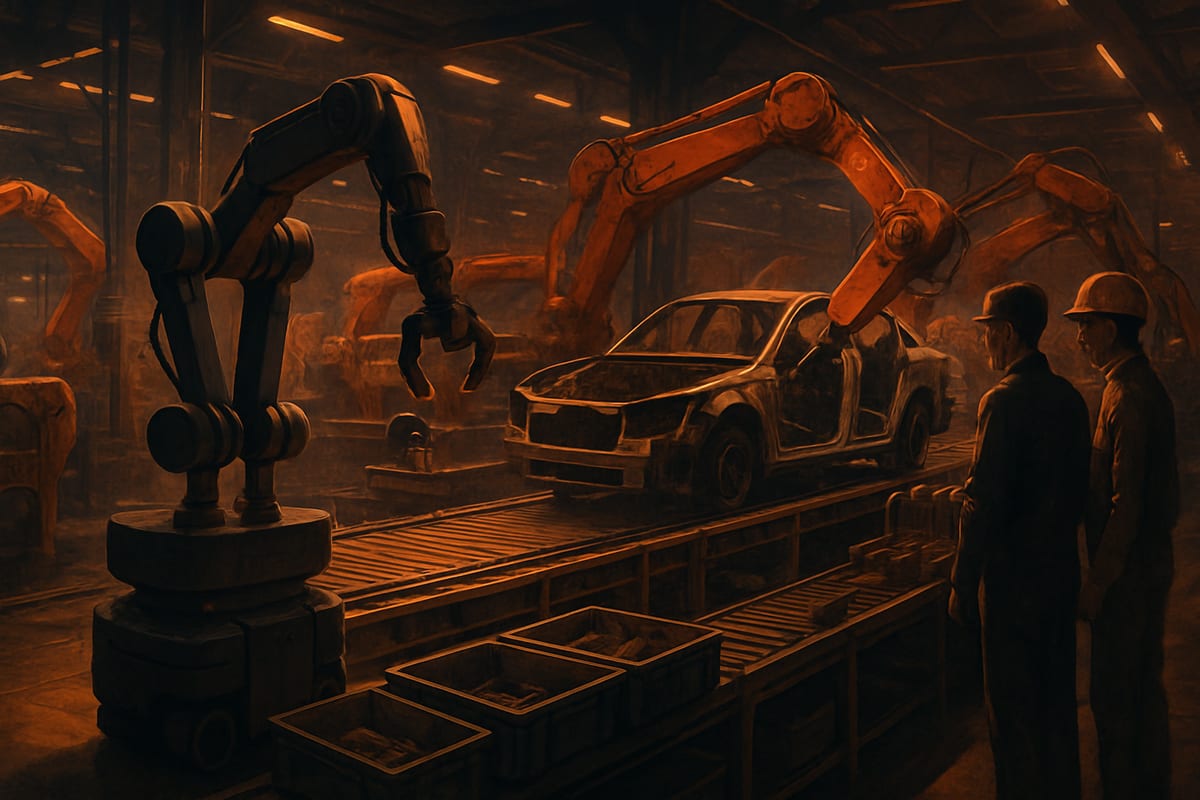
The Japanese manufacturer estimates its automation needs at around 400,000 robots and an annual budget of 1 trillion yen by 2028. This projection, broader than traditional counts of industrial robots, comes as its factories are already testing systems and its R&D focuses on so-called "physical" AI. However, Toyota has not specified the final scale or duration of such an effort, in a market where Japan remains a pillar and where Hyundai is also rolling out its humanoid roadmap.
Japan Remains a Robotics Hub and Hyundai Sets Its Timelines
According to the International Federation of Robotics, Japan represented the second-largest market for industrial robots in 2024, with approximately 450,500 units in operation and 44,500 new installations that year. In 2024, the Japanese automotive sector implemented nearly 13,000 industrial robots, marking an 11% increase from the previous year, thus reaching its highest annual level since 2020. In this context, Hyundai Motor has planned the deployment of humanoid robots in its automotive production lines. The manufacturer intends to start using Atlas for parts sequencing within the Hyundai Motor Group Metaplant America in Savannah starting in 2028, before expanding its use to component assembly from 2030. Hyundai aims to achieve an annual manufacturing capacity of up to 30,000 robots by 2028. Boston Dynamics, which develops Atlas, has been under Hyundai's control since the acquisition of a majority stake in 2021. Meanwhile, the Toyota Research Institute is collaborating with Boston Dynamics on AI control systems for Atlas. In 2025, the two organizations demonstrated that Atlas could perform walking, lifting, sorting, and packaging using a single Large Behavior Model, with skills being added through human demonstrations.
In Factories, Feedback Guides Automation
At Kamigo, a piston assembly line transitioned to robots in January 2025 and achieved full automation after operating with three operators. The first robots were introduced on sub-lines as early as 2008, but expansion abroad revealed maintenance constraints. Some overseas facilities lacked qualified personnel to support the automated equipment, leading to a temporary return to manual processes while transferring know-how from Japanese factories to external sites. Templates and tools designed by the teams have, according to Toyota, doubled or tripled the efficiency of certain manual tasks. These lessons have subsequently informed the development of new automated systems, including the Kamigo line.
Le brief IA que les pros lisent chaque soir
Les 7 actus IA du jour, décryptées en 5 min. Gratuit.
Inclus dès l'inscription : notre sélection des meilleurs guides & comparatifs IA.
Choisissez votre rythme
Gratuit · Pas de spam · Désabonnement en 1 clic
KumiPro, ELEY, and Physical AI: From Simulation to the Field
According to Toyota, physical AI refers to the abilities that allow robots to detect their environment using sensors, learn or adjust their actions based on context, and act autonomously. The company's Frontier Research Center aims to address labor shortages and facilitate the transfer of know-how through robotics, particularly leveraging innovations from the Human Support Robot program. These object recognition, decision-making, and movement control modules have been integrated into KumiPro, a vision-based parts collection system already in use at Toyota Motor East Japan. Toyota has also demonstrated an assembly process where force feedback compensates for camera recognition errors to insert components into tight spaces. The manufacturer is also developing ELEY, equipped with two humanoid arms and an omnidirectional base, for contact tasks capable of managing external forces in case of positional discrepancies; closer trials to production sites are planned, utilizing both successful and unsuccessful attempts for training. Toyota is concurrently working on systems capable of manipulating parts without prior precise positioning and employs reinforcement learning in simulation, with thousands of instances running in parallel before transferring to hardware. Teams have noted that differences in sensors, friction, or actuators sometimes prevent a direct transition, introducing variations and data from physical robots to reduce the Sim2Real gap.
A Projection of 400,000 Robots, an Annual Budget of 1 Trillion Yen
According to Toyota, enhanced automation in its factories, among its affiliates, and with its key suppliers could require nearly 400,000 robots and an annual investment of around 1 trillion yen by 2028. This estimate includes both the renewal of existing equipment and new installations, encompassing both humanoid and non-humanoid systems, as well as industrial robots, automated logistics, and future human-robot collaborations on production lines. The group is already employing and experimenting with robots in various manufacturing processes. In its financial results for the 2026 fiscal year, Toyota reported on factory demonstrations related to the transport and collection of parts, as well as robotics projects for moving medical equipment. The estimate of 400,000 robots exceeds the scope of figures from the International Federation of Robotics, as it includes the replacement of equipment and several types of robots within Toyota, its affiliates, and its key suppliers. This outlook was discussed with investors in early September, but Toyota did not specify whether the full investment would be made or how many years such expenditures would continue at this level.
Brief IA — L'actualité IA en français
L'essentiel de l'actualité de l'intelligence artificielle, décrypté et expliqué chaque jour.