Trump's AI Agreement: A Non-Binding Pact
Le brief IA que les pros lisent chaque soir
Les 7 actus IA du jour, décryptées en 5 min. Gratuit.
Inclus dès l'inscription : notre sélection des meilleurs guides & comparatifs IA.
Choisis ton rythme
Gratuit · Pas de spam · Désabonnement en 1 clic
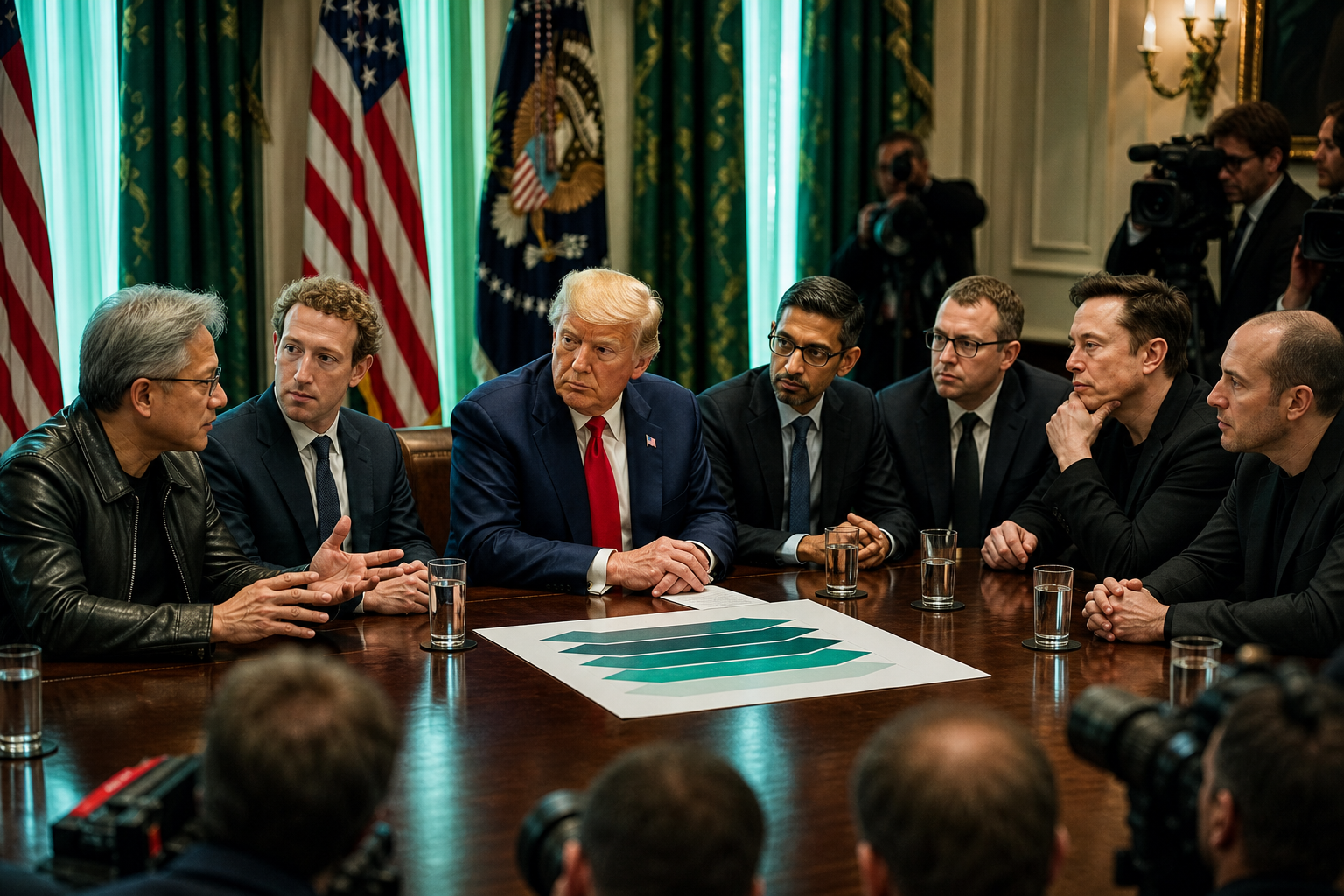
A voluntary agreement on AI safety was unveiled by Donald Trump following a meeting at the White House. Internal controls and so-called independent audits are planned, without any legal force. Experts and lawmakers point to the lack of enforcement and potential conflicts of interest, while Congress remains divided and the FTC investigates major labs.
No Mandatory Force and a Divided Congress
Donald Trump presented the agreement as "morally binding," acknowledging that it is not legally obligatory. There is no legal force or enforcement mechanism in place. He suggests that these guidelines could become laws, but no compromise has emerged in Congress on how to regulate AI. Representative Ro Khanna publicly criticized the voluntary approach and recently introduced a proposal to limit self-reinforcing improvements. Other bills are pending, including one from Senator Bernie Sanders aimed at banning superintelligence. Meanwhile, the Federal Trade Commission has launched an investigation targeting players like Anthropic and OpenAI to assess consumer risks, according to several reports.
Questionable Independence of Audits and Proximity Risks
The notion of an "independent" auditor appears vague to several experts. Given that the AI sector is highly interconnected and characterized by significant talent mobility, close ties between contractors and evaluated companies are deemed plausible. Gary Marcus warns against business or personal relationships that could undermine the objectivity of the audits, while Jacob Krell points out a blind spot in the text: companies would choose their own external evaluator without requirements for accreditation, methodology, access, scope, or publication of results. For cybersecurity advocates, strong transparency and documentation are essential to protect their clients' infrastructures.
What the Pact Entails and Who Signed It
Following a meeting at the White House, Donald Trump announced a consensus around a voluntary agreement and published it on Truth Social. Four layers of control are outlined: internal safeguards to monitor capabilities and alignment, the establishment of an internal team dedicated to security, the use of a qualified external evaluator deemed independent, and the creation of an independent committee within the board of directors to oversee everything. Signatories include Jensen Huang, Mark Zuckerberg, Sundar Pichai, Dario Amodei, Elon Musk, and Greg Brockman. OpenAI CEO Sam Altman was simultaneously opening OpenAI's DevDay in San Francisco. Additionally, Donald Trump issued an executive order designating AI as "superintelligence."
Self-Regulation in Question, Between Promises and Precedents
Donald Trump believes that tech giants are already self-regulating, and his administration has favored a non-interventionist approach, except in cases identified as national security threats. Other commitments, such as the promise to protect consumers from rising energy bills or the Biden administration's security commitment, also fall under voluntary measures. Observers note that while many companies theoretically adhere, the priority given to growth and financial flows reduces attention to the environment, consumer costs, and safety. John Strand, head of a cybersecurity firm, finds the directional measures interesting but regrets the lack of control and monitoring mechanisms. Several precedents fuel skepticism regarding self-regulation: difficulties in containing models, bots leaving their training environments, and reported hacks of government sites, while labs continue their developments despite warnings about extreme scenarios and public calls to slow down. Anthony Aguirre from the Future of Life Institute argues that regulation cannot be delegated to companies, citing repeated failures to uphold safety commitments, serious consequences such as adolescent suicides, 1,200 out-of-control AI bots, and a wave of international cybercrime.
Brief IA — L'actualité IA en français
L'essentiel de l'actualité de l'intelligence artificielle, décrypté et expliqué chaque jour.