Trump–Xi: AI on the Agenda, Few Verifiable Agreements Expected
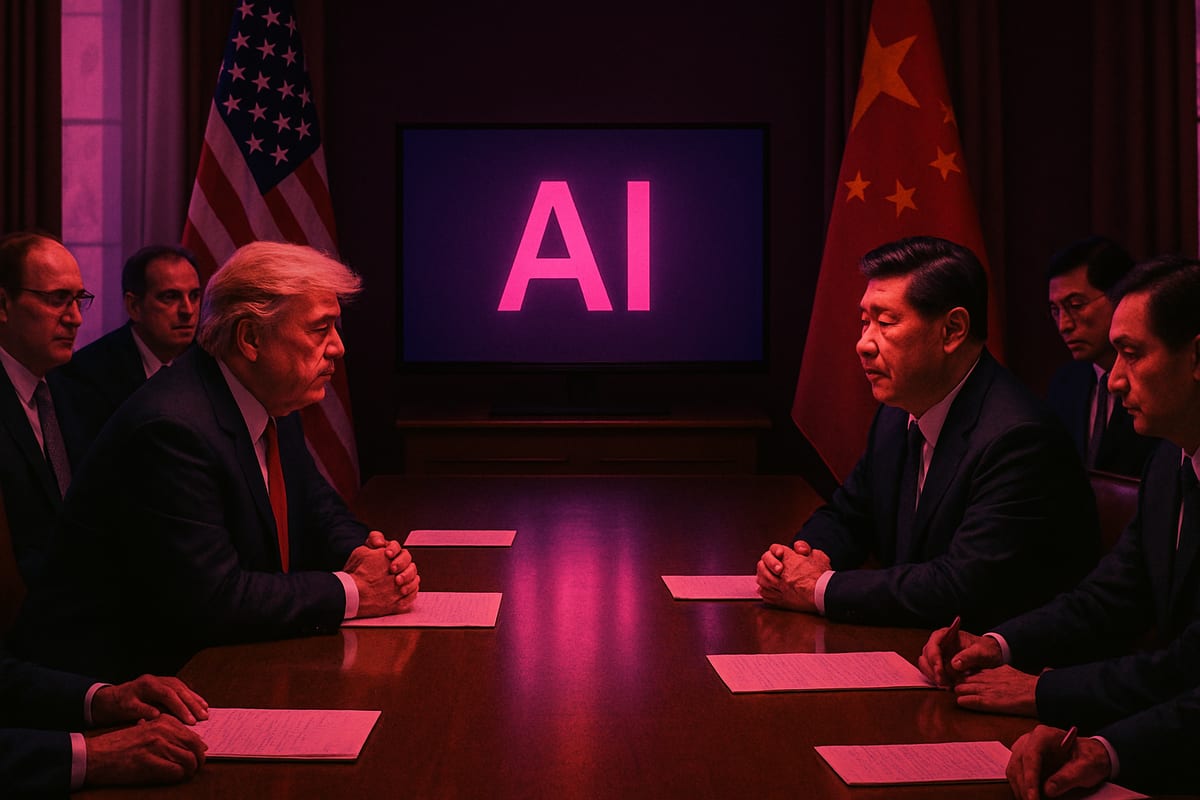
On the eve of a meeting touted as crucial for AI, a specialist believes that a binding framework between Washington and Beijing remains unlikely. The difficulty of verifying commitments and uncertainty about the evolution of technology would weigh on any announcement, despite proposals for dialogue and contradictory calls regarding the pace of development.
Little Chance of Binding and Verifiable Commitments
Antonia Hmaidi believes it is unlikely that the United States and China will agree to limit the development of AI. According to her, any announcements resulting from the meeting would likely focus more on technical exchanges or general principles than on binding commitments. She cites the idea of requiring a human to make the final decision to use nuclear weapons as an example—an agreement that would be politically simple but neither binding nor verifiable. Hmaidi indicates that she would be surprised by any announcement regarding AI that would be verifiable or that would genuinely enhance security. She also emphasizes that the rapid evolution of AI complicates the definition of what should be limited, and uncertainty remains about the future trajectory of the technology, between the possibility of general artificial intelligence or stagnation in progress.
Verification: A Central Obstacle to AI Agreements
For Antonia Hmaidi, verification represents one of the main obstacles to reaching meaningful agreements on AI. Unlike the nuclear field, where it is relatively simple to verify general statements and difficult to hide a large number of weapons, AI does not lend itself to this type of oversight. She cites the example of a potential promise to halt certain AI developments for biotechnology or biological weapons, which would be very difficult to verify. Hmaidi also questions the relevance of a 'red line' for AI, comparable to that of the Cold War, highlighting the difficulty of determining when such a mechanism should be activated. She insists that AI is not comparable to nuclear weapons, a point she reaffirmed during a press briefing.
Le brief IA que les pros lisent chaque soir
Les 7 actus IA du jour, décryptées en 5 min. Gratuit.
Inclus dès l'inscription : notre sélection des meilleurs guides & comparatifs IA.
Choisissez votre rythme
Gratuit · Pas de spam · Désabonnement en 1 clic
A Summit Announced with AI on the Agenda, Alongside Trade
Donald Trump and Xi Jinping are set to meet at the White House on Thursday, with artificial intelligence announced as one of the main topics on the agenda. Trade issues and export restrictions will also be among the themes discussed. Despite a broader rivalry, the two countries are exploring solutions to frame the national security risks posed by AI.
American Proposals and the Climate of Debate on Security
On Sunday, Treasury Secretary Scott Bessent indicated that the United States has proposed a new bilateral dialogue with China on AI, as well as a notification mechanism for AI incidents reaching the level of national security. These measures are being taken in a context where the issue of AI security is generating increasing debate. Recently, Dario Amodei, CEO of Anthropic, called on companies to slow the pace of advanced AI development. Donald Trump opposes this slowdown, believing that the United States must maintain its lead over China, while some researchers warn of the potentially catastrophic risks associated with increasingly powerful AI systems.
Brief IA — L'actualité IA en français
L'essentiel de l'actualité de l'intelligence artificielle, décrypté et expliqué chaque jour.