TypeSafe AI introduces Jev, a typed decision model
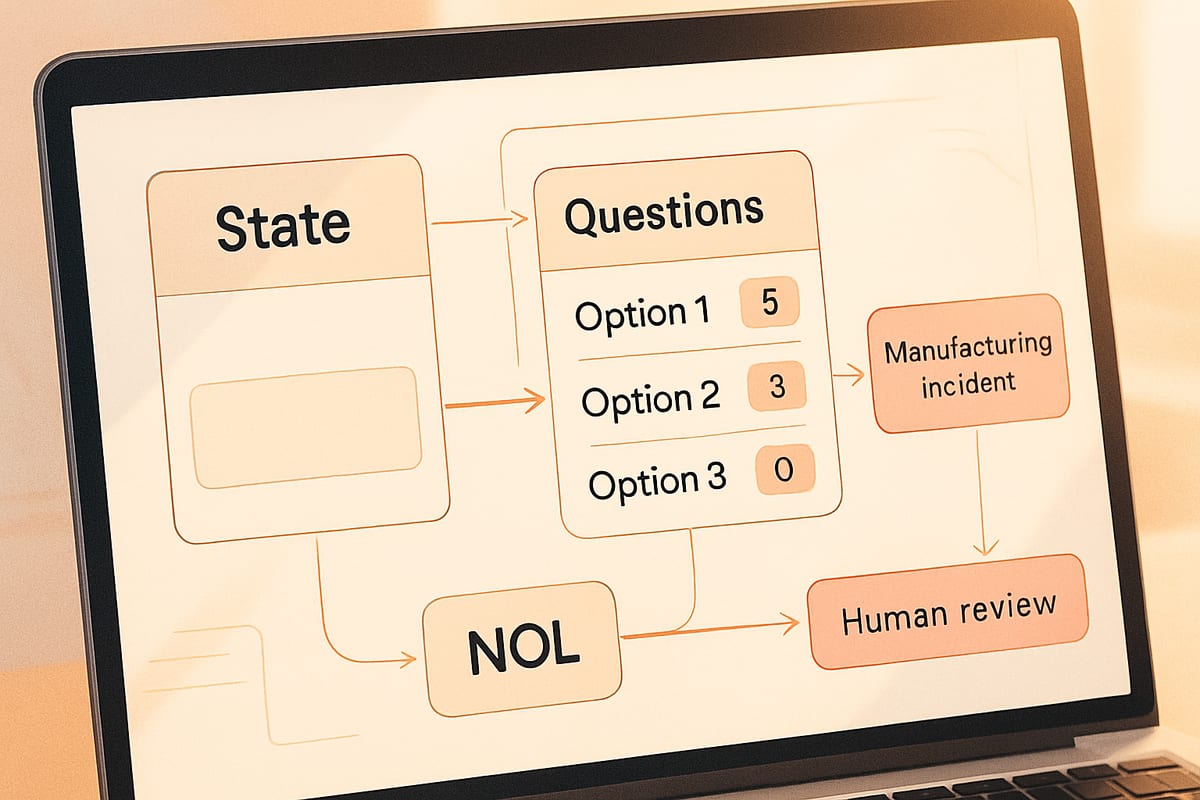
TypeSafe AI highlights decision models capable of extracting structured data in the form of choices or scores, accompanied by calibrated probabilities. The company describes them as suitable for bounded decisions and large-scale processing, while also noting their limitations and complementarity with LLMs. An industrial case illustrates automation with human intervention in cases of uncertainty.
Announced Utility, Safeguards, and Current Limitations
The decision models are described as suitable for bounded judgments, escalation management, and safeguards, as well as large-scale processing. Among the reported limitations are the inability to extract arbitrary values and a current dependence on a purely textual state. Their positioning is not to replace large language models but to specialize alongside them. The approach is presented as structured extraction with AI that cannot hallucinate.
Le brief IA que les pros lisent chaque soir
Les 7 actus IA du jour, décryptées en 5 min. Gratuit.
Inclus dès l'inscription : notre sélection des meilleurs guides & comparatifs IA.
Choisissez votre rythme
Gratuit · Pas de spam · Désabonnement en 1 clic
TypeSafe AI Unveils Jev for Structured Decisions with Confidence Estimation
TypeSafe AI introduces Jev, a decision model designed to provide typed responses derived from predefined option spaces, accompanied by calibrated probabilities. Its structure is based on two main elements: the State and the Questions. Supported output types include Choice, Score, and an option named Noul.
In the Face of LLMs and Application on an Industrial Incident
Large language models are presented as often unsuitable when the goal is a single, bounded decision, due to higher latency, greater costs, and unreliable uncertainty estimates. An example of a manufacturing incident shows how structured probabilistic outputs can enable automation, with human review for cases where confidence is insufficient. The application context involves predominantly unstructured data, such as incident reports, support tickets, maintenance logs, call transcripts, and customer feedback.
Brief IA — L'actualité IA en français
L'essentiel de l'actualité de l'intelligence artificielle, décrypté et expliqué chaque jour.