Ukraine: NATO Details Model 13 for Drone Forecasting
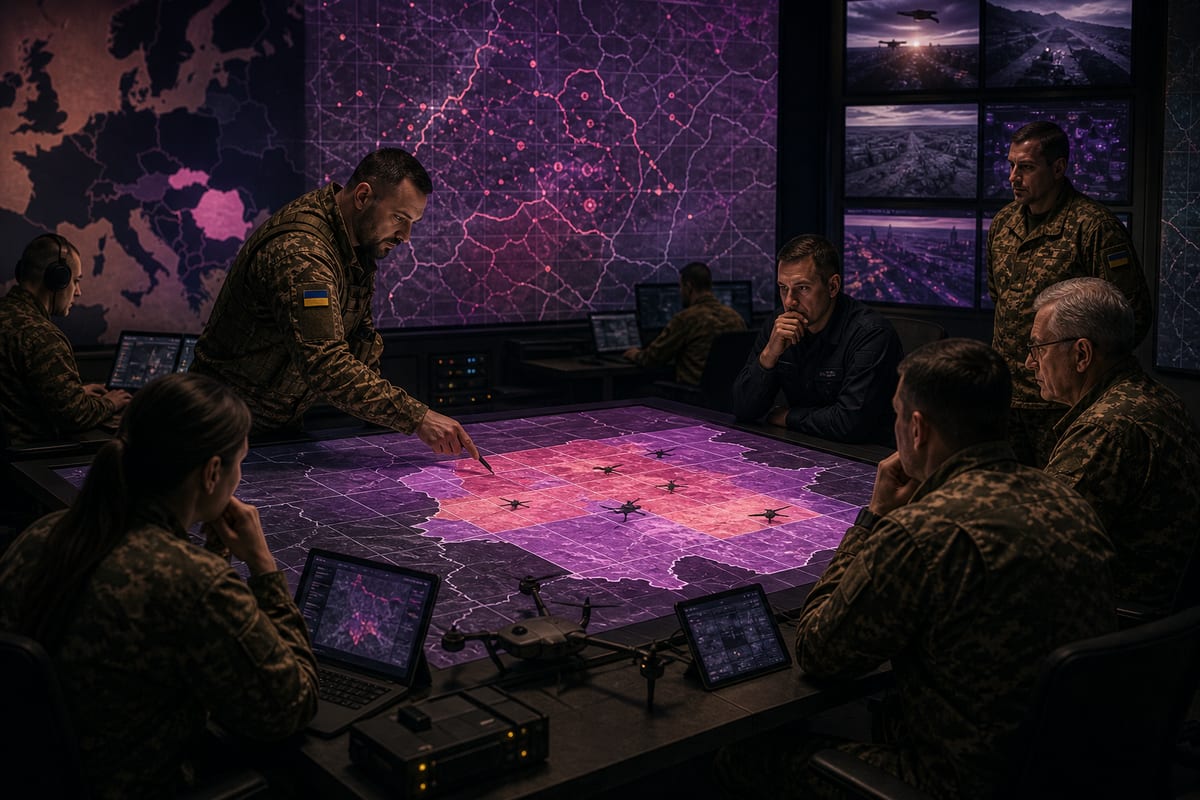
An AI tool co-developed by Ukraine and NATO promises J+1 forecasting of Russian drone activities. Ukrainian authorities say Model 13 is ready for integration into their systems, while a second model for artillery is progressing in prototype. Its range is limited to 50 km behind the contact line and it does not replace real-time data or the judgment of commanders.
Model 13 Announced Ready for Integration, No. 32 in Prototype
In mid-October, the Ukrainian Ministry of Defense indicated that Model 13, also known as Initiative 13, was ready to be integrated into the situational awareness systems of the Ukrainian Armed Forces. This predictive AI model was jointly developed by Ukrainian forces and NATO's Allied Command Transformation, with support from the NATO Joint Analysis, Training and Education Centre (JATEC), a joint organization based in Poland. The Ukrainian Ministry of Defense also announced that another AI model, No. 32, intended for artillery deployment planning, was in development as a prototype. NATO recently detailed how Model 13 operates, designed to anticipate Russian drone strikes, and could predict these attacks with high probability.
J+1 Maps with Intensity, Threat, and Trends by Cell
Model 13 provides commanders with a map of expected Russian drone activity for the following day. This J+1 forecast allows for the identification of high-risk areas and adjustments to the deployment of forces and equipment. For each geographical cell, the AI estimates the expected intensity of strikes and reconnaissance activities, assigns a threat level, indicates the trend of its evolution, and provides a range of possible values.
Le brief IA que les pros lisent chaque soir
Les 7 actus IA du jour, décryptées en 5 min. Gratuit.
Inclus dès l'inscription : notre sélection des meilleurs guides & comparatifs IA.
Choisissez votre rythme
Gratuit · Pas de spam · Désabonnement en 1 clic
A Perimeter Between 5 and 50 km Behind the Front Line
Model 13 covers areas located between 5 and 50 km behind the contact line on Ukrainian territory, which is up to approximately 31 miles. Its training is based on battlefield data and takes into account the previous activity of Russian drones, the types of UAVs employed, the methods and timings of deployment, weather conditions, terrain, and distance to the contact line.
Integration with Delta and Operational Safeguards
The NATO Joint Analysis, Training and Education Centre specifies that Model 13 does not replace real-time situational data or the decisions of commanders. Kyiv's forces use Delta, a battlefield management system that aggregates information from the front lines onto an interactive map accessible via laptop, phone, or tablet. JATEC indicates that the AI converts heterogeneous datasets into a synthetic representation of anticipated activity, thereby facilitating planning for the next day. More generally, Ukraine is already using artificial intelligence to enable medium-range attack drones to locate and target objectives, as well as to automate resupply operations using unmanned ground vehicles.
Brief IA — L'actualité IA en français
L'essentiel de l'actualité de l'intelligence artificielle, décrypté et expliqué chaque jour.