United States: AI and Data Centers, Governors' Choices
Le brief IA que les pros lisent chaque soir
Les 7 actus IA du jour, décryptées en 5 min. Gratuit.
Inclus dès l'inscription : notre sélection des meilleurs guides & comparatifs IA.
Choisis ton rythme
Gratuit · Pas de spam · Désabonnement en 1 clic
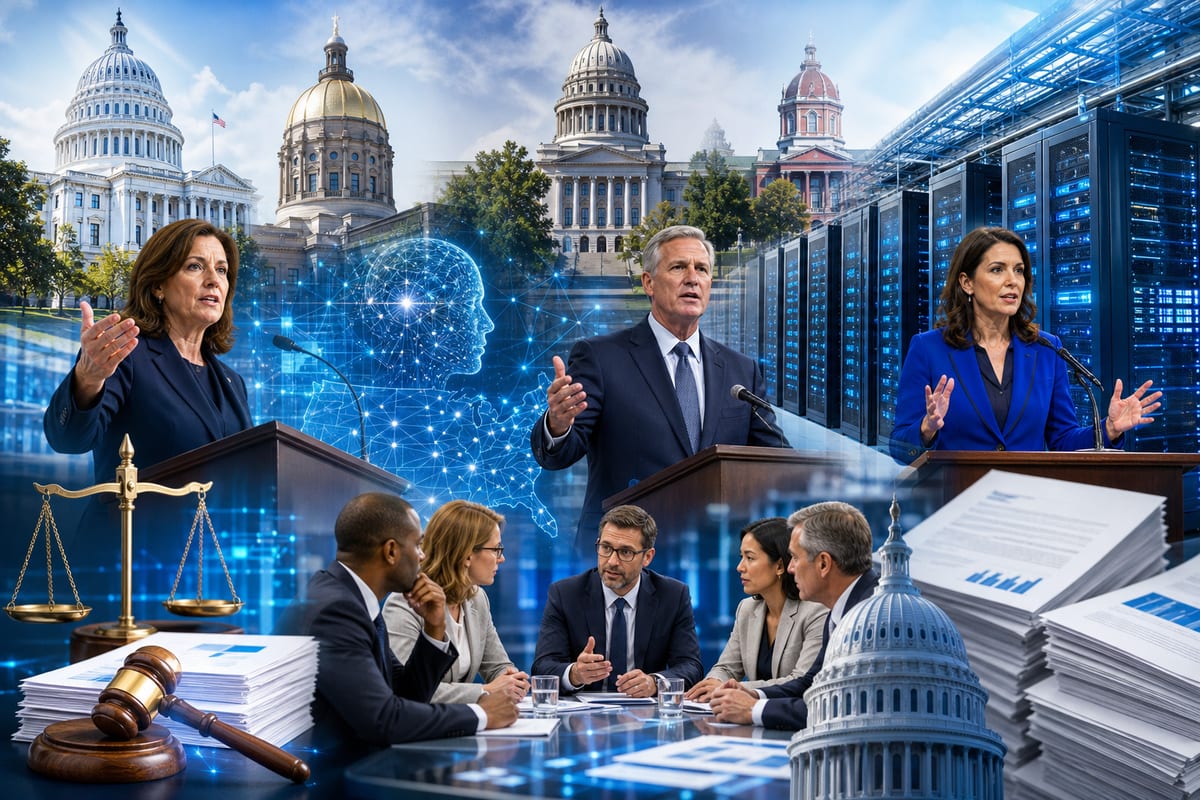
As November 3 approaches, American governors are showcasing varied strategies regarding artificial intelligence and the rise of data centers. Between laws that have been adopted and then repealed, dedicated committees, and proposals for a "kill switch," states are balancing regulation, public action effectiveness, and economic attractiveness, with 39 gubernatorial races on the horizon.
Legislative Safeguards to Repeal: Contrasting Choices
In Colorado, Governor Jared Polis signed a law in 2024 aimed at protecting consumers from algorithmic discrimination related to AI, but this law was repealed the same year. In California, Gavin Newsom has shifted from a cautious approach to proposing some of the strictest safety measures and now supports the idea of a "kill switch" for advanced AI models. In Florida, Ron DeSantis proposed an "AI Bill of Rights" that includes privacy protections and parental controls. Other states have established specific frameworks: in Connecticut, Ned Lamont enacted a bipartisan law on online safety for youth, while in Delaware, Matt Meyer set up a "regulatory sandbox" allowing companies to test AI technologies under government supervision.
Modernizing Administration: Task Forces and Public Services
In Alabama, Governor Kay Ivey views AI as a means to enhance public action while emphasizing the need for safeguards. She created a task force on generative AI in 2024, focused on transparency, privacy, and security. In Arkansas, Sarah Huckabee Sanders believes AI can increase government efficiency if appropriate policies are adopted and launched a task force in 2024 to explore its use in programs like Medicaid and SNAP. In Connecticut, Ned Lamont prioritizes preparing individuals to work alongside AI.
Economic Bet and Data Centers: Attracting, Equipping, Cooling
Several governors are betting on AI as an economic lever. In Alaska, Mike Dunleavy presents the state as a future hub for AI and computing infrastructure, highlighting that the cold climate could reduce server cooling costs. In Arizona, Katie Hobbs sees AI as an opportunity for the economy and established the state's first steering committee dedicated to AI in 2025. In Georgia, Brian Kemp encourages the development of data centers and has engaged with officials from OpenAI to discuss investment issues.
An Electoral Issue: Debated Topics and Scope of the Vote
The rise of AI and data centers has become a point of friction in American politics, with debates surrounding security, regulation, deepfakes, and the rapid growth of infrastructure. Major tech companies advocate for accelerated expansion, while local residents oppose certain projects due to their environmental impacts and energy costs. Voters are questioning the role of state and federal governments in regulating AI, as well as the influence of local communities on data centers built nearby. Governors are taking diverse positions, ranging from exploring a "kill switch" to welcoming data centers. Seventeen governors are running for re-election this year, and 39 gubernatorial races are scheduled across 36 states and three territories, with voting set for November 3. In Hawaii, Governor Josh Green has initiated efforts to integrate AI into public policies.
Brief IA — L'actualité IA en français
L'essentiel de l'actualité de l'intelligence artificielle, décrypté et expliqué chaque jour.