United States: Moratoriums and Democratic Majority Confront AI
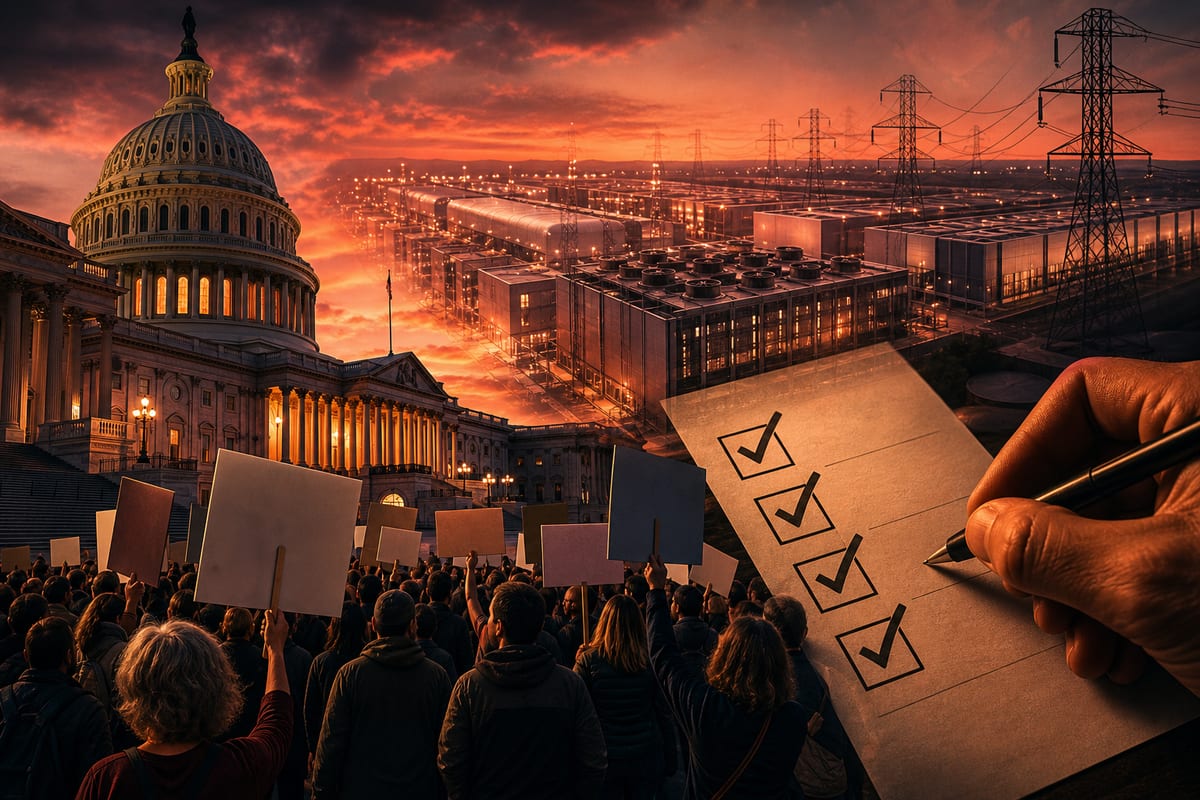
The Democrats' takeover of Congress coincides with a local wave of moratoriums on data centers and calls for accountability from AI companies. Amid anticipated project slowdowns, breakthroughs in security legislation, and partisan tensions, the American ecosystem is preparing for a regulatory shift.
Massive Moratoriums and Slowed Projects, Affecting Up to 1,000 Sites
Voters approved 43 out of 44 local moratoriums, complicating the construction of data centers across the country. In Texas, where expansion is the fastest, elected Governor Gina Hinojosa plans to suspend all new permits until protective laws are adopted. Other key states have made similar commitments. According to Yorkville Ives & Co., the construction of up to 1,000 data centers could be hindered, which may also limit the influx of capital into the market.
Focus on Security and Announced End of State-Level Blockages
The election results seem to have put an end to Donald Trump and the Republicans' attempts to block AI restrictions at the state level. Shaunna Thomas believes this option is no longer viable, and Wes McEnany warns that opposing it could cost elected officials their seats. Kyle Jacobs-Morse anticipates more legislation on tech accountability. AI security is also becoming a central topic in the debate: Mark Warner was re-elected after campaigning on this issue, Jon Ossoff raised concerns about the existential risks posed by AI, and a bill to ban superintelligence was introduced in September. Adam Kovacevich expects new security laws to emerge in Democratic states.
AI Leaders on the Defensive and Plans to Relocate Data Centers
Privately, CEOs in the sector are discussing significant constraints on computing capacity, particularly at OpenAI. Dina Powell McCormick from Meta indicates that many players are considering moving data center construction abroad. Some leaders may cite the political context to explain lower-than-expected revenues, while new politicians promise to summon CEOs for questioning. Publicly, most remain silent: OpenAI and Anthropic have not commented.
Le brief IA que les pros lisent chaque soir
Les 7 actus IA du jour, décryptées en 5 min. Gratuit.
Inclus dès l'inscription : notre sélection des meilleurs guides & comparatifs IA.
Choisissez votre rythme
Gratuit · Pas de spam · Désabonnement en 1 clic
Hostile Local Opinion: 76% Against Centers Near Them
In recent months, bipartisan mobilizations against the construction of data centers have multiplied in many states, driven by concerns over noise and rising electricity bills. A NBC News poll conducted on Tuesday reveals that 76% of voters oppose the establishment of data centers in their community. Shaunna Thomas views this opposition as one of the most bipartisan issues. Kyle Jacobs-Morse emphasizes that in states like Texas, Georgia, and Ohio, Democratic campaigns have highlighted the indirect costs to residents, communities, and governments.
Contested Rebranding and Reconfigured Political Landscape
OpenAI has renamed its data centers "computing campuses," and Donald Trump attempted to rebrand AI as "super intelligence" in September. However, the midterm election results indicate that a significant portion of voters does not buy into these rebranding efforts. Shaunna Thomas believes these initiatives have very little chance of success, and Kyle Jacobs-Morse notes that Trump's specific positions did not convince voters. Democratic campaigns have insisted on the need to hold AI companies accountable.
A Polarized Landscape, Between Rejection, Caution, and Measured Optimism
Wes McEnany speaks of a "total rejection" of AI, reminding that the technology concerns employment, social networks, and even electricity bills near data centers. Other voices, like Katie Barr, see it as a warning signal regarding accessibility, employment, and safety, rather than a rejection of technology. Conversely, Donald Trump considers the AI security crisis a hoax, and the future of the issue within the Republican Congress remains unclear between blockage and discussions. Elon Musk had supported the Republican vote and invested nearly $450 million to promote these campaigns, but his message was withdrawn after the results were announced. On X, sharp opinions are shared, and Sam Altman has argued that citizens must retain control over their future. Guru Sethupathy highlights that the issue of data centers was explicitly on the ballot, while François Ajenstat awaits regulatory developments and Yorkville Ives & Co. announces major obstacles ahead. The electoral sequence, marked by the takeover of both chambers and several symbolic shifts, fuels expectations of regulation and a slowdown in infrastructure.
Brief IA — L'actualité IA en français
L'essentiel de l'actualité de l'intelligence artificielle, décrypté et expliqué chaque jour.