Uttar Pradesh Plans AI for Over 240 Million Residents
In India, Uttar Pradesh is considering an AI system aimed at over 240 million residents, based on the consolidation of administrative data. Prime Minister Narendra Modi, for his part, proposes a digital tracking system for children to guide their educational paths. The Internet Freedom Foundation contests the framework of the state's project.
A foundation denounces insufficient safeguards
The Internet Freedom Foundation, an Indian organization, is concerned about the lack of a law explicitly authorizing the systems being considered in Uttar Pradesh. It also laments that the tender does not mention certain important oversight measures. Other critics point to vague formulations that could allow the system to connect with other administrations.
Indian authorities, both at the national and state levels, have already cut off Internet access to deprive protesters of communication via social networks or messaging services. Uttar Pradesh, for its part, plans to use only anonymized data and wishes to host models with open weights itself. A restriction is also planned for the police assistant: it would neither assess evidence nor draw conclusions from investigations.
Modi proposes tracking from age three
The educational project of Narendra Modi, India's Prime Minister, stipulates that parents will provide information about their child's activities and achievements starting at age three. This information would feed into a public system that could also be accessed by the child's teachers and friends. An AI application would analyze the accumulated data throughout the child's growth to assess suitable training or professions.
Le brief IA que les pros lisent chaque soir
Les 7 actus IA du jour, décryptées en 5 min. Gratuit.
Inclus dès l'inscription : notre sélection des meilleurs guides & comparatifs IA.
Choisissez votre rythme
Gratuit · Pas de spam · Désabonnement en 1 clic
Narendra Modi claims that this tracking would help to early recognize children's interests and abilities, subsequently guiding their study choices. He presents the recommendations as a valuable aid for parents when considering funding for education. In India, entrance exams for the most prestigious higher education institutions require high fees.
Uttar Pradesh is also considering a school usage, distinct from the tracking proposed by the Prime Minister: an application would advise teachers in preparing resources tailored to their students.
The state plans a dozen administrative uses
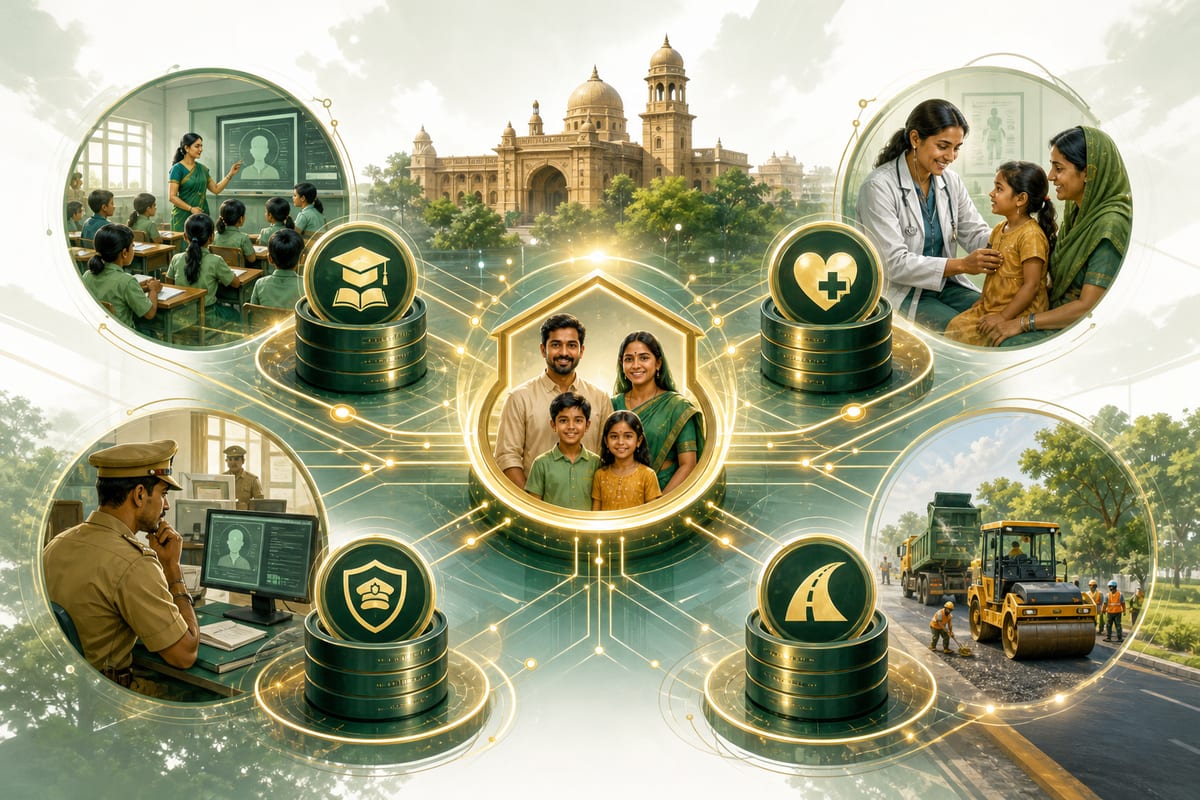
Uttar Pradesh, India's most populous state, has launched a 178-page tender to find providers to build its "AI Stack." The system would rely on a unique identifier for each household to consolidate information from multiple administrations. A dozen use cases for AI are being considered.
One of them would examine public posts on social media, online news channels, and connected complaint circuits. It would aim to identify emerging urban issues, grievances, service interruptions, or their repeated failures. The executive intends to automatically forward reports to the relevant agencies and automate certain interventions, such as dispatching teams to repair roadways.
For police officers, the planned assistant would consult historical case files as well as other information. Healthcare personnel would have a recommendation aid tool during their visits to patients. Residents could, through natural language exchanges, obtain guidance on finding and accessing public services.
Brief IA — L'actualité IA en français
L'essentiel de l'actualité de l'intelligence artificielle, décrypté et expliqué chaque jour.