Vercel Releases Open-Source SDK for AI Agents with 50 Behaviors
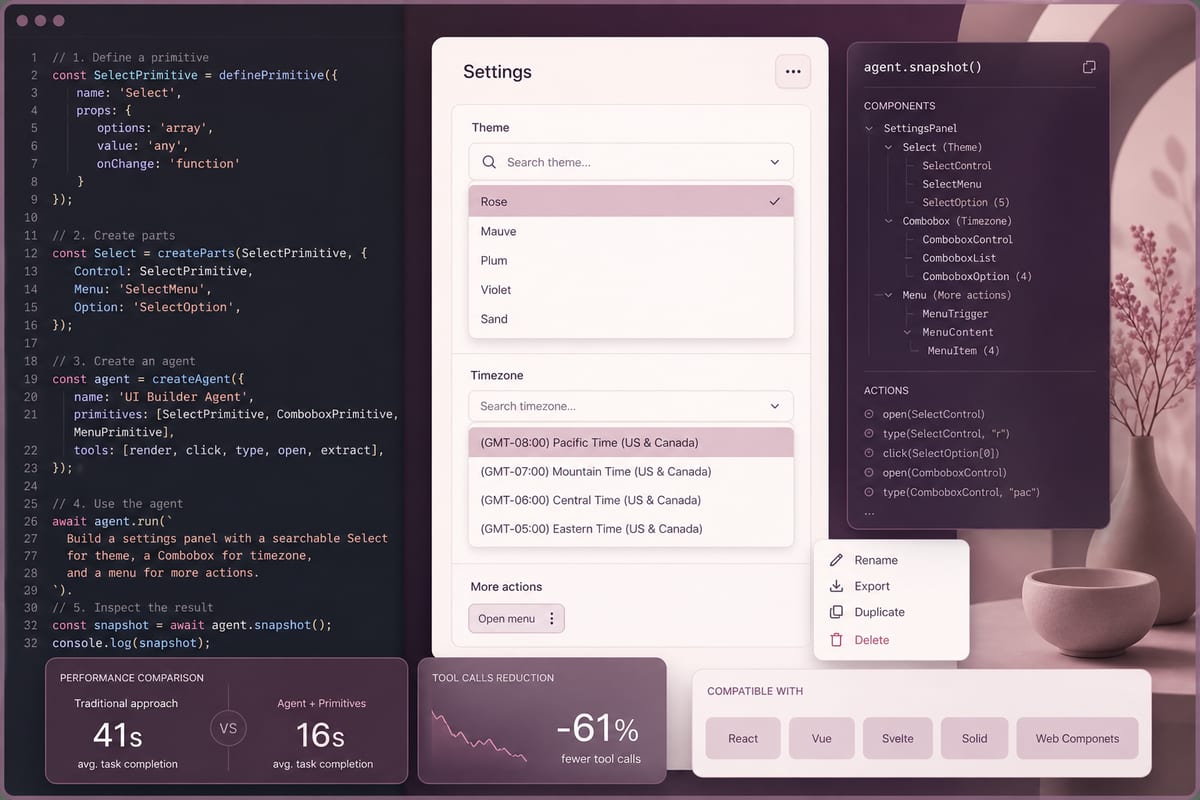
Vercel Labs has released a beta version of an open-source UI behavior library and an execution bridge for agents. Compatible with React, Vue, Svelte, Solid, and Web Components, the UI SDK enables LLM-driven interactions without screenshots. Vercel reports time and cost savings on a typical task, while noting that these figures come from a limited sample.
Measured Gains on a Single Task and Explicit Reservations
Vercel Labs reports a 69% reduction in tool calls on a parameter task using the UI SDK in an internal test. Measured time decreased by 61%, from 41 seconds to 16 seconds, and cost dropped from $0.073 to $0.032. The tested case involved renaming a project, modifying members and notifications, and then saving. Both agents used Sonnet via Claude Code, with identical task and system prompt, and the reported results correspond to the median of three trials. Navigation tools totaled 165 calls, the number of characters read fell from 39.8k to 6.8k, and duration decreased from 41 to 16 seconds. Vercel clarifies that the sample pertains to a single task, that the execution with browser tools used a different component library, and that the version of Sonnet is not specified.
An Execution Bridge for Agents to Control the Interface
The UI SDK offers a bridge created with createAgent() before rendering, allowing agents to act on the state without screenshots. The method agent.snapshot() inventories available components, states, and actions, while agent.act() executes these actions, such as renaming via setValue. Applications can interpose an allow callback to approve or deny actions and receive annotated change callbacks with source:"agent" to enable modification rollback. Tools can also be registered with supported browsers via WebMCP.
The Library Offers Over 50 Behaviors for AI Agents
The library includes over 50 behaviors in @ui-sdk/core, rendered by lightweight adapters. It illustrates how to assemble a Select from a popup, a selection model, and a typeahead, elements that can also compose an autocomplete, a combobox, or a novel component. Highlighted behaviors include createRovingFocus, createTypeahead, createPopup, createSelection, as well as createReorder, createResize, createViewport, and createVirtualizer. The documentation organizes everything into ten categories and provides pre-built components like Select, Combobox, Date Picker, Menu, Tree, and Color Picker. The project emphasizes a single core and five adapters, with an approach where agents compose components from behaviors rather than templates.
Le brief IA que les pros lisent chaque soir
Les 7 actus IA du jour, décryptées en 5 min. Gratuit.
Inclus dès l'inscription : notre sélection des meilleurs guides & comparatifs IA.
Choisissez votre rythme
Gratuit · Pas de spam · Désabonnement en 1 clic
Primitives, Slots, and Identical Rendering Across Five Adapters
Components are created as primitives via definePrimitive, which declare a state, an API, and slots. These slots bind attributes, events, and behaviors to areas of the DOM. One example shows a search field with createFocusRecovery, where the Clear button only appears in the presence of text. Rendering occurs via createParts, and according to the documentation, the parts remain identical across the five adapters, allowing the same behavior definition to power both a React application and a Svelte application. The UI SDK targets React, Vue, Svelte, Solid, and Web Components, operates in modern browsers without a GPU, and requires recent framework versions, including React 19+ and Vue 3.5+.
Beta Released on npm, Licenses, and Peer Requirements
Six packages are available on npm in version 0.1.0-beta.1, published on November 12, 2026, under the Apache-2.0 license. To install, the command npm install @ui-sdk/react @ui-sdk/core is used, with the adapter replaced according to the framework. Required peer dependencies are React 19+, Vue 3.5+, Svelte 5.33+, and Solid 2.0.0-rc.14+, and an optional web.css file provides a default style. Agent setup involves a prompt to paste for installing packages and annotating AGENTS.md, with a ui-sdk skill installable via npx skills add vercel-labs/ui --skill ui-sdk. Pages without a build can load web.js and web.css from ui-sdk.dev. The GitHub repository, documentation, and npm package are available online.
Positioning Against Radix, React Aria, Base UI, and Ark UI
The UI SDK stands out with a model where behaviors are composed by agents, while Radix and Base UI provide unstyled components, React Aria offers hooks and components, and Ark UI provides components on state machines like Zag.js. The covered frameworks differ: the UI SDK targets React, Vue, Svelte, Solid, and Web Components, while Radix, React Aria, and Ark UI focus on React, and Base UI covers React, Vue, Solid, and Svelte. The licenses are Apache-2.0 for SDK UI and React Aria, and MIT for Radix, Base UI, and Ark UI. The latest versions cited are 0.1.0-beta.1 (SDK UI), 1.8.1 (Radix), 1.2.2 (React Aria Components), 2.1.1 (Base UI), and 0.9.0 (Ark UI), with peer ranges of React 19+ for the SDK UI, 16.8 to 19 for Radix and React Aria, 17 to 19 for Base UI, and 18+ for Ark UI. Version data comes from npm as of November 13, 2026. While React Aria and Ark UI already separate behavior and markup, the highlighted difference for the SDK UI is the existence of a dedicated agent layer with skill, grouped llms.txt, and execution bridge, which is not disclosed by the others.
Brief IA — L'actualité IA en français
L'essentiel de l'actualité de l'intelligence artificielle, décrypté et expliqué chaque jour.