VivaTech 2026: European AI Steps into the Spotlight
Le brief IA que les pros lisent chaque soir
Les 7 actus IA du jour, décryptées en 5 min. Gratuit.
Inclus dès l'inscription : notre sélection des meilleurs guides & comparatifs IA.
Choisis ton rythme
Gratuit · Pas de spam · Désabonnement en 1 clic
VivaTech 2026: European AI Steps into the Spotlight
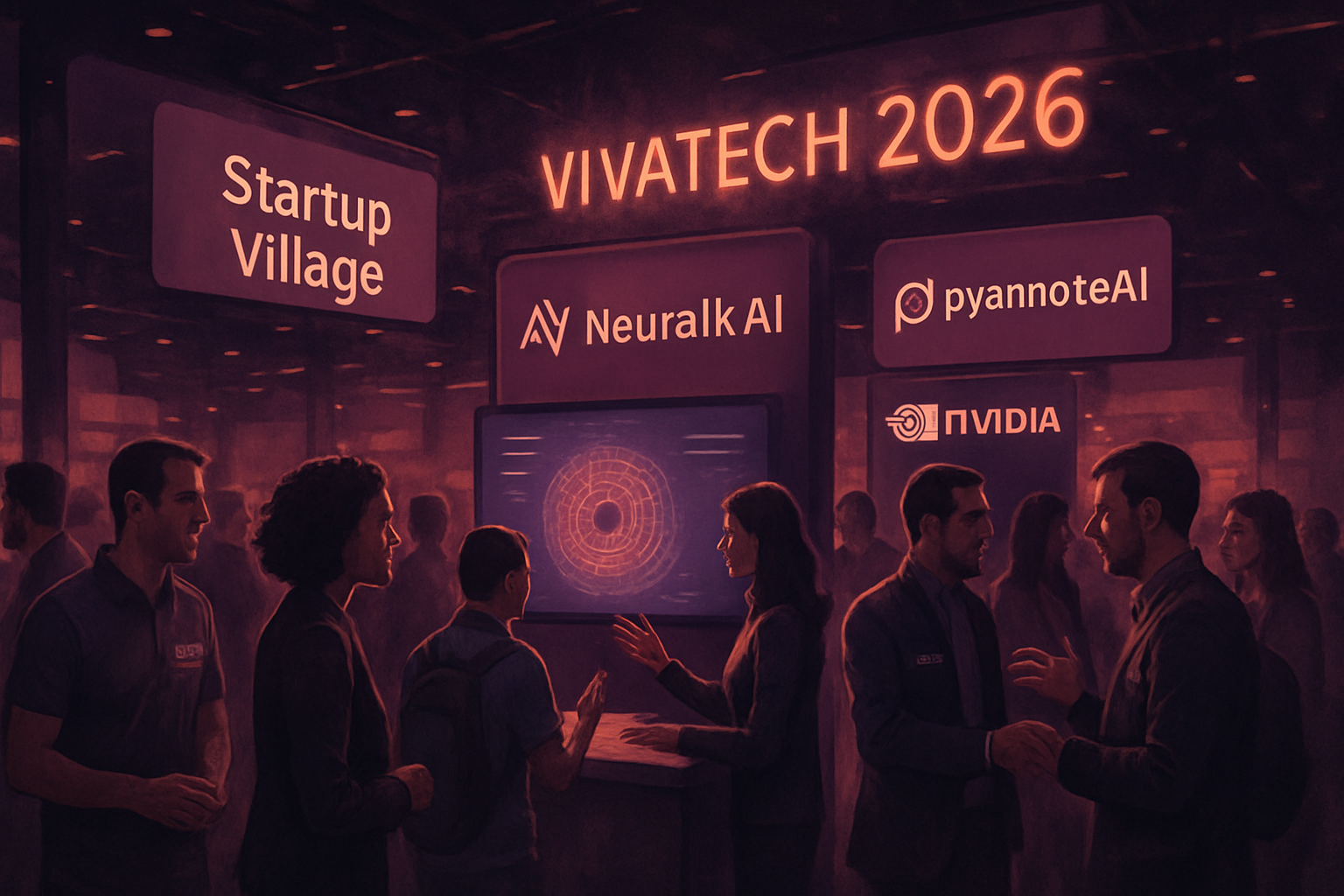
At its tenth edition, VivaTech marked a turning point for artificial intelligence (AI) in Europe, showcasing solutions that are no longer mere prototypes but market-ready products. At the heart of this event, Amazon Web Services (AWS) and NVIDIA collaborated to create a "Startup Village." This village brought together seven promising European startups, highlighting the growing importance of the cloud as a driver of innovation on the continent.
Featured Startups
To celebrate this anniversary, AWS and NVIDIA chose to spotlight seven European startups: Neuralk AI, Gradium, pyannoteAI, Aily Labs, Physicl, Seltz AI, and Ask for the Moon. These companies, which cover various fields such as voice recognition, robotics, and decision intelligence, share a common trait: they offer products that are already in production and count major corporations among their clients.
Some of these startups stem from public research. For instance, pyannoteAI is based on twelve years of research conducted by CNRS, while Gradium is a spin-off from the Kyutai laboratory. These companies are not just creating gadgets; they are developing solutions that have a measurable impact on business, both economically and socially. Sasha Rubel, head of AI policy at AWS for the EMEA region, stated: “These startups are deploying use cases in production, with measurable business impact and both economic and social returns on investment. They are building blocks on which thousands of European companies will be able to rely.”
Physicl is a striking example of this trend. The startup specializes in generating 3D training data for robots, positioning itself at the forefront of "world models," a technology that allows AI to be transposed into the physical world, representing the next major wave of innovation.
France: A Fertile Ground for AI Startups
According to a study conducted by Strand Partners for AWS, titled "Unlocking AI Ambitions in France," eight out of ten French startups had adopted AI by 2025. This rate is higher than the European average, and 90% of these startups report accelerated innovation cycles. Furthermore, 67% of them claim they are ready to adopt advanced tools like agentic AI, compared to only 19% for all European companies.
France is now the third country in the world in terms of concentration of native AI startups, behind the United States and Israel. French startups show an average annual growth rate that exceeds the global average. However, this dynamism among startups contrasts with the broader reality of the French economic fabric: only 19% of companies use AI in a transformative way, and two-thirds of those that have adopted it limit themselves to basic uses.
Sasha Rubel emphasizes the stakes: “40% of European startups are considering leaving Europe to accelerate. Europe has the talent, research, and a tech sector worth €4 trillion. The question is not whether Europe has what it takes, but whether it will act decisively while the window remains open.”
An Acceleration Infrastructure
Behind the Startup Village lies a shared vision from AWS and NVIDIA: to create an ecosystem where computing power and cloud infrastructure serve as a springboard for native AI startups. Over the three days of the event, more than 40 sessions were organized, and a 240 m² "Founders Arena" was dedicated to founders, featuring practical sessions on fundraising, go-to-market strategies, and open source.
Howard Wright, vice president of the startup ecosystem at NVIDIA, stated: “Startups are no longer just experimenting in the field of AI: they are now developing applications ready to be put into production and that must be scalable. Together, AWS and NVIDIA provide a remarkable gateway to a 'full-stack' AI infrastructure, combining accelerated computing, networking, software, and AI models to help developers and companies create, deploy, and scale their AI applications more quickly.”
In Europe, and particularly in France, Wright observes a turning point in the startup ecosystem. These startups are attracting real corporate clients, possess solid technical expertise, and have clear infrastructure needs. France's long-standing strengths in mathematics, engineering, and research have given rise to an exceptional concentration of AI talent, and with increasing capital and ecosystem support, this talent is finding its way into companies with global potential.
AWS also took advantage of VivaTech to launch AWS Startup Advisor, an AI agent trained on the patterns of over 350,000 global startups, offering personalized recommendations for free from day one. Sasha Rubel summarizes this ambition: “Twenty years ago, AWS removed the barrier of servers by inventing the cloud. Our first clients were startups: Netflix, Airbnb, Zalando, Vinted, The Fork, Bolt, N26... Today, we continue to innovate every day for founders. Now, with agentic AI, we are removing the technical barrier.”
Since 2017, AWS has partnered with Station F and reaffirmed its commitment to France with an investment of over €6 billion by 2030, as well as granting $1 billion in cloud credits to startups worldwide in 2024. This commitment is beginning to bear fruit, as evidenced by the successes of the seven startups present in the Startup Village.
Brief IA — L'actualité IA en français
L'essentiel de l'actualité de l'intelligence artificielle, décrypté et expliqué chaque jour.