Walmart: In-Store AI Deployed, Impact Report Rejected
Le brief IA que les pros lisent chaque soir
Les 7 actus IA du jour, décryptées en 5 min. Gratuit.
Inclus dès l'inscription : notre sélection des meilleurs guides & comparatifs IA.
Choisis ton rythme
Gratuit · Pas de spam · Désabonnement en 1 clic
At Walmart, digital assistants are now assigning an increasing share of in-store tasks via the internal application. Employees describe irrelevant pathways and alerts that they must correct or ignore. While a workers' organization has requested a dedicated report on the impact of AI, the proposal was not adopted. Management emphasizes a "people-driven" approach and promises investments in training and skill development.
The Board Rejects a Dedicated Report and Promises Training
United for Respect submitted a shareholder proposal in April asking Walmart to produce a report on the impact of AI on its workforce. This proposal was presented last month during the shareholders' meeting. The measure was not approved.
The board of directors rejected the request, stating that technology should benefit employees by enhancing human skills, optimizing the customer experience, and giving more meaning to work. The company indicates that it will allocate resources to training, acquiring new skills, and opening additional career pathways.
AI Pathways, Safety, and Metrics: Daily Frictions
A fulfillment employee explains that she works more slowly than the AI application predicts, partly due to a pathway that "takes her everywhere," making projected times difficult. Spark drivers report that a "smart path" sometimes asks them to pick up frozen products at the start of their route, consuming time and energy at the expense of the next order.
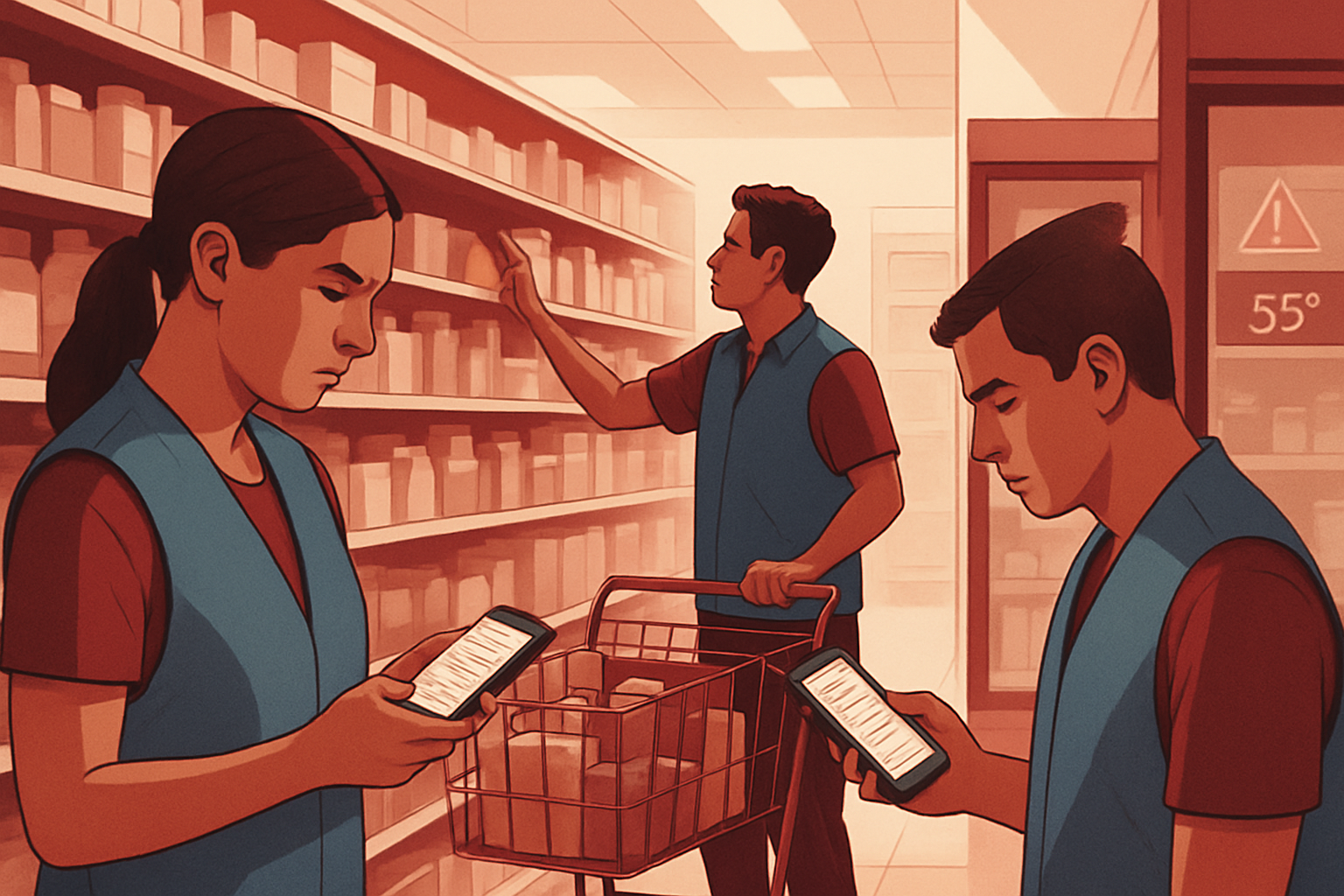
A dedicated AI safety agent is still learning to interpret data from cameras and sensors, generating confusion. One employee says she receives numerous alerts meant to point out spills or refrigerator temperatures out of range, and often has to correct or contextualize these reports, to the point of ignoring those deemed irrelevant.
Employees also feel that the tool does not account for essential tasks related to restocking, such as checking dates, removing damaged products, or cleaning, which vary in time. However, a store HR manager assures that teams are not penalized based on unrealistic AI metrics and that "there will be no impossible standards."
Tools in Place: MyWalmart, Sidekick, and an Assistant for 1.6 Million
In stores where they are activated, AI features increasingly assign tasks and goals via the MyWalmart app, usable on provided or personal phones. A growing share of the 1.6 million U.S. employees thus has a digital assistant, and Walmart relies on Sidekick to guide in-store work.
According to an asset protection manager in Wisconsin, allowing AI to establish a task list enables some employees to start without waiting for a manager, with the assistant even learning assignment habits. Walmart is accelerating this deployment and training thousands of employees, while acknowledging that a digital assistant sometimes needs to learn to be fully useful.
The group reiterates its doctrine of a people-driven company powered by technology, with tools intended to simplify work. It is heavily investing in AI to support its growth.
Human Corrections and Feedback Loops
Workers describe AI errors that they must correct, manage, or ignore, and Walmart claims to rely on this feedback to improve its tools. In practice, employees say they spend time training the software by providing context and judgment.
The deployment has also triggered significant activity on social media: posts and hundreds of comments on Reddit, attributed to employees, mention confusing security alerts, automated performance evaluations, and various issues. A store HR manager summarizes a frequent criticism: an AI agent that assigns tasks "assumes" perfect execution.
Employee Perception: Widespread Distrust, Mixed Expectations
More than 250 employees surveyed this year express marked concerns among frontline workers, according to a survey conducted by United for Respect. Over 85% of respondents say they do not trust Walmart to prioritize their needs in AI development.
However, about 40% expect a reduction in their workload, and a similar number believe that AI could eliminate repetitive tasks. Fears mainly center on HR decisions being entrusted to AI, cited by nearly three-quarters of respondents, as well as a reduction in interactions with management and colleagues for two-thirds of them; half fear penalties related to mistakes.
Ava Williams, a night employee in Spokane, mentions "impossible deadlines" and AI-driven workflows that, according to her, push some team members to rush or skip steps like disinfecting shelves or checking for expired products.
Brief IA — L'actualité IA en français
L'essentiel de l'actualité de l'intelligence artificielle, décrypté et expliqué chaque jour.