With $500 million, Genesis AI Aims to Produce More
Genesis AI announced on Tuesday a Series A funding round of $500 million, which values the company at $3.5 billion. The company plans to allocate these funds to its computing capabilities, robot manufacturing, and recruitment.
Genesis Explores Leasing for Its Clients
The Eno robot is initially intended for manufacturing, logistics, and laboratories. Genesis claims to be ramping up its production for industrial clients while exploring a leasing model that combines hardware and software. A partnership with LG CNS has been announced.
Other Fortune 500 companies are among the prospects, says Zhou Xian, co-founder and CEO of Genesis AI. He did not disclose revenue figures or the number of paying customers.
Vedant Agrawal, a partner at Premji Invest, explains his firm's interest through demonstrations where robots autonomously performed extended tasks. According to him, the reliability expected by a company requires complete operations executed in real-time, rather than brief sequences. Genesis is also considering applications in hospitality and healthcare, before moving on to consumer or outdoor applications.
Premji, Khosla Ventures, Eclipse Lead the Funding
The round is co-led by Premji Invest, Khosla Ventures, and Eclipse. The total amount raised since Genesis was founded in 2024 now reaches $605 million, following a $105 million funding round announced in July 2025. The company has nearly 100 employees, with headquarters in Paris and offices in San Carlos, California.
T. Rowe Price Associates, Durable Capital Partners, Bpifrance, HSG, Nvidia, AMD Ventures, Zoom, Samsung Next, and Ericsson are also participating in the round. Eric Schmidt, Eric Yuan, Jerry Yang, Xavier Niel, and Zach Kirkhorn are investing individually.
According to Crunchbase, robotics startups received $9.9 billion in the third quarter of 2026, compared to $4.3 billion in the third quarter of 2025, more than doubling. Most of the investments in this rapidly growing sector in 2026 are benefiting established companies in China or the United States, according to Crunchbase. Venture capital dedicated to physical AI is also progressing this year.
Le brief IA que les pros lisent chaque soir
Les 7 actus IA du jour, décryptées en 5 min. Gratuit.
Inclus dès l'inscription : notre sélection des meilleurs guides & comparatifs IA.
Choisissez votre rythme
Gratuit · Pas de spam · Désabonnement en 1 clic
Gloves Power the GENE Model
The lack of available examples for teaching robots has guided Xian's research and Genesis's approach. Unlike language models, which leverage abundant text, robots require data on movement, grasping, manipulation, as well as touch and the effects of their actions.
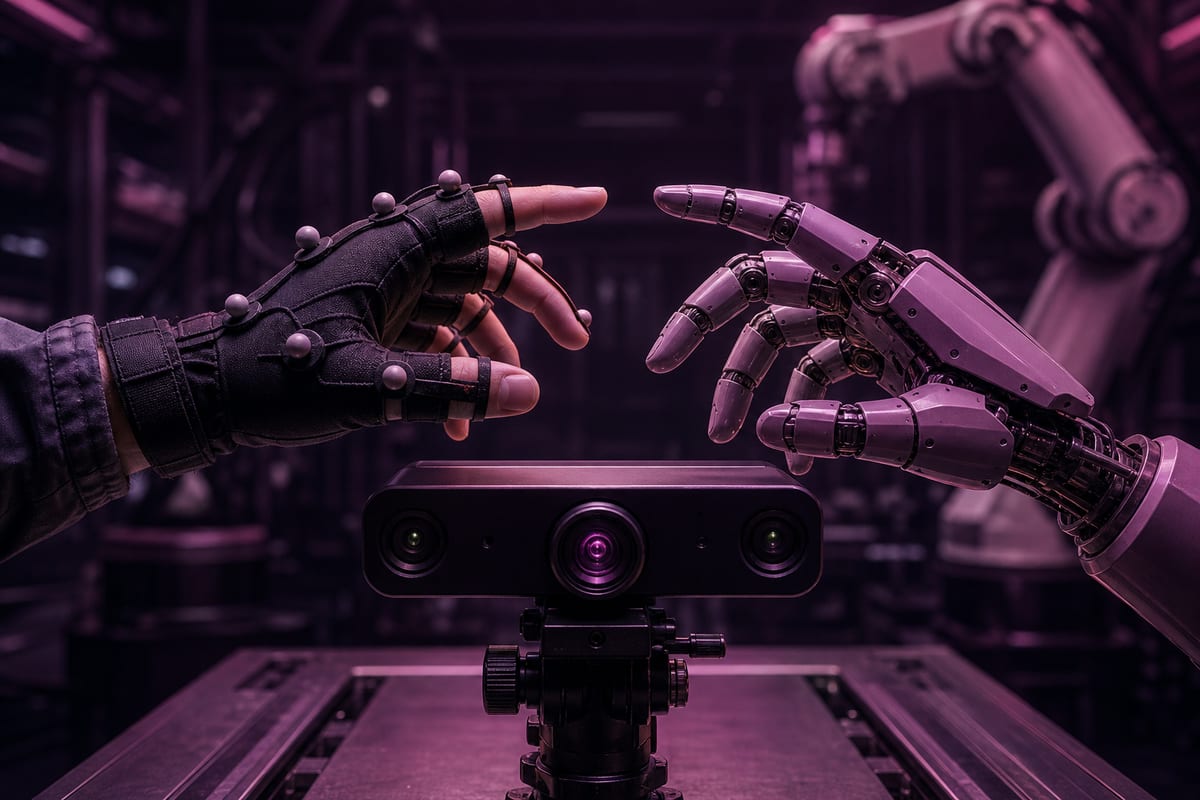
Cameras and gloves at Genesis capture the finger and hand movements of people at work, along with tactile data. These captures feed into the training of the GENE model. The company asserts that the similarity between its robotic hand, a human hand, and the glove used facilitates the transfer of gestures.
Xian recalls that this data was historically obtained by hiring operators to remotely control the robots. Genesis aims to collect it from individuals performing their jobs normally. Learning from human gestures is linked to Genesis World, its simulation tool, where skills are trained and tested before physical execution. According to the company, this method takes less time than training based solely on real machines.
Genesis Also Develops Robotic Hardware
The company designs its robots and their control software in-house. Xian advocates for the joint development of intelligence, hardware, and training and testing methods: their operation as a cohesive unit should, in his view, make the product reliable. He also claims to seek an elegant, timeless, and closely integrated product.
The Genesis scientific project, launched by Xian in 2022 during his PhD in robotics at Carnegie Mellon University, initially focused on simulation tools. Researchers from more than a dozen universities participated in it. Graduating in late 2024, Xian partnered with Théophile Gervet to found a company. Officially launched in March 2025, it has expanded its activities to AI software and robotic hardware.
Brief IA — L'actualité IA en français
L'essentiel de l'actualité de l'intelligence artificielle, décrypté et expliqué chaque jour.