Workday and SaaS: AI Redefines Their Future
The Potential Impact of AI on SaaS
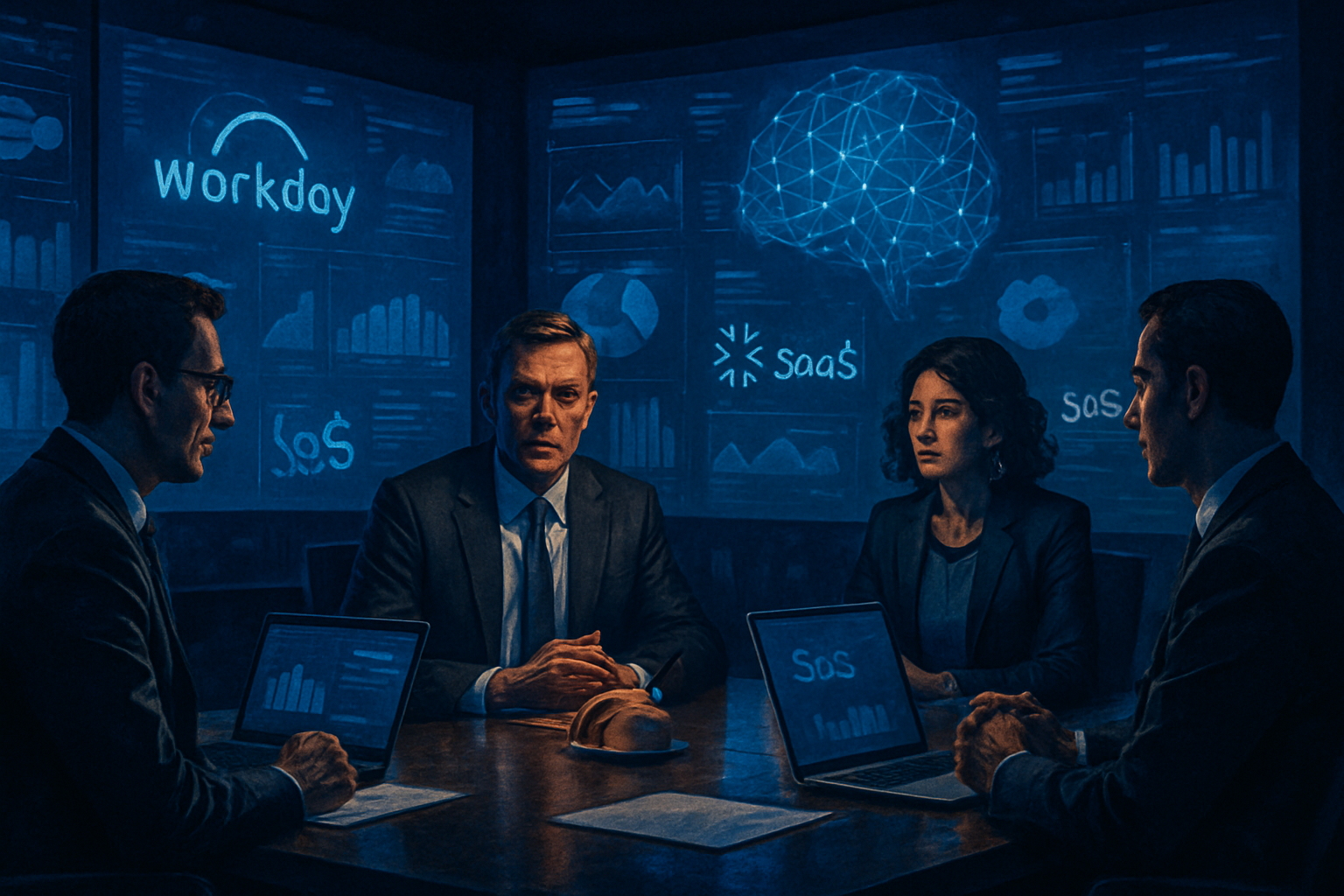
Artificial intelligence (AI) is poised to profoundly alter the business models of enterprise software. While some speak of a "SaaS apocalypse," this view is often considered exaggerated. However, the threat of disintermediation, where AI agents could become the primary means of accessing software services, is very real. Software providers must therefore refine their core competencies to remain relevant in this new environment.
This transformation could disrupt the established order in the tech industry. The enterprise applications that professionals rely on daily risk being replaced by AI agents, thereby redefining how users interact with information technology. Companies will need to establish new relationships with AI providers to adapt to these changes.
Gartner's Forecasts
According to technology analyst Gartner, agentic AI is set to disrupt the revenue models of enterprise software. Gartner predicts that by 2030, up to $234 billion in application spending will be exposed to agentic arbitration. This means that by the end of the decade, approximately 20% of SaaS application software spending could be influenced by interactions with AI.
These forecasts have fueled the discourse around the "SaaS apocalypse," with estimates indicating that markets have lost about $300 billion in SaaS valuations over the past 18 months. This correction is driven by fears that AI agents will replace traditional tools. This raises the question of whether your favorite software provider is at risk of disappearing and how companies are responding to this threat of disintermediation.
A Transformation Rather Than Destruction
It is essential to understand that, while the impact of AI has already affected the market values of some software companies, disintermediation is a complex phenomenon. Some providers may struggle to maintain their dominance, but others could adapt and thrive.
Gartner suggests that the shift to agentic AI is less an apocalypse than a metamorphosis. SaaS will not be destroyed but will evolve into a new form. The companies that succeed will be those that can effectively respond to the threat of disintermediation.
Le brief IA que les pros lisent chaque soir
Les 7 actus IA du jour, décryptées en 5 min. Gratuit.
Inclus dès l'inscription : notre sélection des meilleurs guides & comparatifs IA.
Choisissez votre rythme
Gratuit · Pas de spam · Désabonnement en 1 clic
Shannon Kalvar, research director at IDC, shares this view. He believes that the idea of a SaaS apocalypse is exaggerated but acknowledges that disintermediation is a reality. He emphasizes the potential for professionals to use AI-powered solutions that bypass traditional enterprise software interfaces.
Trust as a Pillar of Survival
Clare Hickie, CTO for EMEA at Workday, is one of the executives contemplating these challenges. She acknowledges that AI brings uncertainty and that business leaders will seek providers capable of offering a certain degree of certainty. She believes that Workday excels in this area.
Hickie points out that digital leaders are not always ready to embrace AI due to concerns about trust. She stresses the importance of privacy by design and security frameworks integrated into all of Workday's activities.
She also mentions Workday's recent innovation, where executives discussed the product roadmap, including the development and integration of agents through their next-generation service, Sana. Hickie believes that Workday's ability to build a trusted platform for inter-company workflows will be a sustainable asset.
Fundamental Rules Remain Unchanged
Despite the changes brought about by AI models, the underlying rules of effective enterprise software, such as governance, security, and data management, remain essential. IT companies that possess a unique selling proposition still have their place in the market.
Benoît Dageville, co-founder and president of Snowflake, acknowledges that AI is bringing new specialists to the market. However, he believes that Snowflake will remain relevant by listening to its customers and developing a trusted data platform. "We have the data, and there is no AI without data," he asserts.
Dageville adds that those looking to understand the risk of disintermediation should learn from the past, particularly from the rise of cloud giants. He wonders if companies like Anthropic or OpenAI could become competitors to Snowflake, but he remains skeptical about their ability to replicate what Snowflake has built. "They do not fully understand this domain - we specialize in our technology," he says, emphasizing that specialization remains a significant asset.
Brief IA — L'actualité IA en français
L'essentiel de l'actualité de l'intelligence artificielle, décrypté et expliqué chaque jour.