XPENG unveils WorldGPT to train six types of machines
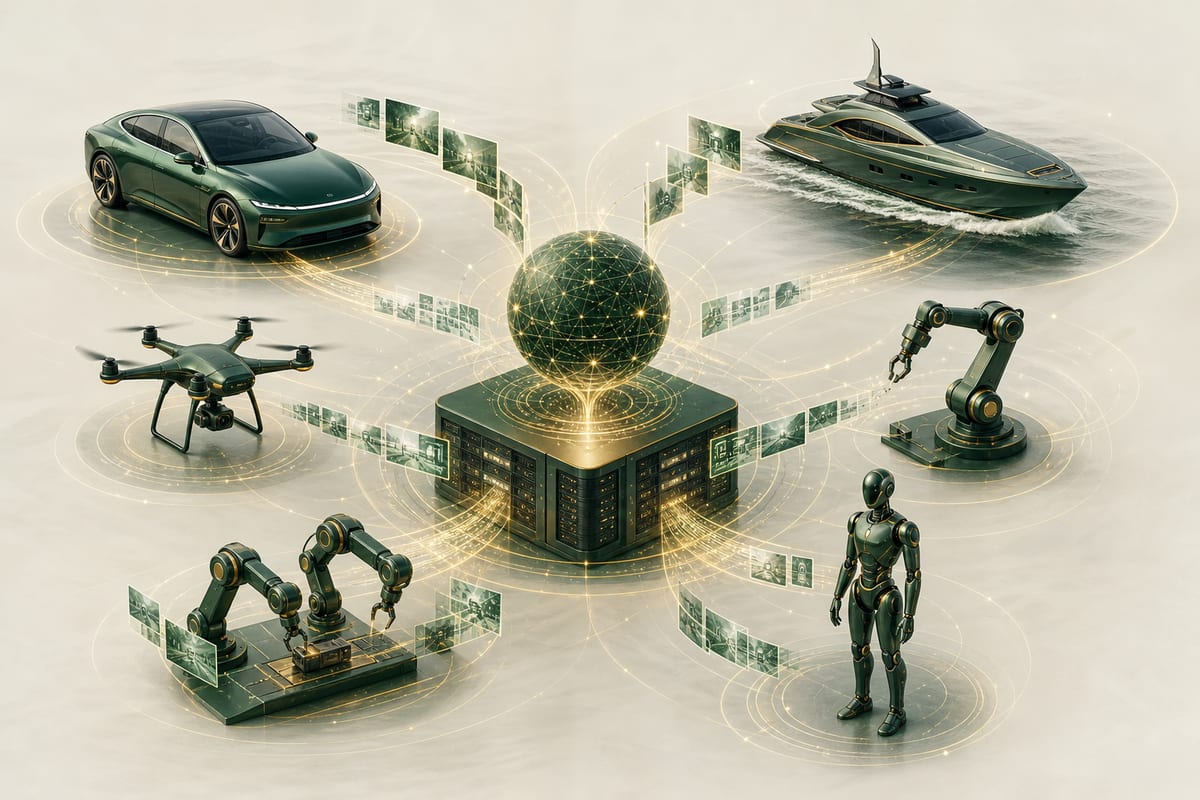
XPENG unveiled WorldGPT on November 24 in Guangzhou, China: this model is designed to learn from six categories of machines. The manufacturer aims to share learnings among its cars, robots, and drones. However, no timeline has been announced for versions intended to operate directly on these devices.
XPENG claims 12 top positions in evaluations
As of November 12, XPENG claims 12 top positions in public tests covering robotics, autonomous driving, image understanding, and video production. The manufacturer announces that it leads four evaluations of autonomous driving. For single-arm manipulation, it reports an average success rate of 95.2% across 50 tasks in simulation within Meta-World MT50.
The company also claims the best performance on CV-Bench, on two sub-tasks of BLINK, as well as in the overall ranking of VBench 2.0. However, it acknowledges that these comparisons do not control for the data used to train the models. The VBench 2.0 score comes from a self-assessment with rephrased instructions, while the expected technical report is still missing to allow for a more comprehensive independent evaluation.
XPENG aims to transfer knowledge between machines
A member of the Turing World Model family, WorldGPT is designed to learn from automobiles, boats, drones, single-arm robots, dual-arm robots, and humanoids. XPENG trains a large model in the cloud using data from various devices, and then plans to transfer the learnings to lightweight embedded models. According to the company, this method could reduce the additional data needed to integrate a new machine.
The AI brief the pros read every evening
The 7 best AI stories, the essentials in 5 min. Free.
Included when you join: our pick of the best AI guides & comparisons.
Choose your rhythm
Free · No spam · Unsubscribe in 1 click
Images captured by cameras serve as the shared medium for this learning. Despite different commands, both a car and a robotic arm must identify objects, assess distances, and anticipate movements. XPENG presents WorldGPT as a system that combines visual analysis, reasoning, anticipation, and action preparation: based on videos and written instructions, it could represent the possible sequence of a scene in video and prepare a response.
The demonstrations start from about one second of footage filmed in the real world, then display a generated sequence showing the anticipated movements. The actual recordings are presented in parallel to compare anticipation and actual execution. At Nvidia, GR00T 2 also combines video production and action preparation to train robots, learning from sequences where humans or machines perform tasks.
Possible on-site verifications
For robot buyers, the anticipated gain concerns the effort required to teach each device a new task. An operator can start from a task that the team is already measuring: in a retail setting, for example, scanning a shelf before opening and then during a peak activity period.
This protocol would involve noting how many examples from the store are needed to obtain a first usable reading, then counting the correctly scanned shelves. It would also measure staff interventions after a change in presentation or when a customer obstructs the passage, as well as the functions available in case of a connection loss. The results would be compared to the existing working method before committing a budget for further implementations.
Brief AI — AI news in French
The essentials of artificial intelligence news, decoded and explained every day.