AI and Cybersecurity: The 2026 Reference Guide for Businesses

Le brief IA que les pros lisent chaque soir
Les 7 actus IA du jour, décryptées en 5 min. Gratuit.
Inclus dès l'inscription : notre sélection des meilleurs guides & comparatifs IA.
Choisis ton rythme
Gratuit · Pas de spam · Désabonnement en 1 clic
An automated attack can now unfold in minutes: ENISA indicates that the transformation of a vulnerability into a weapon can occur within 15 minutes of its disclosure, and CrowdStrike mentions an average eCrime breakthrough time of 29 minutes by 2025. For companies, AI is no longer just a tool for SOC defense but a new attack surface made up of agents, data, machine identities, and models. This guide reviews the effective use cases, tools, rules, pitfalls, and a plan to get started.
What AI Really Changes for Cybersecurity
AI shifts the center of gravity in cybersecurity. Teams are no longer just protecting endpoints, servers, and applications, but also agents, memories, prompt libraries, autonomous workflows, and machine identities. Check Point describes AI's presence in social engineering, vulnerability research, credential harvesting, and lateral movement. KELA summarizes this shift with a formula featured in our analysis on the new cyber landscape: “AI shapes cybersecurity on both sides.”
The first operational change is the compression of time. ENISA states that advanced AI compresses several stages of the attack chain, from reconnaissance to exfiltration. In the same vein, CrowdStrike mentions an average eCrime breakthrough time of 29 minutes by 2025. Therefore, the SOC can no longer classify critical alerts as a backlog to be addressed later. It must identify attack paths, cut privileges, and orchestrate responses before exploration turns into extraction.
The second change concerns trust. Deepfakes, personalized phishing, and autonomous agents undermine usual signals: voice, video, internal messages, authenticated sessions, API requests. The right response is not to delegate all security to AI but to make it a layer of correlation, sorting, and simulation. Sensitive decisions must remain traceable, verifiable, and contestable, especially when they affect employees, customers, or regulated data.
 Cybersecurity team testing an AI workflow in a bright office
Test AI in a bounded perimeter before opening it to the information system
Use Cases That Work Today
The most mature use cases are those that enhance an existing security chain, with limited rights and verifiable outcomes. Agentic uses provide more gain but also more risk of state, permissions, and drift.
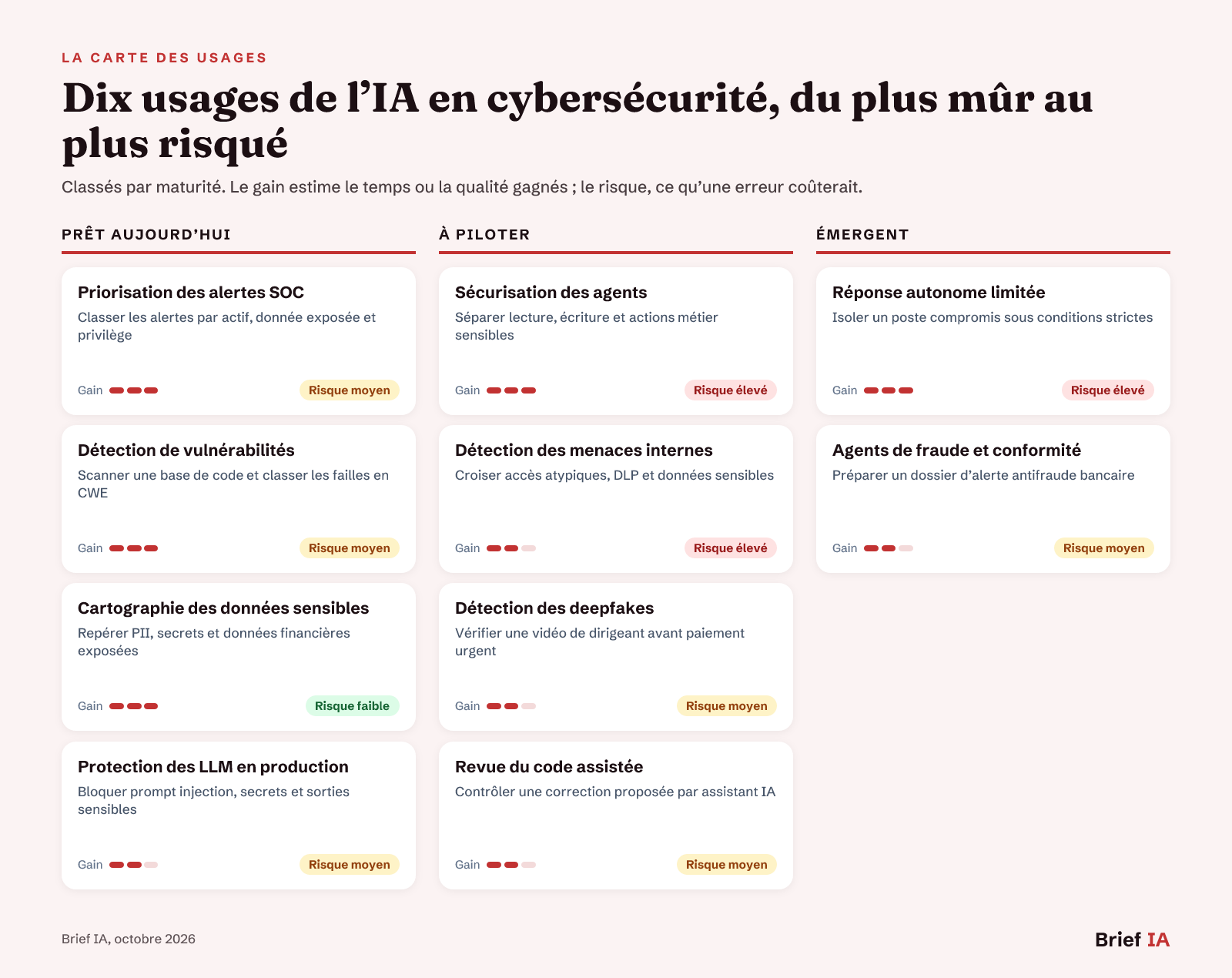 Map of AI use cases for security leaders
Use cases ranked by maturity, with expected gain and risk in case of error.
Ready-to-Use Use Cases
SOC Alert Prioritization. Models can correlate network signals, identity events, and data sensitivity to elevate truly critical alerts. The gain comes less from replacing analysts than from reducing noise and automatically documenting incidents. Require explainable rules, an audit log, and human validation before isolating a production system.
Vulnerability Detection. AI-assisted scanners analyze large codebases, assess severity, and propose fixes. Anthropic applies Claude Security to Claude Mythos 5 to identify vulnerabilities, classify them in CWE, and suggest corrections. Microsoft has introduced MAI-Cyber-1-Flash and MDASH for identification and remediation. Our analysis on AI innovations in cybersecurity details this shift towards guided correction agents.
Sensitive Data Mapping. Data posture platforms discover forgotten sources, classify sensitive content, and link each exposure to access rights. Our analysis on data security tools indicates that such platforms reduce the volume of alerts to be processed by 30 to 60% by focusing attention on risks related to critical data. They are useful before deploying any internal chatbot or agent connected to the information system.
Protection of LLMs in Production. Execution safeguards control the inputs and outputs of LLM-based applications. They detect prompt injections, circumvention attempts, and leaks of personal data or secrets. Their place is both upstream and downstream of the model, not just in the system command. For internal applications, pair these filters with minimal access rights and comprehensive logging.
Use Cases to Manage
Securing Agents. An agent connected to systems quickly becomes a technical account. The incident reported to the AEPD in Spain illustrates the risk of an automated chain linking access, data modification, and invoice consultation. Our analysis on the Spanish breach recommends least privilege, separate accounts, short tokens, secret rotation, and isolation between testing, pre-production, and production.
Detection of Insider Threats. AI can spot behavioral anomalies: unusual access, massive copying, use of unapproved AI tools, data transfer. This signal is never proof of malice. It should trigger a proportionate investigation, with privacy rules, human validation, and a clear social framework. Quality depends on logs, data classification, and risk indicator tuning.
Deepfake Detection. Deepfakes impact fraud, crisis communication, and validation procedures. According to SkyShark, global losses related to these scams reached $1.1 billion, or €930 million, in 2025, compared to €304 million in 2024. Our analysis on deepfake threats recommends combining technical detection, double confirmation channels, and recognition phrases for sensitive requests.
Assisted Code Review. AI-assisted coding is suitable for bounded tasks, but it is not enough to secure an application. In a reported outcome, SWE-Agent with Claude 4 Sonnet delivered 61% correct solutions but only 10.5% secure ones. The news on vibe coding reminds us that gains must be framed by testing, human review, and explicit security rules.
Emerging Use Cases
Limited Autonomous Response. Automatic isolation of an endpoint or revocation of a token can reduce the attack window, but these actions must remain bounded. Reserve autonomy for well-defined scenarios, with thresholds, excluded assets, rollback, and immediate alerting. Irreversible actions, such as data deletion, cutting off a critical service, or mass account blocking, must remain subject to human validation.
Fraud and Compliance Agents. In banking, Feedzai presents Farol as an agent integrated into RiskOps Studio to audit detection rules, prepare alert files, and draft suspicious activity reports. Feedzai claims up to 12 times faster for these tasks and 20% time saved on alert processing, figures to be confirmed in production. The interesting model mainly lies in the integration into the existing business tool.
Tools to Know
There is no universal ranking: the right choice depends on the data, rights granted to agents, the existing SOC, and the level of automation accepted.
- Data and AI Posture Platforms. They map sensitive data, models, flows, and misconfigurations. Our analysis on data security tools cites Cyera for automated discovery and classification in cloud and SaaS environments. Requirements: verifiable classification, covered connectors, access mapping, audit log, compliance export.
- Execution Safeguards for LLMs. They filter requests, detect prompt injections, and block certain outputs containing secrets or personal data. Lakera Guard is presented in our analysis as a production safeguard solution for LLM-based applications. Requirements: input-output filtering, policies by use case, jailbreak testing, measured latency, proof of blocking.
- AI-Augmented EDR, XDR, and SIEM. They detect abnormal behaviors, correlate alerts, and can propose orchestrated responses. Automatic functions must be tested on realistic scenarios before impacting production. Requirements: containment rules, rollback, identity integration, human supervision, test scenarios.
- Internal Risk and Behavioral DLP Tools. They cross user activity, sensitive data, and atypical events. Our analysis on internal threats cites Microsoft Purview Insider Risk Management for Microsoft 365, Azure, and Fabric environments. Requirements: proportionality, validated HR rules, data classification, human review, alert traceability.
- Code Scanners and Correction Assistants. They inspect codebases, classify vulnerabilities, and suggest fixes. Anthropic indicates that Claude Security analyzes codebases with Mythos 5, provides severity assessments, and uses CWE classifications. Requirements: testing proof, CWE classification, dependency control, developer review, CI/CD integration.
The Framework: AI Act, GDPR, Digital Resilience, and Social Dialogue
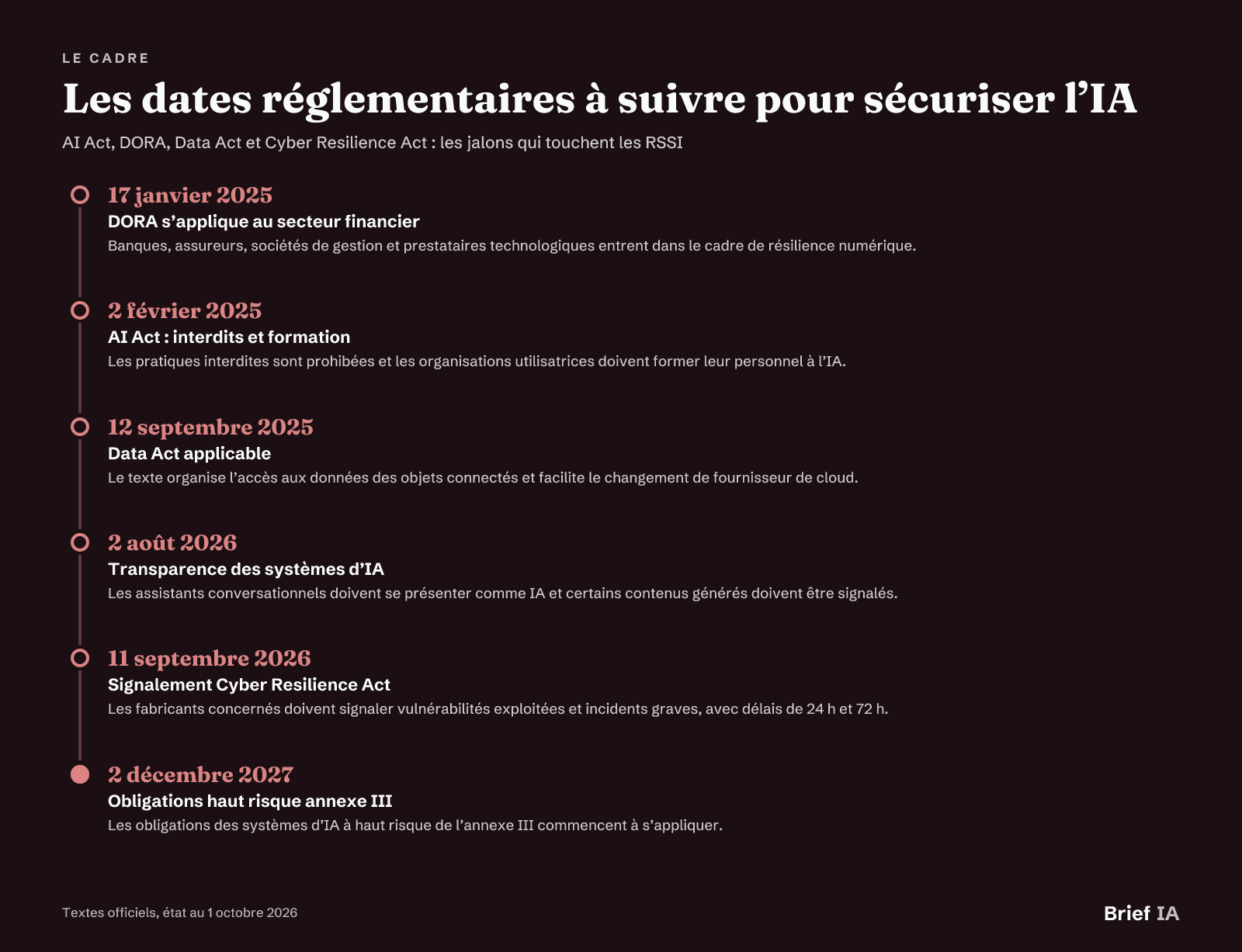 Regulatory dates to follow for securing AI
Key dates, status as of October 1, 2026.
AI Act: Training and Transparency
The AI Act came into effect on August 1, 2024, and applies in phases. Since February 2, 2025, prohibited practices are banned, and any organization using AI systems must ensure a sufficient level of AI mastery among its personnel. From August 2, 2026, transparency obligations apply: a conversational assistant must indicate that it is AI, and certain generated content must be labeled as such.
High Risk: Watch the Timeline
High-risk systems listed in Annex III include biometric identification, critical infrastructures, employment, access to certain essential services, policing, migration, justice, and democratic processes. Following the Digital Omnibus, their obligations will apply from December 2, 2027. AI tools without high-risk use, such as writing, summarization, accounting, cash flow forecasting, or fraud detection, are not considered high-risk systems; only general obligations apply to them.
Data, Employees, and Automated Decisions
The GDPR has been in effect since May 25, 2018. Its Article 22 regulates decisions based solely on automated processing that produce legal or significant effects on an individual. For internal detection, access control, or monitoring projects, this point must be addressed before going into production. The Labor Code also mandates informing and consulting the CSE when introducing new technologies in the company.
Digital Resilience and Suppliers
DORA has been applicable since January 17, 2025, to banks, insurers, and management companies, including technology providers. The Data Act has been applicable since September 12, 2025, facilitating cloud provider switching. Since September 11, 2026, the Cyber Resilience Act requires manufacturers of products containing digital elements to report actively exploited vulnerabilities and serious incidents, with alerts within 24 hours and notifications within 72 hours.
Pitfalls to Avoid
Granting Too Many Rights to Agents. An agent that reads, writes, and triggers business actions within the same perimeter becomes a single point of failure. Separate accounts, limit tokens, isolate environments, and prohibit sensitive actions without additional control.
Believing Functional Code. An output that compiles or satisfies a business test can still be vulnerable. Reported results on SWE-Agent with Claude 4 Sonnet show the possible gap between functional correction and security. Integrate review, testing, and dependency analysis.
Filtering Only After Generation. Placing security downstream of the model allows sensitive data to pass through in retrieval or context. Enterprise agent systems must start with a security assessment of the request before any document search or generation.
Confusing Alert with Proof. Internal risk tools signal atypical combinations, not intent. Treat alerts as hypotheses for investigation, with human validation, minimization of consulted data, and clear rules regarding employees.
Forgetting the State of Agents. Agents accumulate traces, drafts, tokens, and contextual data. Without retention duration, cleaning, and tool governance, the state becomes an attack surface and degrades operational control.
Taking Action: The 90-Day Plan
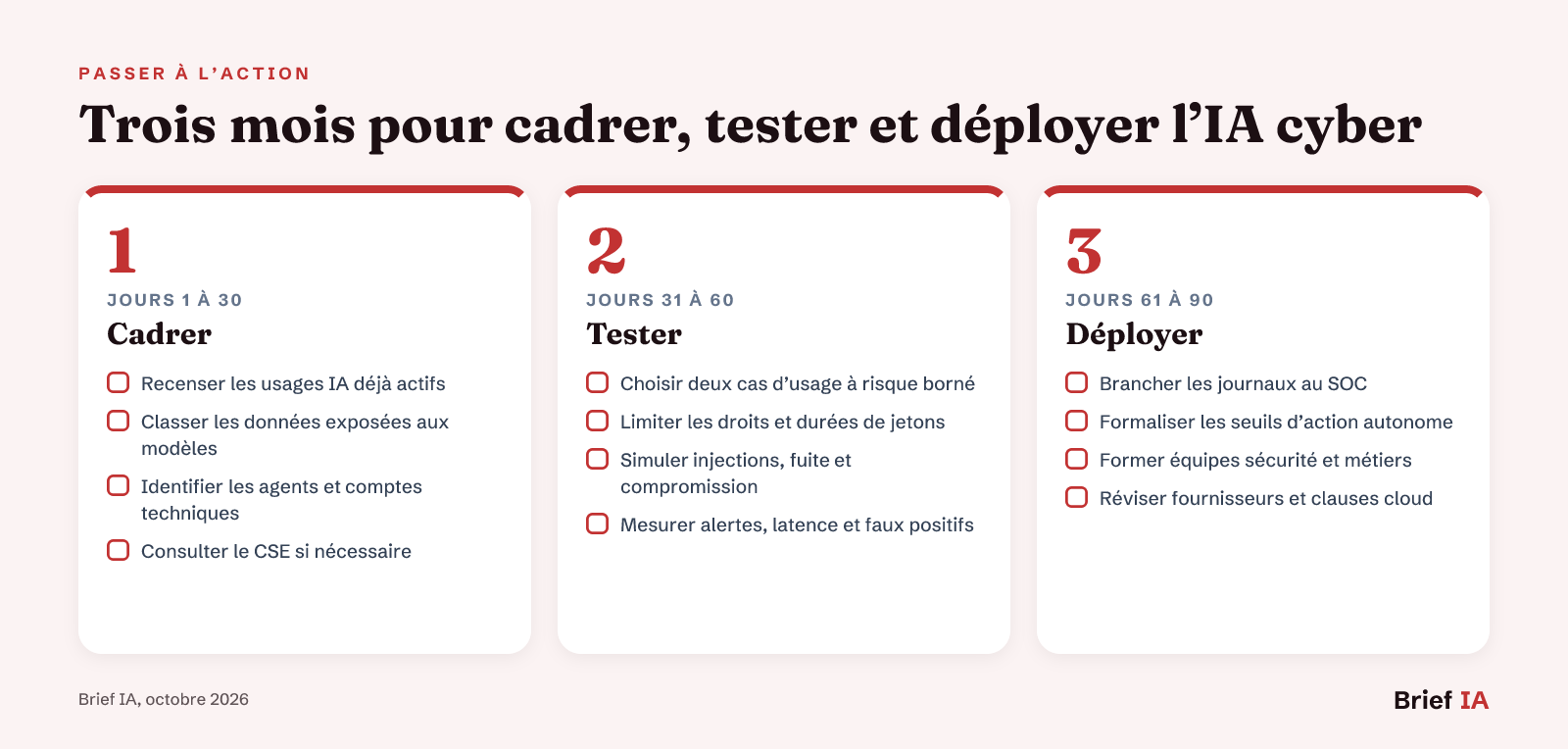 Three months to frame, test, and deploy AI in cybersecurity
Three steps: frame, test, deploy.
Start with assets where AI already touches sensitive data: internal assistants, coding tools, SOC, DLP, customer support, and business agents. Over three months, aim for a limited, measurable, and auditable perimeter. The first month frames the use cases, rights, and obligations. The second tests two use cases with controlled data. The third industrializes logging, security controls, and training for relevant users.
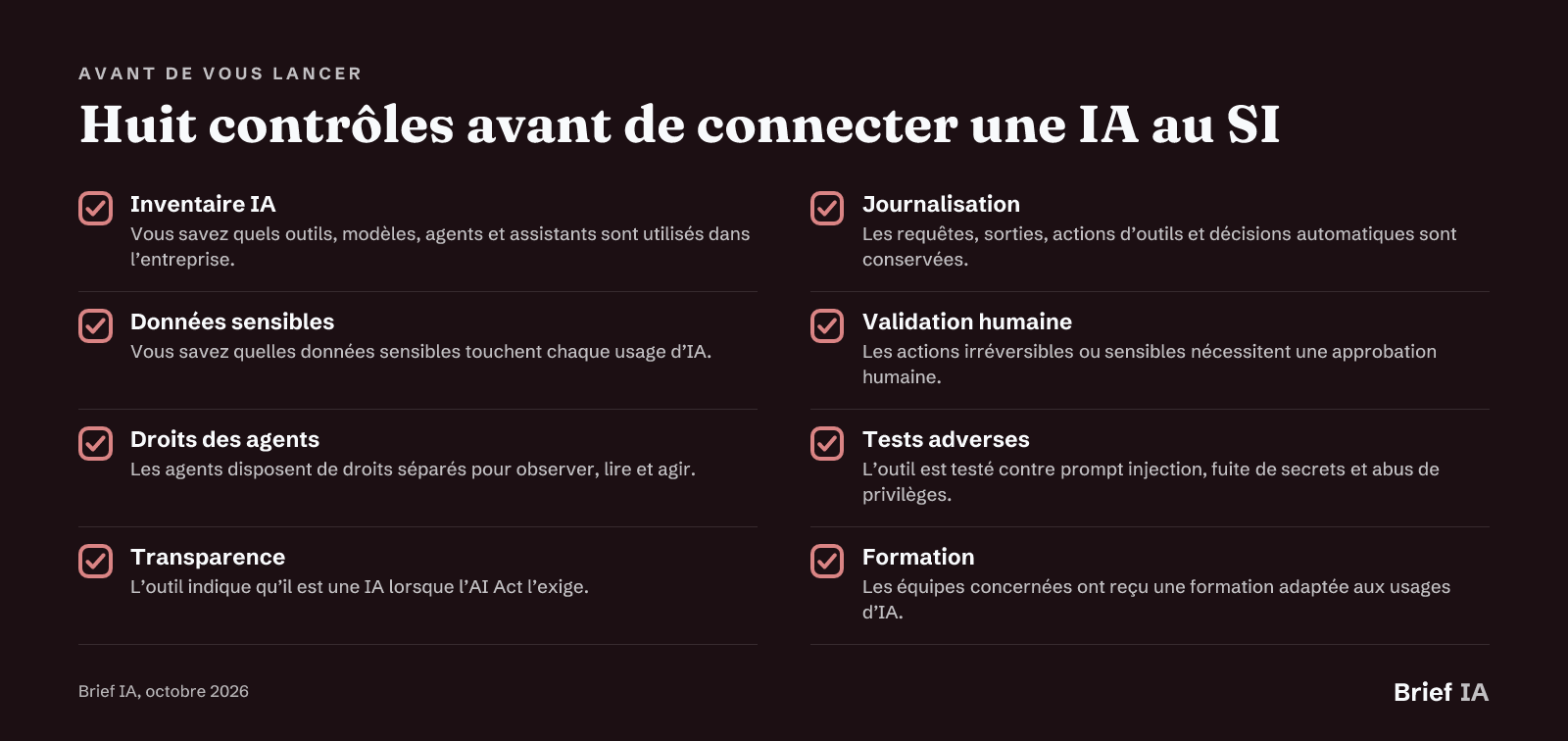 Eight checks before connecting AI to the information system
Eight verifications to perform before each new use.
To Go Further
Our analyses for security leaders
- Five AI innovations to watch for strengthening cybersecurity. Here you will see detection agents, guided remediation, AI posture, and LLM safeguards.
- Securing an AI project after the breach reported in Spain. The analysis details priorities: identity, permissions, monitoring, and detection in minutes.
- Five families of AI tools to protect data. Here you can compare DSPM, LLM safeguards, model protection, and operational noise reduction.
- Detecting internal threats with AI without overinterpreting. The guide explains UEBA, DLP, assisted investigations, and the limits of these behavioral signals.
- Why AI is changing the priorities of CISOs. You will find the new surface to protect: agents, memories, workflows, and machine identities.
- What unauthorized access to OpenAI says about AI security. The analysis shows how a classic flaw and an advanced model can combine in an attack.
Key News to Remember
- Anthropic deploys Claude Security on Mythos 5 to analyze code
- OpenAI aims for internal security alerts in 30 minutes
- Five uses of agentic AI in business and their risks
- Agentic systems place security at the top of the pipeline
- The Linux Foundation launches Akrites to secure open source
- Feedzai launches Farol, an AI agent for banking fraud investigations
Do you publish a solution for cybersecurity and AI governance?
This guide is read by CISOs, CIOs, SOC managers, compliance officers, and executives of companies exposed to cyber risk. Brief IA offers cybersecurity solution publishers, AI governance, data protection, and observability dedicated articles, evening brief inserts, and promotion in the directory. Formats and rates at briefia.fr/partenaires.
The Essentials in Questions
How to secure an AI agent connected to the information system?
Start by limiting what the agent can do. Separate observation, reading, and action, use short tokens, isolate testing and production, log tool actions, and prohibit sensitive operations without human validation. Prompt control is not enough if the agent has overly broad rights.
Does the AI Act already impose obligations for high-risk systems?
No. Following the Digital Omnibus, the obligations for high-risk systems listed in Annex III will apply from December 2, 2027. However, since February 2, 2025, prohibited practices are banned, and organizations using AI must ensure a sufficient level of AI mastery among their personnel.
Can AI be used to monitor employees in cybersecurity?
Yes, but with a strict framework. Internal risk tools produce signals, not proof. Emotion recognition in the workplace is prohibited by the AI Act, except for medical or security reasons. The GDPR regulates exclusively automated decisions that have significant effects, and the CSE must be informed and consulted when introducing new technologies.
Are AI code assistants safe for production?
They can accelerate certain tasks, but their outputs should be treated as unreviewed code. A reported outcome indicates that SWE-Agent with Claude 4 Sonnet produced 61% correct solutions but only 10.5% secure ones. Testing, human review, dependency analysis, and security policies remain necessary.
Which AI tools should be prioritized for a SOC?
Prioritize tools that enhance an existing chain: alert correlation, data posture, behavioral detection, code scanners, or LLM safeguards. Avoid starting with broad autonomy. The right criterion is not novelty but measurable reduction in detection time, noise, and risk of uncontrolled action.
Brief IA — L'actualité IA en français
L'essentiel de l'actualité de l'intelligence artificielle, décrypté et expliqué chaque jour.