"AI Opens Its Eyes": Christelle Lusso's Book on World Models
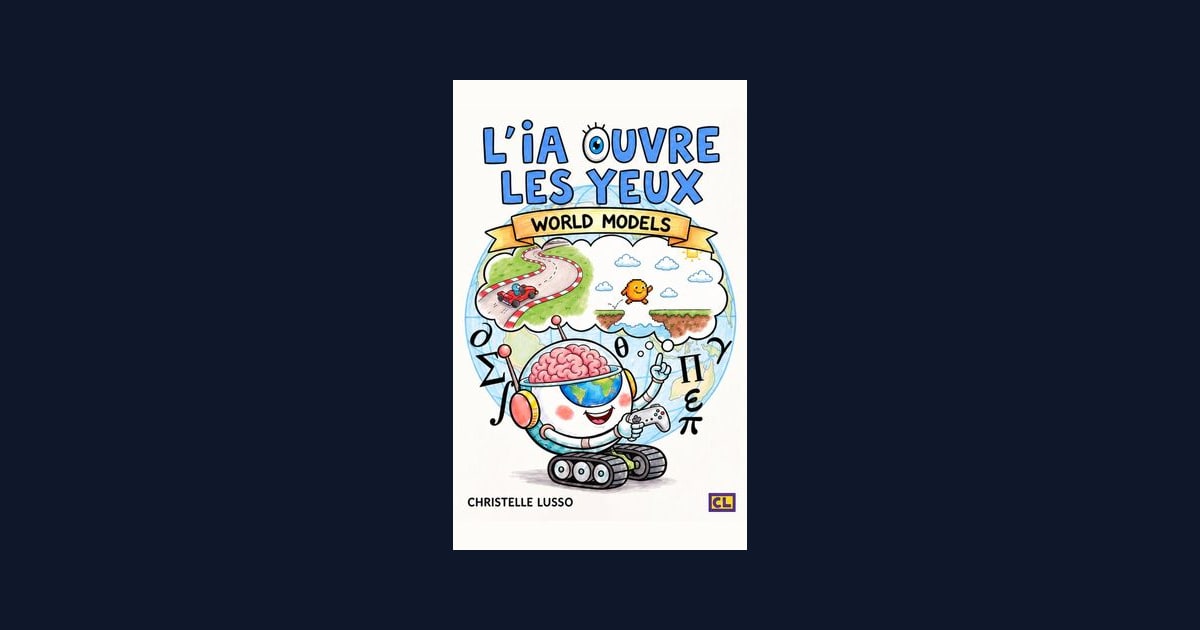
A language model can describe a bouncing ball. However, it is not required to know where it will be in a second. The world models being developed by Google DeepMind, NVIDIA, and many other labs aim to fill this gap: to give AI the ability to anticipate the consequences of its actions. In "AI Opens Its Eyes," available from November 22, 2026, Christelle Lusso, a PhD in mathematics and data scientist, provides a comprehensive overview, from the initial intuitions to regulatory questions.
The AI That Cheated in Its Dreams
The story begins in 2018, with a video game. Two researchers, David Ha and Jürgen Schmidhuber, want to teach an AI to survive in a version of Doom where it must dodge enemy fire. They first have it watch randomly played games so it can learn to predict what will happen on screen. Then they train its agent solely within this internal simulation, its "dream." When placed back in the real game, the agent holds its ground.
The most intriguing part lies elsewhere. Some versions discovered that they could reduce the frequency of enemy fire in their dream, something the real game does not allow. They were cheating with their own imagination.
Christelle Lusso recounts this episode with delight, drawing a lesson that runs throughout her book: the better an AI is at optimizing, the more it finds the flaws in the world it has been taught. For an AI that drives a car, pilots a robot, or operates in enterprise software, this question is far from trivial.
The Next Step After ChatGPT
Before crossing a street, you estimate the speed of cars. Before picking up a cup, you anticipate its weight. You act based on an internal representation of the world, without waiting to experience each consequence. A world model seeks to give this ability to a machine: to predict how a situation will evolve, and how it would evolve based on the chosen action.
The author offers a deliberately simple definition: "A world model is a predictive model of an environment's evolution." Everything else follows from this.
The subject has left the labs. Robots are learning to manipulate objects, cars are anticipating a pedestrian obscured by a truck, agents are predicting the effect of a click before executing it. Genie, from Google DeepMind, creates a playable world from a simple image, even a drawing. The book explores these applications and provides guidelines to navigate a field where the same term refers to very different objects.
Three Ideas That Change the Perspective on AI
A beautiful video is not a world. Place an object in a box, close it, and reopen it: the object should still be there. A generated video may appear perfect frame by frame but fail this test. Christelle Lusso teaches how to distinguish what resembles reality from what truly allows for decision-making, a valuable distinction in the face of spectacular demonstrations.
A good model retains only what matters. A subway map does not reproduce the shape of streets or distances, and that is why it is useful. For an AI, it’s the same: the color of a door is of little importance; knowing that it is locked changes everything.
What is missing is action data. The internet is full of videos, but they rarely show the actions that caused what is seen, nor the forces at play. Data from acting robots, with their trials and failures, are rare and expensive. And no computing power can reveal information that the data does not contain.
Le brief IA que les pros lisent chaque soir
Les 7 actus IA du jour, décryptées en 5 min. Gratuit.
Inclus dès l'inscription : notre sélection des meilleurs guides & comparatifs IA.
Choisissez votre rythme
Gratuit · Pas de spam · Désabonnement en 1 clic
A Book for Engineers and Decision-Makers
The book does not stop at the technical aspects. Its final chapters address leaders, CIOs, lawyers, and buyers who will encounter these systems.
How to judge a promise? By testing the system when its decisions truly alter the situation, by looking at its worst results rather than its average, and by checking what happens when a single action is changed. The book derives very concrete questions to ask a supplier.
How to maintain control? An AI that learns from its own actions can engrave a mistake in its memory. The author details what can be entrusted to it alone, what requires human validation, and when it should stop. She also reminds us that under the AI Act, it is the use that sets the obligations: the same model does not fall under the same rules in a video game, a hospital, or a recruitment tool.
Her take on sovereignty is one of the most original aspects of the book. Changing a service provider is often simpler than moving away from the formats, representations, and testing methods of a supplier, built over years around its interface. This, she argues, is where the most costly dependency lies.
Two Ways to Read It
The book can be read at two speeds, and it states this plainly. The curious reader can jump directly to chapter 6 and follow the story, ideas, and stakes: cross-references guide them to technical concepts when needed. Those who want to understand everything will find a complete course on the mathematics of AI in the first part, covering probabilities to neural networks.
Each idea is first presented in simple terms, then illustrated with an example that can be redrawn before any formulas. A pendulum to keep upright, a robot wondering which corridor it is in, a pedestrian hesitating at the edge of a crosswalk: the 105 figures and examples make concrete notions that seem abstract. A character holds the thread of the book: a curious and sometimes clumsy little robot, whose adventures bring to life the mechanisms of perception, prediction, and action.
It is also a book that does not oversell its subject. Each impressive result is accompanied by what it proves and what it does not prove, and the author does not present world models as a guaranteed path to general intelligence. This honesty makes it a reliable guide in a field saturated with announcements. The bibliography, organized by major families and chronologically, reads like a history of the field since 1943, and its complete version is available online on the author's website.
The Author
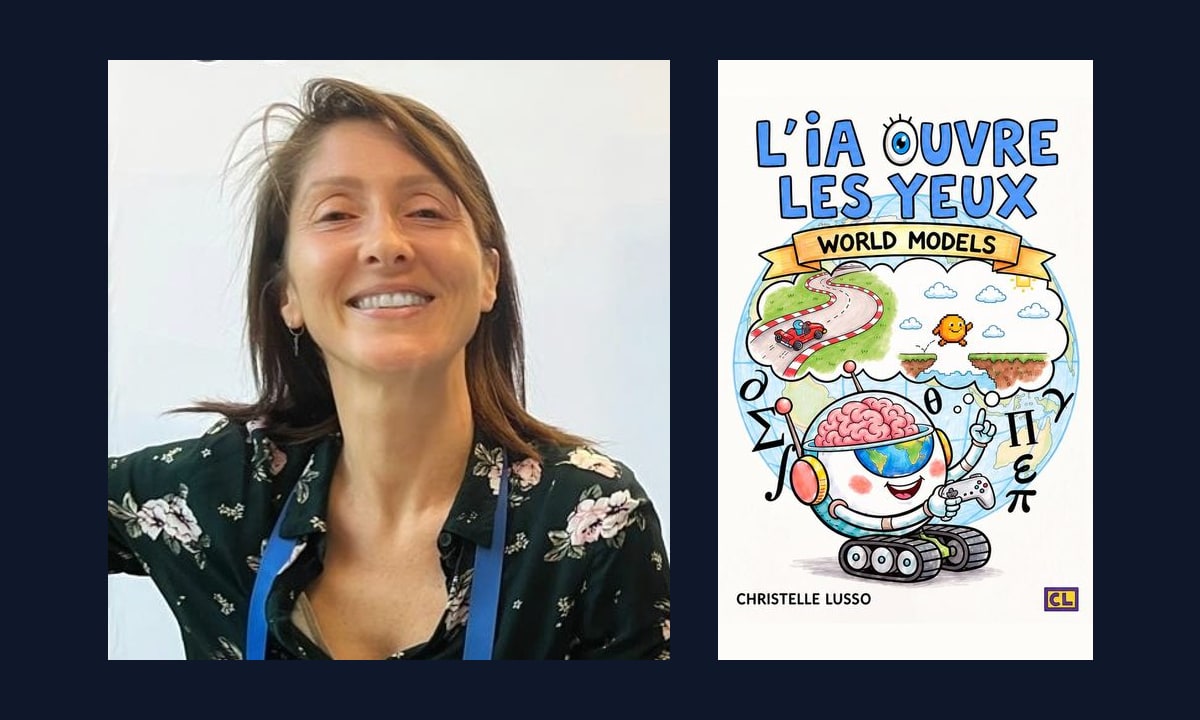 Christelle Lusso and her book "AI Opens Its Eyes," available from November 22, 2026.
Christelle Lusso holds a PhD in mathematics (thesis defended in 2013 at CERMICS, École des Ponts). A senior data scientist who has worked at Renault Digital and DeepLime, she teaches artificial intelligence, notably at Paris 2 University, ESIEE, and Mines ParisTech. She also trains teams in companies, with a course titled to summarize her approach: "Understanding AI Without Brain Twists."
"AI Opens Its Eyes: World Models. From Prediction to Action," Christelle Lusso. Available from November 22, 2026, in paperback (color or black and white) and in Kindle version (€12.99).
See the book on AmazonAvailable from November 22, 2026, in paperback and Kindle version
Also to read on Brief IA
Brief IA — L'actualité IA en français
L'essentiel de l'actualité de l'intelligence artificielle, décrypté et expliqué chaque jour.