Anthropic: The 7 Co-Founders and Their Challenges Ahead of the IPO
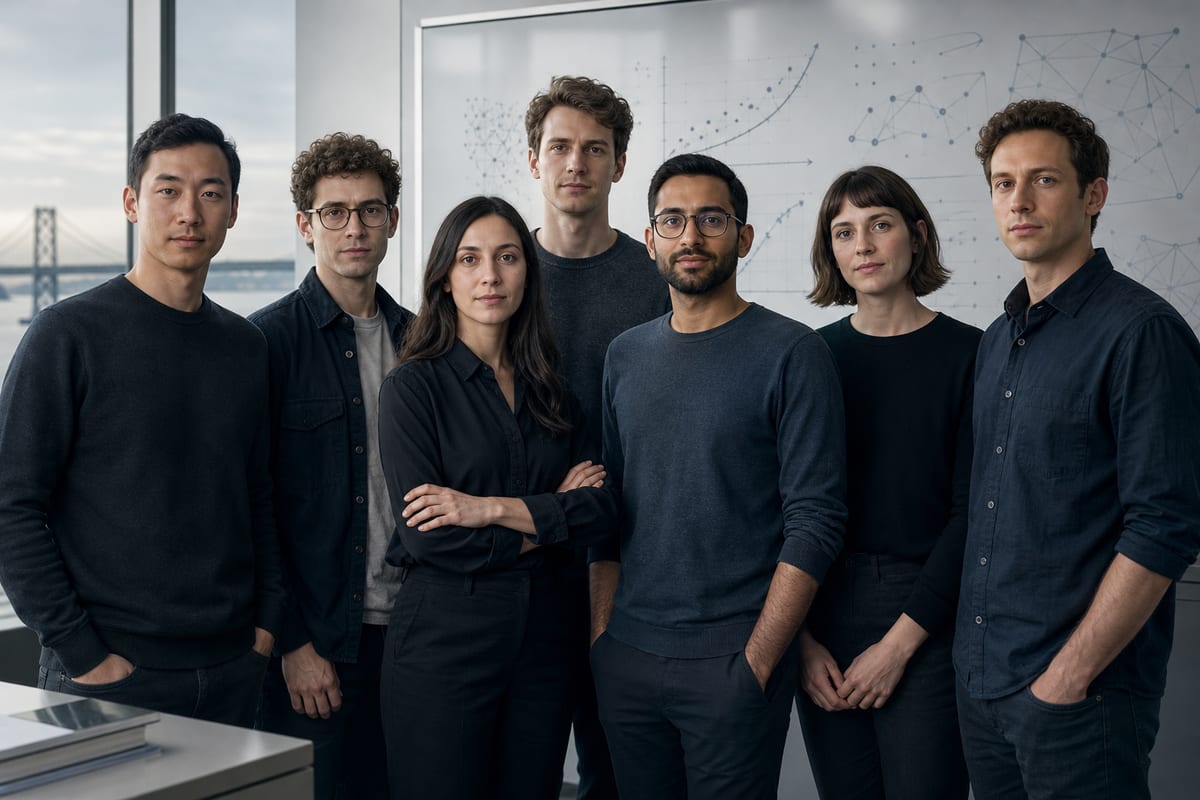
Seven former OpenAI members with complementary profiles are preparing to make their stock market debut with Anthropic. Their shares could be worth up to $17 to $18 billion each if the price range is met, and a cash envelope of $250 million is planned for each. All claim to have a focus on AI safety while expressing concerns about the rush to commercialization.
Risks Publicly Discussed by Kaplan, McCandlish, Olah, and Dario Amodei
Several co-founders have expressed their views on the risks associated with AI and their motivations. Jared Kaplan believes that allowing an AI to improve recursively would represent "the ultimate risk," estimating the possibility of such a decision between 2027 and 2030. Sam McCandlish states that none of the founders initially intended to create a company, but they acted out of duty. Chris Olah explains that he has long advocated for a nonprofit structure dedicated to safety research rather than a commercial company. Dario Amodei indicates that he turned to AI to tackle "almost intractable" and "slow" biology problems, criticizing the use of the term "impact" as a recruitment argument. The co-founders' areas of work cover interpretability, pre-training, and other core topics to monitor model behaviors and document their limitations.
What the IPO Would Change for Them: Cash, Share Price, and Valuation
Anthropic's IPO, scheduled for November 19, is shaping up to be one of the largest ever conducted. The seven co-founders are each set to receive $250 million in cash and could see the value of their stock portfolios exceed $18 billion if the price range is met. Together, they own nearly 10% of the capital, with nearly 240 million Class A shares per founder, equating to about 1.4% individual ownership. In the most recent funding round, the share price was set at $58.90, already amounting to about $14 billion for each co-founder. The targeted range of $70 to $78 per share corresponds to a market valuation close to $1.4 trillion, which would raise the individual value of their holdings to about $17 to $18 billion. Anthropic did not respond to requests for comment on these matters.
Key Technical Skills: RLHF, Scaling Laws, Pre-training, and Interpretability
The co-founders of Anthropic have contributed to several major technical advancements. Dario Amodei and Tom Brown are credited with co-inventing RLHF, a tuning method aimed at aligning model outputs with human expectations, such as politeness or avoiding dangerous responses. Tom Brown also led the training of GPT-3, which marked a scaling leap from 1.5 billion to 175 billion parameters compared to GPT-2. Jared Kaplan co-pioneered the scaling laws of models with Dario Amodei and helped formalize "constitutional AI," which relies on principles and safety policies for alignment. Current projects include pre-training on very large corpora and interpretability, which aims to understand what inputs and reasoning methods a model uses to produce its outputs. Sam McCandlish also led early research on Codex, which now represents a significant portion of OpenAI's revenue.
Le brief IA que les pros lisent chaque soir
Les 7 actus IA du jour, décryptées en 5 min. Gratuit.
Inclus dès l'inscription : notre sélection des meilleurs guides & comparatifs IA.
Choisissez votre rythme
Gratuit · Pas de spam · Désabonnement en 1 clic
Roles and Governance: CEO, Chair, Internal Think Tank, and Functions
Dario Amodei, 43, leads the company and holds 245,259,100 shares, including shares subject to voting proxies. Daniela Amodei, 39, serves as chair and chair of the board. Jack Clark is responsible for public benefits and leads the Anthropic Institute, an internal think tank dedicated to the social and economic dimensions of AI. These assignments structure the company's approach to safety, public utility, and scientific strategy.
Founders' Backgrounds: From Princeton to Baidu, MIT, Johns Hopkins, and Journalism
The profiles of the seven founders span research, engineering, and public policy. Dario Amodei earned a PhD in computational neuroscience from Princeton in 2011, completed a postdoc at Stanford until 2014, then led speech recognition research at Baidu in China before a stint at Google Brain, and joined OpenAI in 2016. Tom Brown, a 2010 MIT graduate, founded MoPub and Grouper, experienced MoPub's acquisition by Twitter, and then self-taught in machine learning research. Jared Kaplan, Chief Scientist and Associate Professor at Johns Hopkins, holds a PhD in physics (Harvard, 2009) and was a former postdoc at SLAC. Sam McCandlish, who earned a PhD in theoretical and mathematical physics (Stanford, 2017), worked at Boston University; his academic work focused on quantum gravity and tensor networks. Chris Olah, 34, left the University of Toronto after a year and worked at Environment Canada and then Xelerance. Several transitioned through OpenAI into key roles: Tom Brown managed the training of GPT-3; Jack Clark left journalism for AI policy; Jared Kaplan worked there as a consultant; Sam McCandlish and Chris Olah were technical staff members. Jack Clark, a former journalist in the UK, studied literature and creative writing, wrote for various media, and explains that he joined OpenAI out of personal conviction. Regarding governance and origins, Dario and Daniela Amodei, raised in the Mission district of San Francisco and having attended Lowell High School, have local ties close to the current headquarters. Daniela graduated from UC Santa Cruz in 2009, worked for Democratic Representative Matt Cartwright, and then spent five years in risk management at Stripe; she notes that her campaign experience naturally led her to startups.
Why They Left OpenAI and Launched Anthropic
The collective departure at the end of 2020 stemmed from disagreements over safety and commercial trajectory. Dario and Daniela Amodei, then vice presidents at OpenAI, were dissatisfied with their employer's safety approach and feared that model capabilities were advancing faster than their understanding. Early the following year, they founded Anthropic and brought along Tom Brown, Jack Clark, Jared Kaplan, as well as Sam McCandlish and Chris Olah. The founders were concerned about OpenAI's commercialization ambitions. Jeffrey Ladish asserts that they did not create Anthropic to get rich but to shape a field deemed crucial, while also acknowledging the weight of financial incentives. The co-founders are also presented as early beneficiaries of the rise of AI.
Brief IA — L'actualité IA en français
L'essentiel de l'actualité de l'intelligence artificielle, décrypté et expliqué chaque jour.