Avatarin and GPT-Realtime Revolutionize Japanese Retail
Le brief IA que les pros lisent chaque soir
Les 7 actus IA du jour, décryptées en 5 min. Gratuit.
Inclus dès l'inscription : notre sélection des meilleurs guides & comparatifs IA.
Choisis ton rythme
Gratuit · Pas de spam · Désabonnement en 1 clic
avatarin and Yamada Holdings: A Collaboration for Retail
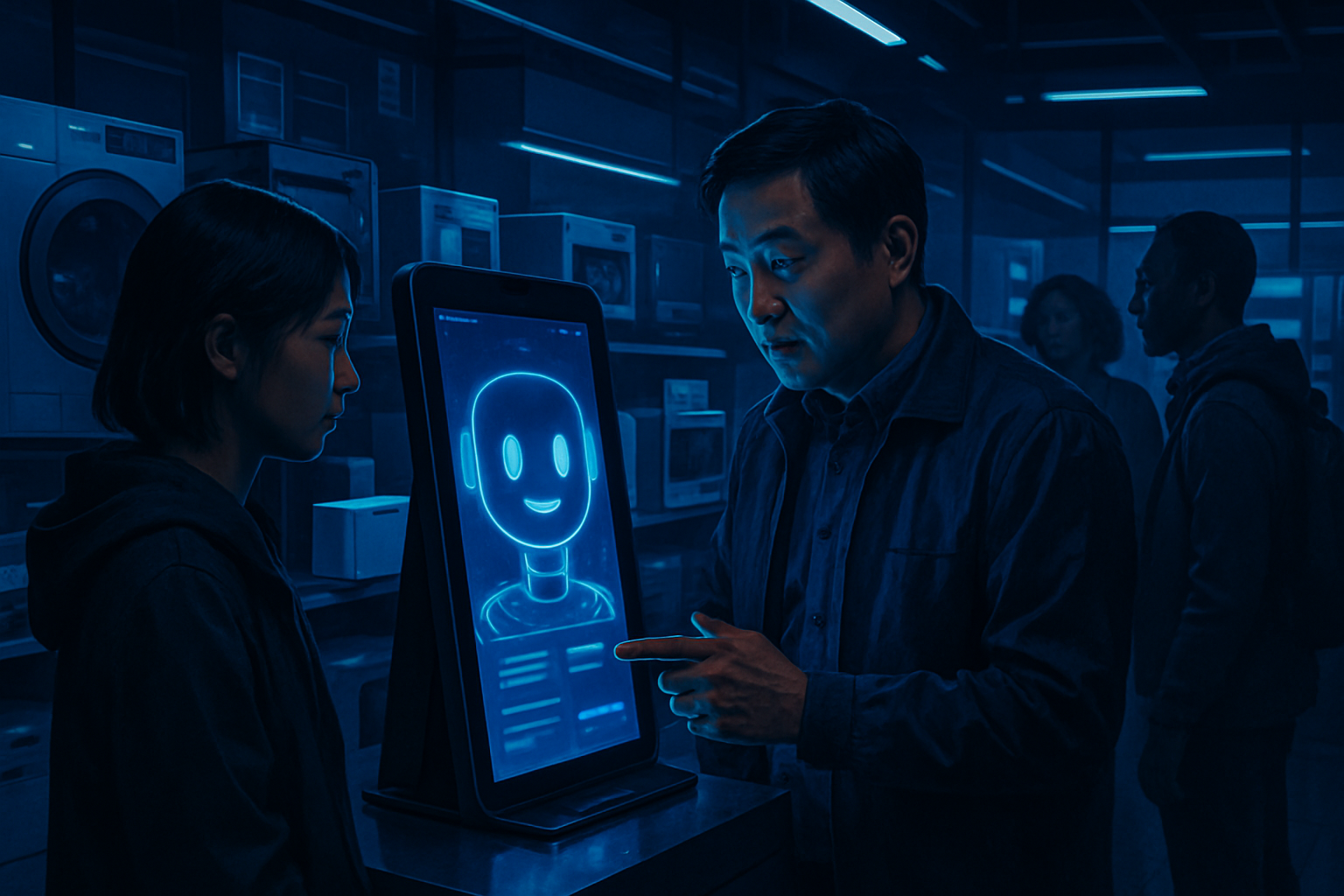
Retailers of household appliances in Japan are facing a significant challenge: how to provide expert support for sales beyond traditional business hours while managing a limited staff. To address this need, avatarin, a company specializing in artificial intelligence and part of ANA Holdings, has partnered with Yamada Holdings. Together, they have transformed the expertise of experienced salespeople into a multilingual shopping agent, available 24/7.
This agent, based on the GPT-Realtime technology developed by OpenAI, enables natural voice conversations. It guides customers from product discovery to purchase decision. During a two-week campaign on Yamada Denki's online site, the agent was used by approximately 30,000 people, with 92% positive responses in satisfaction surveys.
“This is not simply an extension of a classic chatbot. It’s an attempt to redefine what customer service can be through AI. We see this as the beginning of an ‘interface revolution’ in retail.” — Akira Fukabori, CEO, avatarin
A Deep Understanding of Customer Needs
Before collaborating with Yamada Denki, avatarin had already worked with OpenAI, utilizing its API for voice recognition, request analysis, and employee training. These experiences allowed the team to better understand how to apply AI practically. The project with Yamada Denki was their first major opportunity to apply these lessons directly to customer service.
For Akira Fukabori, one of the main strengths of GPT-Realtime is its ability to integrate voice, text, and visual understanding into a unique conversational experience.
- “The performance of a single model has surpassed what we had seen with specialized voice recognition systems. It operates across speech, text, and images with low latency. That’s why we chose GPT-Realtime. Rather than imposing rules on users, the technology naturally adapts to their way of communicating.”
Unlike traditional chatbots that wait for specific keywords, avatarin's agent is attentive to context. It can respond to buyers' uncertainties, changing preferences, and details that transform a generic response into a personalized recommendation.
Fukabori illustrates this difference with an example from everyday shopping.
- “Customers don’t want just a simple chatbot. They seek intelligence. ‘I need a refrigerator for a family of four, but my kitchen is small. Which one should I choose?’ True customer service means being able to answer that question.”
Sales Expertise at Your Fingertips
avatarin designed the agent around three essential qualities:
-
Maintain product information accuracy without slowing down the conversation. An augmented generation system anchors the agent's responses in product information, while GPT-Realtime ensures a smooth interaction. This allows buyers to benefit from a dynamic voice conversation while receiving information based on relevant product data.
-
Translate Yamada Denki's sales expertise into conversation design. The information a salesperson needs to gather varies by product category. avatarin integrated Yamada Denki's customer service knowledge into the agent's conversation flows and prompts. The system is designed to adapt when customers change their requirements or temporarily stray from the topic, while keeping the conversation focused on the shopping experience.
-
Design an agent that asks questions rather than simply responding. Many traditional chatbots wait for the customer to provide the next instruction. avatarin took a proactive approach. The agent asks follow-up questions to uncover the customer's true needs, transforming the conversation from a simple Q&A exchange into a guided product discovery.
OpenAI collaborated with avatarin to structure complex prompts, optimize API costs for a constantly active voice service, and share best implementation practices. This support allowed avatarin to focus on translating Yamada Denki's service model into an accurate, responsive, and brand-aligned experience.
“I am excited about how it understands our intentions so naturally,” says Fukabori, “and about the insights of intelligence that sometimes exceed what humans can do.”
A Conversation Rich in Insights
The public campaign quickly demonstrated the agent's impact in just two weeks:
- Approximately 30,000 users
- Multilingual support 24/7 via voice and text
- 92% positive responses to surveys
The most significant discovery was not just the scale of usage. Each conversation revealed what concerned buyers, why they hesitated, and what could help them make a decision. “With traditional online retail, these insights were hard to obtain,” explains Fukabori. “With an AI agent, they become an integral part of the conversation.”
The service also opened new opportunities for retail. Customers could ask questions after store hours and freely express their budget concerns or uncertainties without feeling sales pressure.
Each interaction ended with a short voice survey, making feedback a natural continuation of the shopping experience. Customers described the agent as “easier to approach than a real salesperson” and appreciated the ability to ask questions without stress.
For avatarin, the stakes go beyond mere sales. A better conversation can also reveal how to improve service, marketing, and the next customer experience.
One Intelligence. One Brand. Every Interface.
avatarin envisions a future where a single AI agent serves customers seamlessly across the web, by phone, and in physical stores. Instead of separate systems for each channel, the same intelligence retains the customer context. The result is continuity: one customer, one conversation, and one brand, regardless of where the interaction takes place.
For Yamada Holdings, whose operations span household appliances, housing, financial services, and more, this vision could make AI a trusted companion in daily life. The ambition is not just to connect channels but to create an AI that embodies the brand and the spirit of hospitality of the company.
OpenAI's technology is helping to accelerate this vision. “AI has clearly shifted into a higher gear,” says Fukabori. “I look forward to seeing what we can build with this extraordinary intelligence.”
However, avatarin does not want every company to have the same voice. “We want people to experience an intelligence that embodies the identity and brand of each company across every interface. That’s what we mean by ‘One Intelligence. One Brand. Every Interface.’ The era of single-purpose AI is over. I believe OpenAI will lead the next era of general-purpose multimodal intelligence.”
Brief IA — L'actualité IA en français
L'essentiel de l'actualité de l'intelligence artificielle, décrypté et expliqué chaque jour.