Bedrock: Three Autonomous Excavators Tested on Construction Sites
Le brief IA que les pros lisent chaque soir
Les 7 actus IA du jour, décryptées en 5 min. Gratuit.
Inclus dès l'inscription : notre sélection des meilleurs guides & comparatifs IA.
Choisis ton rythme
Gratuit · Pas de spam · Désabonnement en 1 clic
Autonomous excavators from Bedrock are operating without operators at three commercial sites in Texas and Nevada. Experts believe that adoption is contingent on proven gains and the systems' ability to adapt to highly changing job sites. Founded in 2024 and valued at $1.75 billion, the company, led by former Waymo employees, aims to extend its AI to other machinery, facing rivals that are already active, such as Caterpillar.
Kamat: Convincing Contractors and Proving ROI
According to Vineet Kamat, gaining the support of contractors will depend on providing quantified proof of return on investment, especially as margins are tight and contracts are awarded through competitive bidding. He believes that an investment of several hundred thousand dollars in robotic equipment will only occur if the return is certain, adding that once the value is proven, enthusiasm will follow.
Job sites are less predictable than industrial environments, with terrain, teams, and tasks evolving day by day. Researchers estimate that fully autonomous sites remain a distant goal, and Kevin Peterson expects that humans will still be present in the short term. Kamat speaks of a limited test, and Bedrock's technology is still at the beginning of its trajectory. For Fernanda Leite, the robot is currently measured against a highly skilled and versatile human, and job sites will resemble airports in the short term, where automated systems and professionals collaborate.
In Texas and Nevada, Three Operatorless Excavators Dig
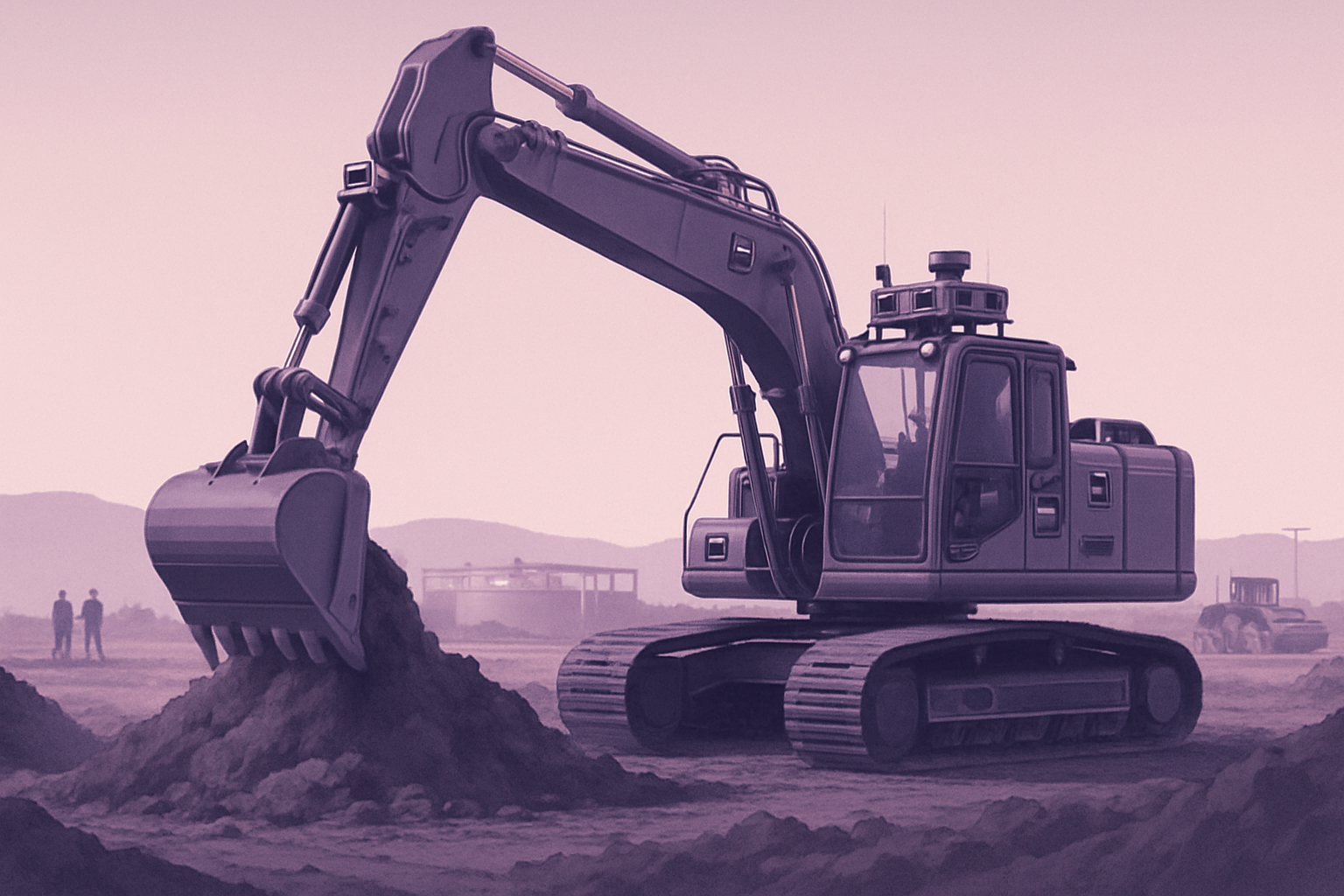
The company Bedrock, based in San Francisco, announced on Monday that excavators equipped with its autonomous technology are operating without human intervention. These vehicles are present at three commercial job sites located in Texas and Nevada.
These machines dig and move earth, particularly as part of a project that includes a water treatment facility. The company has begun deploying its autonomous excavators at three job sites.
Embedded Sensors and Targeted Transfer to Bulldozers and Trucks
Bedrock equips its excavators with sensors and embedded computers to perceive the environment, plan movements, and execute tasks defined by a site manager. Current autonomous construction systems target narrow and repetitive tasks.
The next announced step is to transfer this same system to other machinery, including bulldozers, dump trucks, and loaders. Kevin Peterson acknowledges open questions regarding this transferability, while considering the goal achievable but difficult. He compares the targeted expansion trajectory to that of the early years of Waymo, an analogy he claims as a co-founder and CTO.
Bedrock bets that these lessons will enable a more adaptable AI, covering multiple types of equipment and coordinating entire fleets. Kevin Peterson envisions that eventually humanoids will take on more tasks if the technology matures, while Boris Sofman, co-founder and CEO, asserts that the physical economy represents the next great frontier for machine learning, drawing from nearly five years spent at Waymo in highway and trucking applications.
Valued at $1.75 Billion, Bedrock Faces Caterpillar and Built
Founded in 2024 and estimated at $1.75 billion, Bedrock aims to make construction autonomous and shorten timelines for housing, data centers, and infrastructure. The company faces competition ranging from startups to large corporations: Built Robotics is already using autonomous vehicles for solar and data center projects, including at Meta's Hyperion center in Louisiana; Caterpillar has announced over 800 autonomous trucks; AIM Intelligent Machines is transforming equipment for applications in construction, mining, and defense.
The sector is grappling with a labor shortage, a high number of fatal accidents, frequent delays, and more than 40% of workers could retire by 2031 according to the NCCER. Bedrock must demonstrate that its AI works beyond excavators and generates tangible savings for companies with thin margins, a set of challenges that the company acknowledges it must overcome.
Brief IA — L'actualité IA en français
L'essentiel de l'actualité de l'intelligence artificielle, décrypté et expliqué chaque jour.