Big Math: AI and Redistricting Shake Up Mathematics
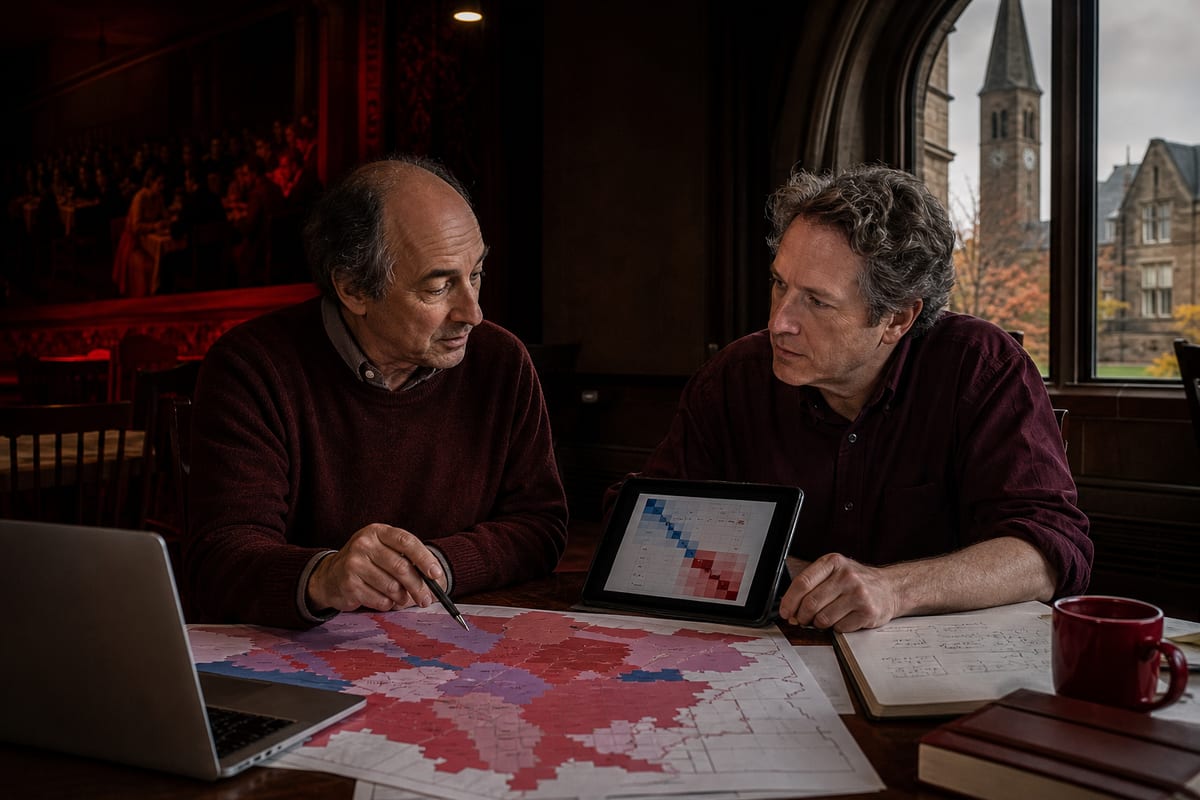
Two applied mathematicians, Steven Strogatz and Alex Townsend, have published Big Math, a book arguing that AI and massive computation are shifting the center of gravity in mathematics. Their demonstration is illustrated through a very concrete case: gerrymandering, while the Supreme Court has issued opposing rulings depending on the cases.
The Supreme Court Validates Partisan Gerrymandering, Despite Statistical Methods
A Supreme Court decision asserts that partisan gerrymandering can be practiced without violating the Voting Rights Act. In another voting rights case in Alabama, however, John Roberts voted with the plaintiffs, who cited harm suffered by Black voters due to a state map. Alabama argued that no reasonable map allowed for two majority-Black districts, while Moon Duchin demonstrated that it was possible to generate thousands. The high court examined numerous cases on the subject, remaining hesitant about the use of mathematical tools. John Roberts notably dismissed the efficiency gap as a legal criterion. The principle of equal weight of votes remains established, but its mathematical operationalization is contested.
A Book to Explain the Rise of "Big Math"
Big Math: The Hidden Codes That Run Our World, authored by Steven Strogatz and Alex Townsend, reveals how AI and large-scale computation are disrupting the practice of mathematics. According to some authors, the discipline faces its greatest challenge in the age of AI regarding the role of human reasoning, and it is necessary for knowledge to serve a broader purpose. They emphasize that large language models and chatbots, joined by the anticipated quantum computing, contribute to developments that surpass their creators. This dynamic extends an ancient movement, made possible by increasing computational power, as decisive aspects of modern life already rely on machine-operated mathematics.
Authors' Background and Collaboration
Steven Strogatz co-authored a foundational paper on small-world networks with Duncan Watts in 1998 and has worked on chaos theory, the geometry of supercoiled DNA, and biological oscillators such as fireflies and crickets. He applied the study of synchrony to the crowds on the Millennium Bridge in 2005. A seasoned communicator, he has written columns for The New York Times in 2010, 2012, and 2025 and hosted a podcast for Quanta in 2020-2021. He has published Sync (2003), The Calculus of Friendship (2009), The Joy of X (2012), and Infinite Powers (2019), the latter being a New York Times bestseller. Alex Townsend, recruited at Cornell and specializing in numerical analysis and deep learning, was mentored by Strogatz. Their collaboration began over regular lunches at Risley Hall, initially with the idea of a book stemming from a course on the 20 best algorithms of the 20th century, before evolving into a work on large matrix computations and then Big Math. Strogatz criticizes the abundance of pure mathematics books that ignore computers and, alongside Townsend, advocates for the importance of very high-dimensional problems, referencing the outsourcing of calculations since the abacus and fangcheng, an idea about 2000 years old. He notes that the book was finalized before the recent Supreme Court decision that was less favorable to mathematical approaches to gerrymandering.
Le brief IA que les pros lisent chaque soir
Les 7 actus IA du jour, décryptées en 5 min. Gratuit.
Inclus dès l'inscription : notre sélection des meilleurs guides & comparatifs IA.
Choisissez votre rythme
Gratuit · Pas de spam · Désabonnement en 1 clic
Gerrymandering as a Testing Ground for Map Generation Methods
Gerrymandering illustrates the use of massive calculations subject to multiple constraints. The criteria cited by law include compactness, contiguity, respect for natural boundaries, and approximate equality of population between districts. Numerous maps can satisfy these criteria, opening the door to exploiting past voting data to advantage the ruling party. Moon Duchin and her colleagues presented a procedure for randomly generating a large set of maps that comply with the law to create an experimental baseline. A considered map can then be compared to this sample to quantify how often a similar outcome would occur without targeted intent. An extreme position in this distribution indicates an atypical map, without establishing malicious intent.
From Servant to Pathfinder: The Changing Role of Computers in Mathematics
Strogatz describes a historical shift in the role of computers, initially simple accelerators of calculations, comparable to scientific instruments. With the electronic computers of the 1950s, stemming from the invention of the transistor, computational power led to today’s supercomputers. A major philosophical turning point occurred around the same time: the computer became a pathfinder of unknown mathematical territories. The work of Enrico Fermi, Pasta, Ulam, and Tsingou on a numerical experiment provides an example, with Mary Tsingou having performed the calculations. Unlike uses aimed at an expected value, this exploration did not presuppose the answer, marking the entry of simulations as a tool for discovery.
Brief IA — L'actualité IA en français
L'essentiel de l'actualité de l'intelligence artificielle, décrypté et expliqué chaque jour.