Cate Blanchett Challenges AI in Brussels with a Consent Register
Le brief IA que les pros lisent chaque soir
Les 7 actus IA du jour, décryptées en 5 min. Gratuit.
Inclus dès l'inscription : notre sélection des meilleurs guides & comparatifs IA.
Choisis ton rythme
Gratuit · Pas de spam · Désabonnement en 1 clic
Cate Blanchett and the Fight Against AI in Brussels
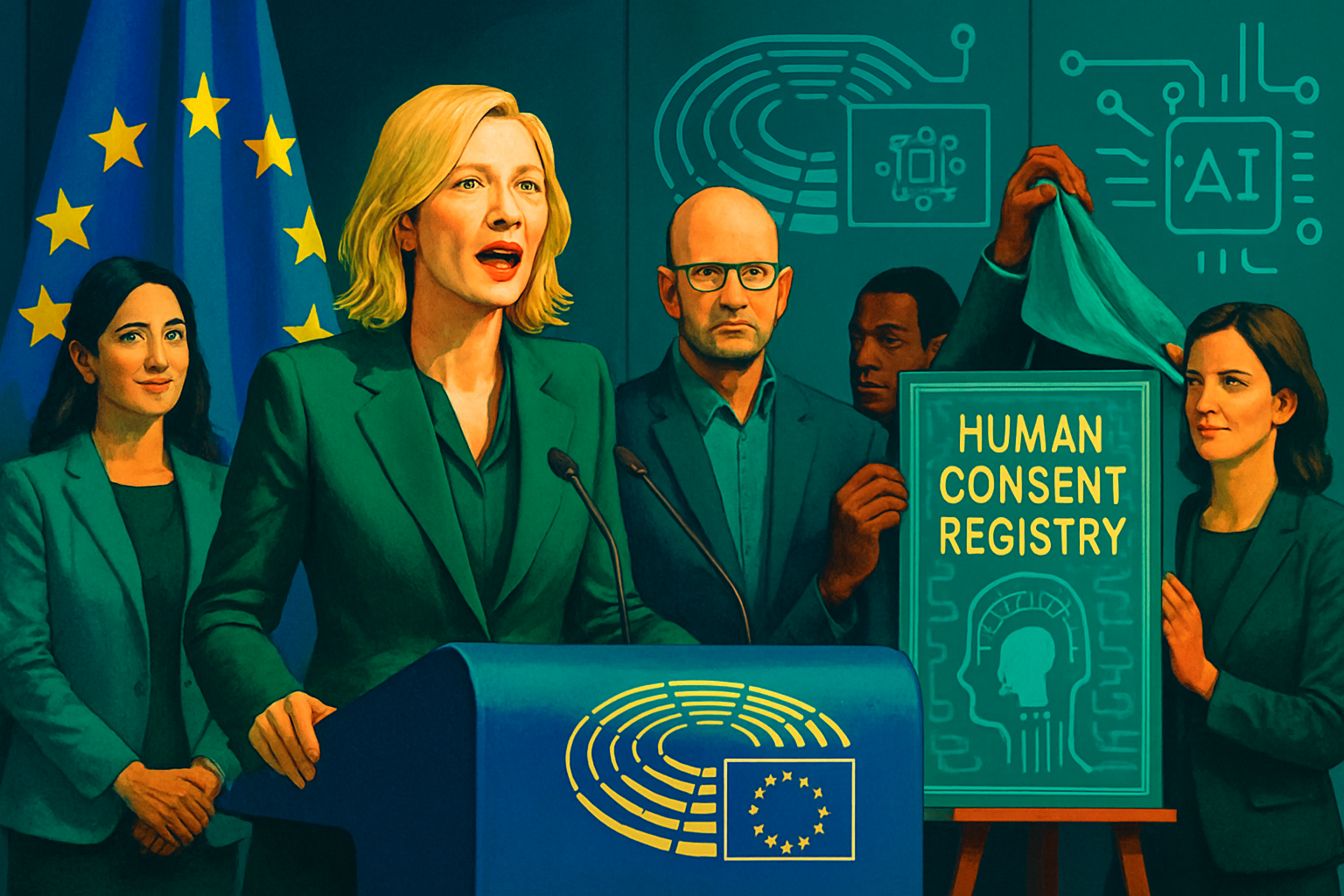
Artificial intelligence, with its ability to replicate personal elements such as a person's voice, face, or even gait, presents unprecedented challenges regarding image rights. These technologies, often fueled by public data, operate without obtaining prior consent from the individuals involved. In light of this reality, Cate Blanchett, along with her allies, has taken the initiative to launch a consent registry in the European Parliament, hoping to change the game.
Since the summer of 2023, the strikes by Hollywood writers and actors, represented by the WGA and SAG-AFTRA, have highlighted the importance of generative AI in union negotiations. However, no definitive solution has yet been found to protect image rights against training models. These models can recreate a voice from just a few seconds of public recording or a face from a few photos, without the majority of the individuals ever having given their consent.
The Consent Registry: An Initiative by RSL Media
RSL Media, a nonprofit organization co-founded by Cate Blanchett, Eckart Walther, co-creator of the RSS standard, and Doug Leeds, former CEO of Ask.com, launched a free consent registry called the "Human Consent Registry" on June 23, 2026. This registry is accessible both in the United States and within the European Union.
The registry is based on the open RSL (Really Simple Licensing) standard, developed since September 2025. This universal technical format allows individuals to express their consent in a machine-readable manner. Users can associate encoded signals in structured metadata with their identity, indicating their level of consent.
Three colors are used to indicate the level of consent:
- Red for a total prohibition.
- Yellow for conditional permission.
- Green for unrestricted consent.
AI companies are expected to consult this registry before using a person's attributes to train their models. Access to the registry is free via the website rslmedia.org, and it is open to everyone, not just celebrities, which distinguishes it from similar initiatives that often focus on the entertainment industry.
A Symbolic Launch in Brussels
The launch of the registry took place at the European Parliament in Brussels, under the auspices of Bulgarian MEP Eva Maydell, a key figure in the negotiations of the AI Act. Filmmaker Steven Soderbergh is among the supporters of this project. The choice of Brussels for this launch, rather than Washington, underscores Europe's lead in AI legislation.
In France, shortly before the launch of the registry, around 150 cultural figures, including Annie Ernaux, Hervé Le Tellier, and Enki Bilal, called for a boycott of generative AI tools to protest against the non-consensual use of their works. The registry proposed by Cate Blanchett offers a less radical alternative than a boycott: it aims to formalize consent rather than reject it outright.
Existing Protections in Europe
For a European citizen, registering with the RSL adds to an already robust regulatory framework, unlike their American counterparts. The AI Act, the world's first legal framework dedicated to AI, has required since August 2, 2025, that AI model providers respect the opt-out expressed by rights holders through machine-readable processes.
The European copyright directive of 2019 provides a right to object to text-and-data mining, allowing creators to prohibit the use of their works for AI training, provided that this is expressed appropriately. Additionally, the GDPR requires explicit consent for the processing of biometric data, with penalties of up to 4% of global revenue or €20 million.
What RSL Media brings new is a standardized format that these texts have not provided. The opt-out from the European directive has existed since 2019, but few have exercised it due to the lack of a universal technical format. The RSL standard functions similarly to the robots.txt file, which search engines consult before indexing a site.
The Limitations of a Voluntary Registry
The "Human Consent Registry" has no enforcement mechanism, and RSL Media hopes that AI companies will consult the registry voluntarily. As Gizmodo points out, there is currently "no method to compel AI companies to comply with this."
Consulting a consent registry before exploiting data assumes a voluntary approach from giants like Meta, OpenAI, or Google, whose large-scale training models on public data have not awaited this type of authorization.
The AI Act, on the other hand, imposes constraints and penalties, with fines of up to 3% of global revenue for failures to meet transparency obligations regarding training data. This framework is already under review to strengthen certain aspects.
RSL Media is addressing a real legal gap: the image rights of individuals, distinct from copyright over their works, which neither the AI Act nor the GDPR directly and universally cover. This is a gap that the registry highlights with precision.
The question remains open: can a voluntary infrastructure create enough pressure for companies to adopt it before binding legislation compels them to do so? As long as a major platform does not integrate RSL into its training processes, Cate Blanchett's registry will remain a testament to an existing problem, without yet being the definitive solution.
Brief IA — L'actualité IA en français
L'essentiel de l'actualité de l'intelligence artificielle, décrypté et expliqué chaque jour.