ChatGPT and Codex Accelerate the Search for New Antimicrobials
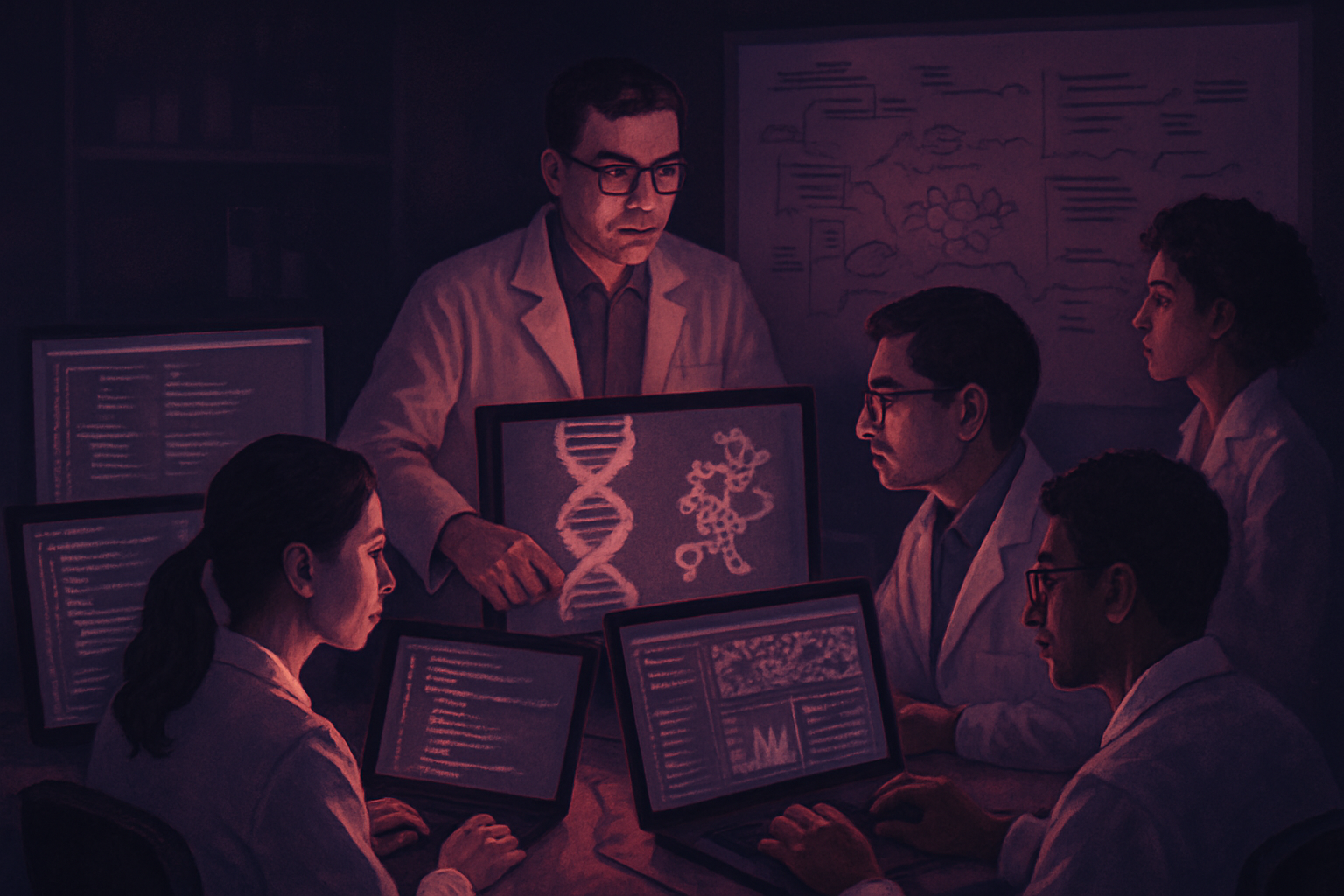
César de la Fuente's laboratory relies on its own deep learning models and tools like ChatGPT and Codex to explore the genomes of living and extinct organisms in search of active molecules. This approach aims to reduce the candidate preselection time without replacing the necessary experimental validations and regulatory steps. In 2021, five million deaths were associated with bacterial resistance, a figure that could nearly double by 2050. The group is betting on a transdisciplinary organization supported by AI.
Validation, Production, and Testing Remain Essential
Identifying a promising sequence is not enough to turn it into a medication. Teams must verify that a molecule effectively eliminates the targeted microbe, establish the required dosage, and analyze its effects on human cells. Chemists can then make adjustments to improve efficacy, safety, or stability. Other tests measure toxicity based on dosage, the speed of resistance development, and how the molecule moves within the body. Additionally, a reliable manufacturing process must be defined. Candidates that pass these stages still undergo regulatory review and clinical trials before any use in patients. César de la Fuente emphasizes the importance of validation experiments to support AI predictions and believes this requirement will remain crucial for advancing the study of a biology he describes as "the most complex thing there is."
Daily Use of AI, from Brainstorming to Preprocessing
César de la Fuente uses ChatGPT as a brainstorming partner while continuing discussions with his colleagues. He appreciates the tool's assistance in shaping hypotheses and its quick access to information. Their workspace receives varied contributions, where members share well-formed or nascent ideas in a collaborative forum logic. However, he stresses that one should not rely solely on AI and that it remains essential to verify the accuracy of results. AI is also employed daily to explore unknown themes, clarify terminology, confront methods from different fields, and structure ideas in the context of drug discovery. Some members use it to import, organize, and preprocess vast genomic datasets. ChatGPT also allows for work in each person's native language, reducing barriers and speeding up workflows.
Le brief IA que les pros lisent chaque soir
Les 7 actus IA du jour, décryptées en 5 min. Gratuit.
Inclus dès l'inscription : notre sélection des meilleurs guides & comparatifs IA.
Choisissez votre rythme
Gratuit · Pas de spam · Désabonnement en 1 clic
A Transdisciplinary Team Supported by ChatGPT and Codex
The laboratory mobilizes skills from biology, chemistry, computer science, and engineering to interpret genomes, understand the proteins coded, and their functions. Some members are more programmers than biologists or chemists, and vice versa. ChatGPT and Codex bridge these gaps by enabling biologists to write programs and computer scientists to tackle biological problems. The group observes that AI lowers the barriers between scientific disciplines.
From the "Code of Life" to Candidates in Just Hours
The laboratory starts at the level of the code of life, considering biology as an information system. César de la Fuente compares DNA nucleotides and protein amino acids to an alphabet and attributes to this informational approach the development of methods to decipher organizing principles leading to functional molecules. Their deep learning models, trained to recognize patterns in sequences, explore vast genomic and proteomic datasets to detect potential antimicrobials. This preselection step can be reduced from several years to just a few hours. Generalist tools like ChatGPT and Codex serve in parallel to connect ideas across disciplines.
From Database Screening to Global Health Challenge
Only a small part of a genome has an elucidated function, and an even smaller portion codes for active molecules against infectious agents. Identifying activity patterns and selecting relevant candidates remains a challenge. Historically, researchers have scoured plants, animals, microbes, insects, water, and soil, collecting samples and testing molecules in lengthy cycles. Digital databases of genomes and proteins now open access to the entire tree of life, at the cost of a deluge of information where useful signals must be identified. AI intervenes here to process these massive datasets, spot difficult-to-identify patterns, and select a limited number of candidates for experimental testing. This mode of operation is applied by César de la Fuente's team, as five million deaths in 2021 were attributed to bacterial resistance, with estimates predicting nearly a doubling of this figure by 2050. At the same time, a large part of current advancements still relies on modifying already known molecules, a strategy whose yield is gradually decreasing.
From Disciplinary Boundaries to Longstanding Tools
César de la Fuente believes that breakthroughs lie at the seldom-frequented boundaries between disciplines and praises AI's contribution to exploring them. He places this approach within a continuum of scientific tools, recalling that machines like the telescope and microscope opened new worlds, and that devices today help to understand, predict, and design biology. In this landscape, the team also uses ChatGPT and Codex to formulate hypotheses, write and refine code, process data, and analyze results.
Brief IA — L'actualité IA en français
L'essentiel de l'actualité de l'intelligence artificielle, décrypté et expliqué chaque jour.