Choosing Your AI Model for Business: The 2026 Reference Guide

Our analysis on Ollama versus the cloud indicates that around 50 million tokens per month is the point at which a local approach becomes cheaper for AI agents and intensive workloads. This threshold encapsulates the new choice for CIOs and product teams: it is no longer about selecting "the best model," but rather about balancing marginal cost, privacy, latency, performance, and vendor dependency. Open models are losing ground, managed APIs simplify production, and compact models are gaining traction. This guide details the use cases that work, the tools, the rules, the pitfalls, and a plan to get started.
What AI Really Changes for CIOs and Product Teams
Choosing a model is no longer an isolated decision. It involves hosting, routing, security, usage-based budgeting, and the ability to switch vendors. Our analysis on Small Language Models shows why smaller models, often under 10 billion parameters, become rational for targeted tasks. The right method is to separate workflows: compact models for repetitive operations, more powerful models for rare cases, and human oversight for sensitive decisions.
The distinction between local and cloud is becoming less clear. Our analysis on Ollama versus the cloud reminds us that local transforms a variable cost into a fixed cost, while the cloud offers simplicity, availability, and immediate power. Therefore, a CIO must build a decision-making framework: frequency of use, data sensitivity, predictable load, reasoning needs, internal operational capacity, and exit clauses.
Product teams must also consider distribution and governance. A proprietary model can reduce the number of deployment steps, but it controls access, billing, and updates. An open model provides more control, without eliminating infrastructure costs. Our analysis on the decline of open AI notes that open models have dropped from 56% of the sector in 2020 to 40% in 2025 according to OnPodé, highlighting the importance of a reversibility plan.
 IT and product team reviewing an AI roadmap near a server room
Model choice is determined by usage, cost, data, and operational capacity.
Use Cases That Work Today
The most reliable use cases are those where inputs, outputs, and controls are bounded. Sensitive or lengthy use cases require tighter management, even when the model appears effective in demonstrations.
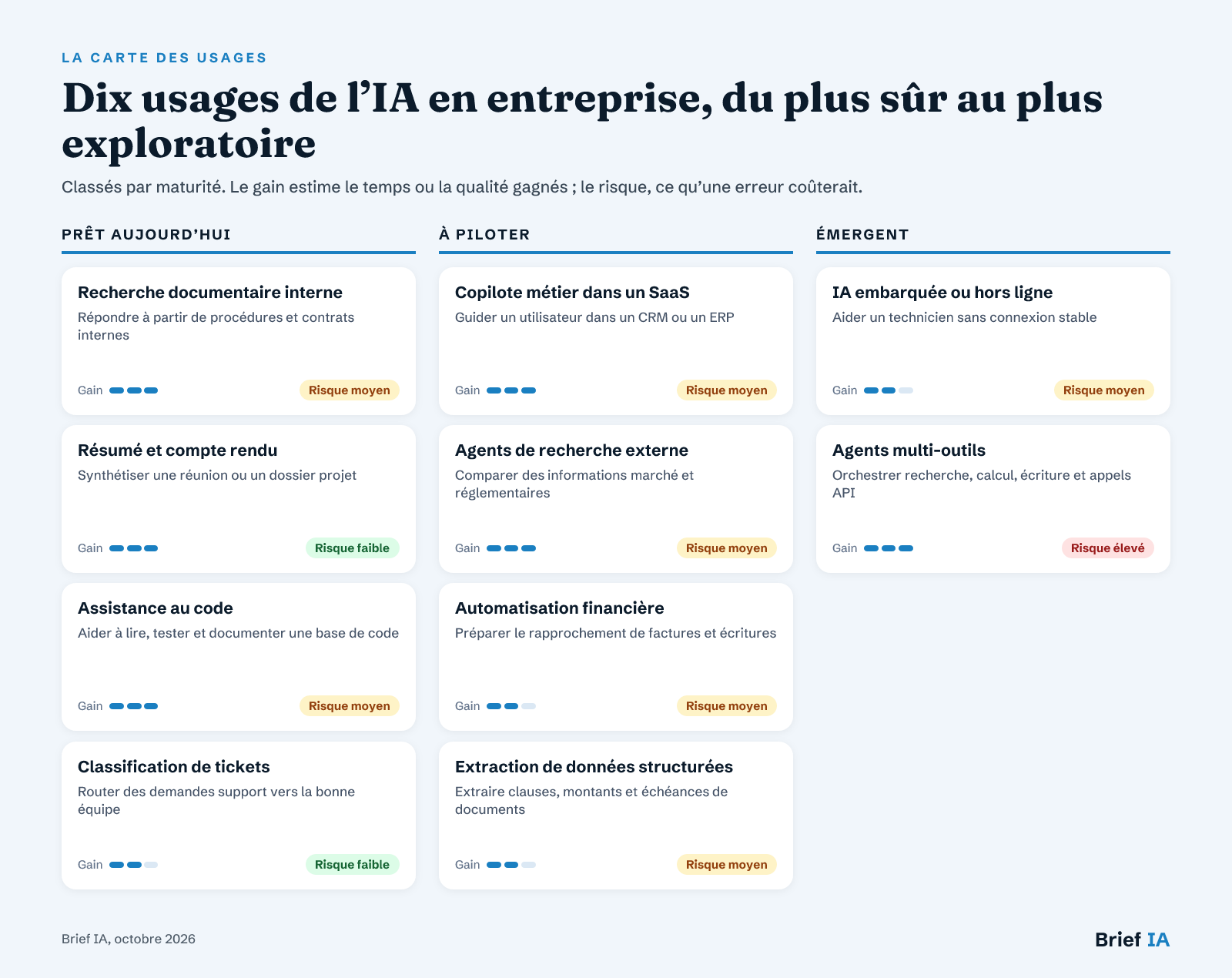 Map of AI use cases for CIOs and product teams
Use cases classified by maturity, with expected gains and risks in case of error.
Ready-to-Use Use Cases
Internal Document Search. A compact model paired with a document database is often sufficient to query procedures, contracts, specifications, and tickets. The decisive criterion is not just the quality of the model, but the quality of the segmentation, filtering, access rights, and source citation. For sensitive documents, prefer controlled hosting or a cloud with contractual data residency.
Summarization and Reporting. Summarization is a good first use case if the output does not automatically trigger a decision. A format must be imposed, the source document retained, and human validation planned for disseminated reports. A general-purpose model via API is suitable for starting; a compact model becomes relevant when volumes are regular or texts remain internal.
Code Assistance. Models specialized in code are useful for explaining a function, generating tests, proposing documentation, or speeding up reviews. The main risk lies in integrating unvalidated code and exposing private repositories. Limit access, log requests, enforce developer reviews, and test models separately for generation, explanation, and correction.
Ticket Classification. Classification, routing, and field extraction are suited to compact models, as categories are finite and errors measurable. Define a representative test set, measure accuracy and escalation rates, and maintain a human oversight queue for ambiguous cases. This case allows for quick cost calculation per processed ticket.
Use Cases to Manage
Business Co-Pilot in a SaaS. A product co-pilot should be designed as an action interface, not just a chat. The model must understand permissions, call limited functions, and explain its proposals before execution. Start in recommendation mode, without automatic action. Transitioning to action requires logs, authorization thresholds, and scenario-based testing.
External Search Agents. Search agents can reduce analysis time, but they quickly consume context and multiply calls. Our analysis on Search as Code shows another path: making search programmable, with retrieval, filtering, ranking, and verification. Test first on topics where responses can be controlled by identified sources.
Financial Automation. For accounting, cash flow forecasting, or anomaly detection, the AI Act does not classify these tools as high-risk systems when they do not have high-risk use. It remains necessary to secure data, track corrections, and avoid uncontrolled automatic validations. Models should be evaluated on anonymized or compartmentalized real entries.
Structured Data Extraction. Extraction works if the expected format is strict and a consistency check verifies amounts, dates, and mandatory fields. Recent news on TOON reminds us that a more economical format than JSON can reduce field repetition in repetitive structured data. Retain JSON when the output must be unambiguously analyzable.
Emerging Use Cases
Embedded or Offline AI. Compact models executed locally open up use cases in workstations, workshops, agencies, or environments without continuous connectivity. The interest lies in privacy, latency, and service continuity. The risk shifts to updates, model distribution, performance measurement on heterogeneous hardware, and protection of locally stored data.
Multi-Tool Agents. Agents that chain multiple tools can yield significant gains, but they concentrate risks: cost drift, unwanted actions, and difficult-to-attribute errors. A pilot must limit the number of tools, impose token ceilings, simulate actions before execution, and plan for automatic shutdown. This is not a first production project.
Tools to Know
There is no universal ranking: one must choose a family of tools based on workflow, data, budget, and acceptable operational level.
- General and Specialized Model APIs. They accelerate prototypes and complex tasks, with billing based on token volume or subscription. Our analysis on Mistral AI in 2026 details an offering combining open-weight models, APIs, and access plans for product teams. Requirements: data clauses, residency, usage logs, cost ceilings, reversibility.
- Self-Hosted Compact Models. They are suitable for regular, sensitive, or repetitive use, provided one can manage the operation. Our article on self-hosting highlights the cost and data protection benefits, while hardware limits remain to be tested. Requirements: internal testing benches, supervision, updates, latency measurement, cloud backup plan.
- Sovereign Clouds and Controlled Environments. They meet data residency, compliance, and contractual control needs. Our analysis on managed AI on sovereign cloud in France compares various offerings for sensitive AI workloads. Requirements: localization, qualification, subcontracting conditions, encryption, data exit.
- Multi-Cloud Access and Routing Platforms. They allow choosing an endpoint, region, or network path based on the use case. Our analysis on Microsoft Foundry and Google Cloud AI shows that routing, identity, and residency matter as much as the model. Requirements: documented routing, identity management, traceability, failover testing, function compatibility.
- Token Counting and Management Tools. They prevent budget surprises and facilitate model comparisons. Version 0.30 of llm-anthropic, for example, adds a token counting command before sending. Requirements: pre-call estimation, project budgets, alerts, usage breakdown, metric retention.
Le brief IA que les pros lisent chaque soir
Les 7 actus IA du jour, décryptées en 5 min. Gratuit.
Inclus dès l'inscription : notre sélection des meilleurs guides & comparatifs IA.
Choisissez votre rythme
Gratuit · Pas de spam · Désabonnement en 1 clic
The Framework: AI Act, Data, Cybersecurity, and Accountability
 Regulatory dates to integrate into an AI roadmap
Key dates, status as of October 27, 2026.
AI Act Already Applicable
The AI Act came into effect on August 1, 2024, and applies in phases. Since February 2, 2025, prohibited practices are banned, and any organization using AI systems must ensure a sufficient level of AI mastery among its personnel. From August 2, 2026, transparency obligations apply: a conversational assistant must indicate that it is an AI, and certain generated content must be labeled as such.
High Risk: The 2027 Deadline
High-risk autonomous systems listed in Annex III cover employment, education, critical infrastructure, certain access to essential services, policing, migration, justice, and democratic processes. Since the Digital Omnibus, published on July 24, 2026, and effective from July 27, 2026, their obligations will apply starting December 2, 2027. Tools for writing, summarization, accounting, cash flow forecasting, or fraud detection without high-risk use only fall under general obligations.
Data and Automated Decisions
The GDPR has been in effect since May 25, 2018. Its Article 22 regulates decisions based solely on automated processing that produce legal or significant effects on a person. In an AI project, qualify the data, limit access, document processing, and plan for human intervention when the tool may affect a person. The CSE must also be informed and consulted when introducing new technologies into the company.
Cloud, Products, and Incidents
The Data Act has been in effect since September 12, 2025, and facilitates changing cloud providers. Since September 11, 2026, the Cyber Resilience Act requires manufacturers of products containing digital elements to report actively exploited vulnerabilities and serious incidents, with alerts within 24 hours and notifications within 72 hours. The directive on liability for defective products includes software, including AI systems, and must be transposed by December 9, 2026, at the latest.
Pitfalls to Avoid
Only Comparing Benchmarks. A general score says nothing about your documents, languages, formats, and latency constraints. Build an internal test set with easy examples, edge cases, long data, and expected outputs. The chosen model must excel in your tasks, not on an abstract average.
Forgetting Total Cost. The price per million tokens does not cover everything. Add storage, orchestration, GPU, electricity, monitoring, security, support, and team time. For local setups, also measure actual energy and throughput, as the least expensive model to run is not necessarily the smallest.
Oversizing Models. A very powerful model for classifying tickets or rephrasing texts often incurs unnecessary costs. First, test a compact model, then escalate only difficult cases to a more powerful model. This cascading architecture reduces the bill and clarifies risk levels.
Neglecting Reversibility. A vendor can change prices, models, regions, quotas, or features. Preserve portable prompts, test sets, an abstraction layer, and a second qualified model. Reversibility must be tested before production, not just written into a contract.
Confusing Assistance with Decision-Making. An assistant that writes, summarizes, or suggests does not carry the same risk as a system that decides on its own. As soon as the tool affects a person or a critical operation, strengthen controls, traceability, operational explainability, and human intervention.
Taking Action: The 90-Day Plan
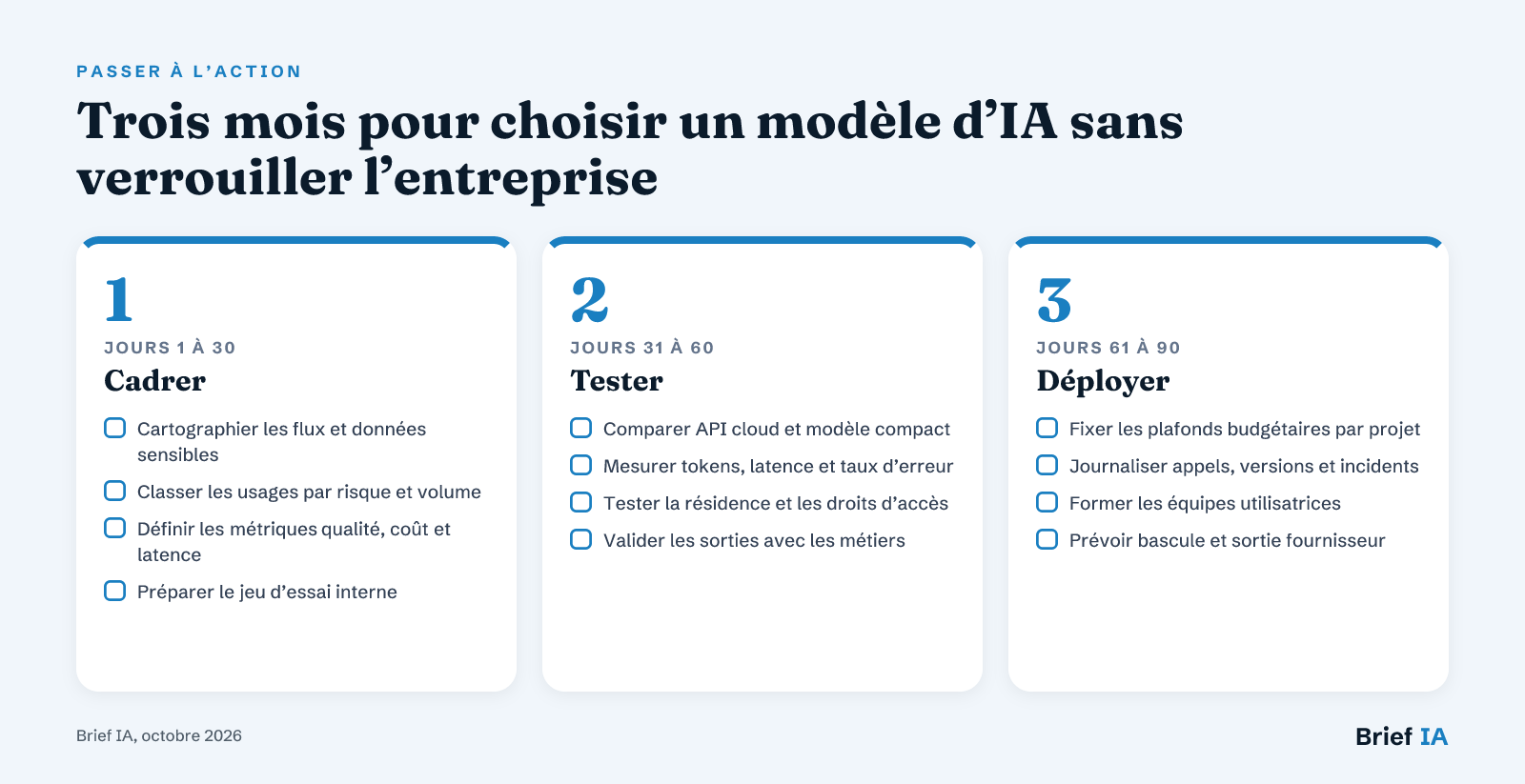 Three months to choose an AI model without locking the company
Three steps: frame, test, deploy.
Start with real-volume business workflows, covering productivity, documentation, and integration into a product. For three months, measure quality, cost, latency, incidents, and operational effort on a managed API and a controlled compact model. Then decide by usage family, without seeking a single model for the entire company.
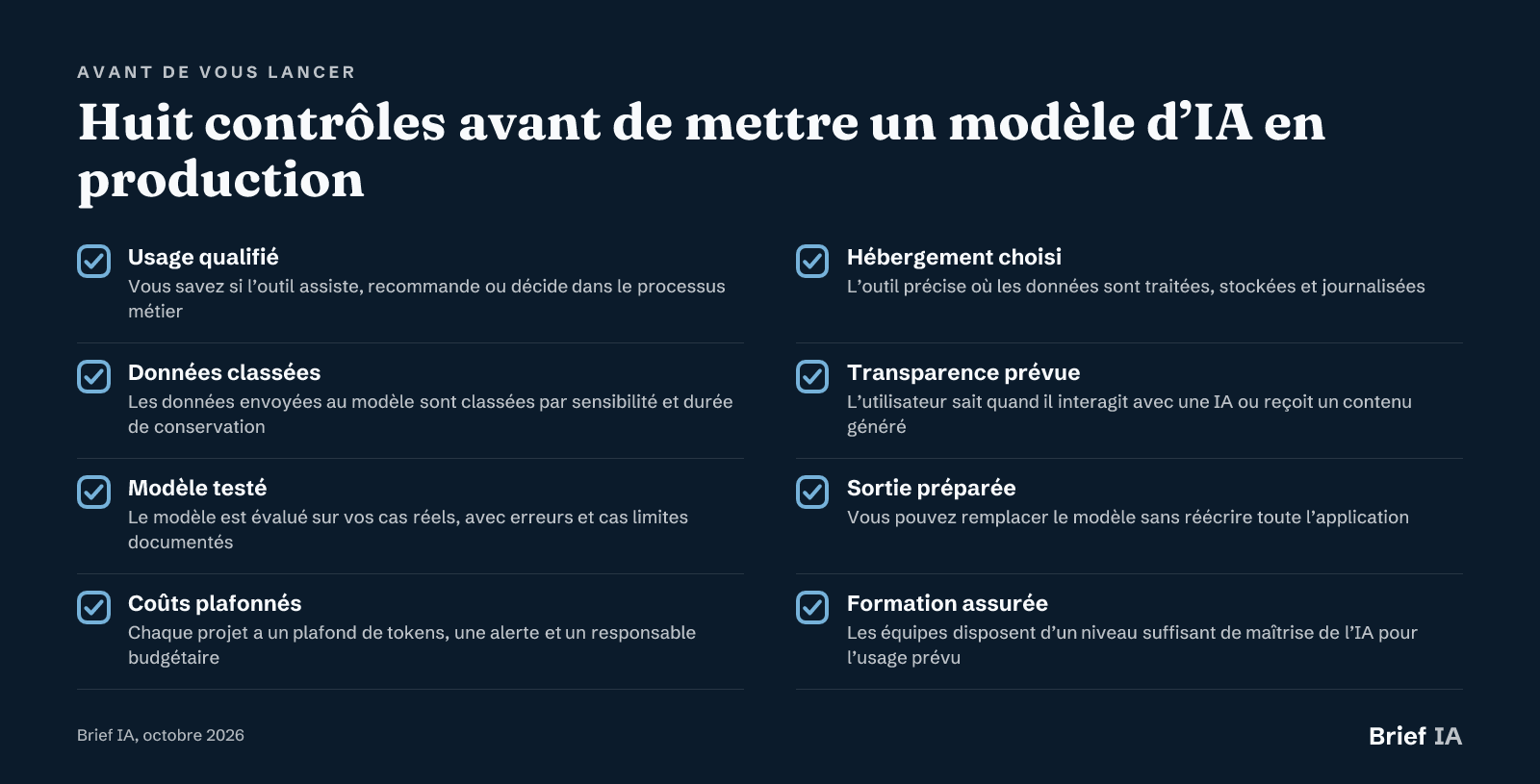 Eight checks before putting an AI model into production
Eight verifications to perform before each new use case.
Further Reading
Our analyses for CIOs and product teams
- Why Compact Models Are Changing the Economics of AI Projects. Understand when a small model suffices and why cost, latency, and privacy become decisive.
- Local AI or Cloud: The Operational Decision Framework. Compare marginal cost, privacy, usage load, and reasoning power before making a choice.
- Deploying Managed AI on Sovereign Cloud in France. Identify hosting, qualification, and architecture criteria for sensitive workloads.
- Microsoft Foundry or Google Cloud AI: Choosing Your Model Access. See how endpoints, regions, identity, and routing influence AI project governance.
- Search as Code vs. Classic LLM APIs. Measure the interest of programmable search for agents and complex documentary uses.
- Why Open Models Are Losing Ground. Understand the effects of costs, licenses, APIs, and distribution channels on model strategy.
Key News to Note
- Self-Hosting LLM: Mastering Your Data and Reducing Certain Costs
- Self-Hosted LLMs: Anticipating Hardware Limits in Production
- Energy Cost of Local LLMs Measured on RTX 3090
- Ollama, LM Studio, and llama.cpp Compared for AI Execution Engines
- TOON Proposes to Reduce Tokens in Repetitive Structured Data
- llm-anthropic 0.30 Adds Model Refresh and Token Counting
Are you publishing a solution for AI projects in companies?
This guide is read by CIOs, IT architects, data managers, and product teams. Brief IA offers AI solution publishers, cloud platforms, model providers, and governance tools dedicated articles, features in the evening brief, and promotion in the directory. Formats and rates at briefia.fr/partenaires.
The Essentials in Questions
Which AI Model to Choose for a Company in 2026?
Start from the use case, not the model name. An internal summary, a document search, a product co-pilot, and a multi-tool agent have different requirements. Compare a managed model and a compact model on your data, measuring quality, cost, latency, privacy, and reversibility.
Should One Prefer an Open or Proprietary Model?
A proprietary model often simplifies the start, access to powerful models, and operation. An open model provides more control, especially for controlled hosting and customization. The right choice depends on volume, sensitive data, internal skills, and the need to switch vendors without overhauling the application.
When Does Self-Hosting an LLM Become Interesting?
Self-hosting becomes relevant when the use is regular, large-scale, or sensitive. It can reduce dependency on APIs and keep data in a controlled environment. However, it requires hardware, supervision, updates, energy measurement, and operational skills. A pilot must measure the total cost, not just the absence of an API bill.
Is an Internal AI Tool a High-Risk System?
Not necessarily. Writing, summarization, accounting, cash flow forecasting, or fraud detection tools without high-risk use are not classified as high-risk systems by the AI Act. However, certain uses in employment, education, critical infrastructure, or access to essential services may fall under Annex III.
How to Avoid an Uncontrolled AI Bill?
Count tokens before sending when possible, limit contexts, choose lean formats, set ceilings per project, and log calls by usage. Compact models and cascading architectures also reduce the bill: simple tasks remain on an economical model, while difficult cases escalate to a more powerful model.
Brief IA — L'actualité IA en français
L'essentiel de l'actualité de l'intelligence artificielle, décrypté et expliqué chaque jour.