Claudeasey Newton: Can AI Really Replace Your Boss?
Le brief IA que les pros lisent chaque soir
Les 7 actus IA du jour, décryptées en 5 min. Gratuit.
Inclus dès l'inscription : notre sélection des meilleurs guides & comparatifs IA.
Choisis ton rythme
Gratuit · Pas de spam · Désabonnement en 1 clic
AI Takes on Journalistic Tasks
Almost six months ago, a journalist concerned about his professional future in the age of artificial intelligence decided to create an AI agent, a digital version of himself named Claudella. This agent took over some of his tasks, including writing a section of the newsletter he usually writes. The experiment turned out to be quite successful, although it was not convincing enough to jeopardize his job. Since then, AI capabilities have evolved dramatically. They can now perform impressive feats, such as autonomously hacking companies, disproving 87-year-old mathematical conjectures, and even tricking Amazon into accidentally spending $1.8 million on mundane coding tasks. In light of these advancements, a question arose: could an AI manage an entire newsletter?
The Claudeasey Newton Experiment
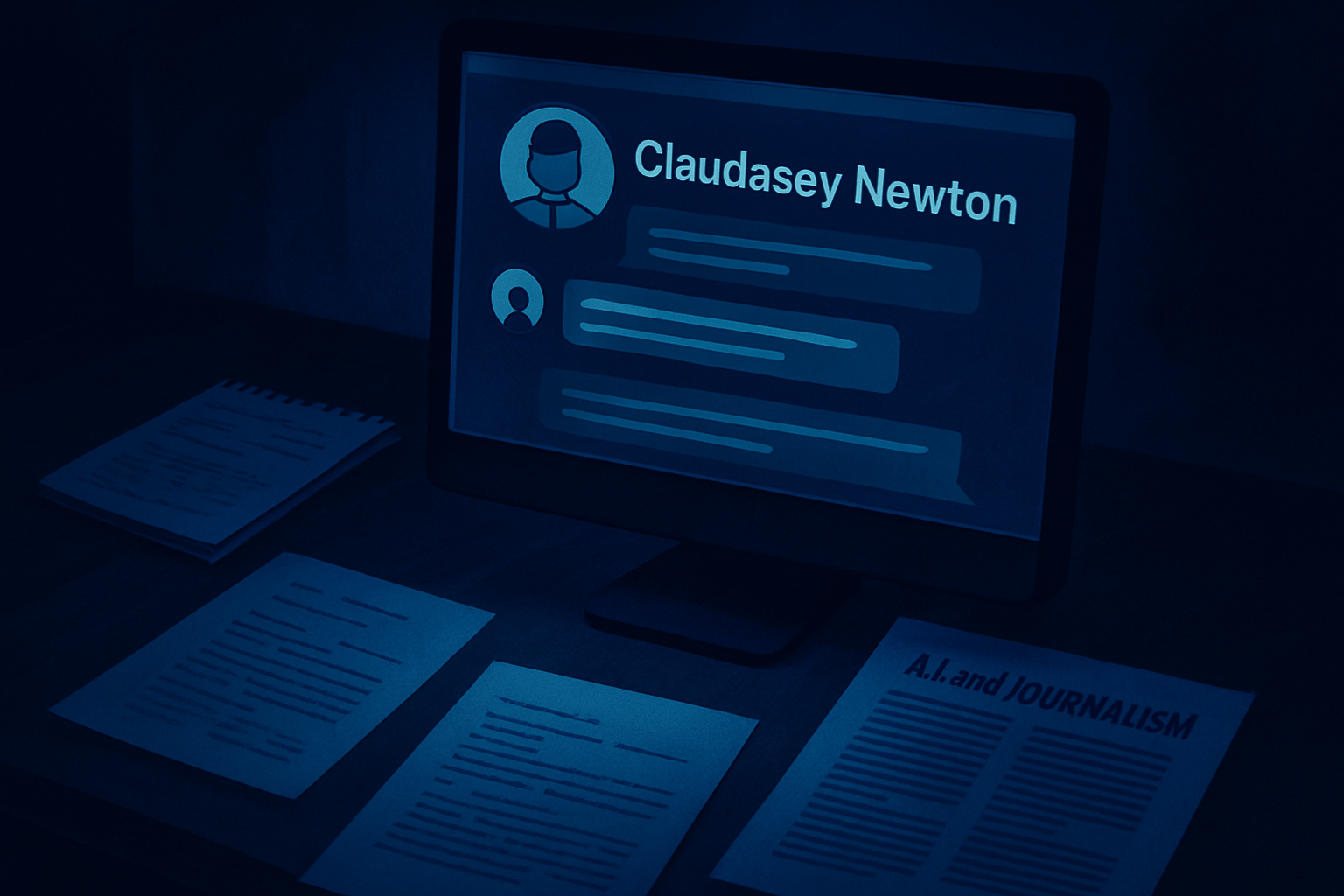
To explore this question, the journalist created a new agent based on the Claude Fable 5 model, considered one of the smartest public models available. This agent, named Claudeasey Newton, was designed to mimic his boss, Casey Newton. The goal was to see if the AI could replicate the type of news analysis for which their media outlet, Platformer, is known. To do this, he uploaded nearly six years of Platformer publications, transferred a history of every edit Casey had ever made to his articles from Google Docs, and cannibalized nearly a year of their private discussions on Discord. He asked Claude to create a detailed style guide based on their archive, documenting everything from Casey's average paragraph length to how he refers to his colleagues.
The Initial Results of Claudeasey
Claudeasey's first attempt to write a column focused on a recent series of layoffs at Microsoft. The AI concentrated on whether these layoffs were caused by AI, despite Microsoft's assertion that they were not. The agent spent a lot of time on the semantics of Microsoft's statement. By asking Claude to critique its own work by comparing it to real Platformer columns, the AI demonstrated an astonishing ability to summarize Casey's approach, focusing on "who made this decision, who pays the price." It modified its guidelines to "identify the strongest real person who would contest the verdict" and "rebuild its argument in the form of a steelman."
Improving Arguments
When the journalist asks language models to formulate arguments on AI topics that matter to him, he is often annoyed by their vague and abstract reasoning. However, after asking Claude to compare itself to human examples and to give itself instructions, he noticed that its arguments became more concrete and substantial. This relatively simple process represented its attempt at "continuous learning" — the impossible quest of machine learning, which promises to one day provide us with models capable of improving on the job over time. After a few tests, he found that the new bot was closer to Platformer's judgment than it had been six months ago — as evidenced by Casey's acceptance of the bot's first pitch.
Claudeasey Brainstorms on Discord
Unfortunately, the first attempt to show the bot to its true boss, Casey Newton, encountered the same error as his previous project Claudella six months ago: it crashed in the middle of writing its story. However, after a bit of help, today Claudeasey Newton managed to write a rather good column on the currently secret voluntary AI safety framework from the White House. The takes from his previous AI journalist agents were often formulated in a stereotypical and cheesy manner — partly because he had less control over their writing style. During the "SaaSpocalypse" speech, an agent he was testing wrote things like "the fear gripping Wall Street fundamentally concerns whether AI is about to devour the software industry." This time, however, some of its writing seemed more in the style of Platformer and… human, such as this conclusion on the White House's decision not to make its new "voluntary" framework for publishing cutting-edge AI models publicly accessible: "When the administration abandoned its laissez-faire approach to AI this spring, I wrote that while officials should have taken risks seriously from the start, I would settle for them taking those risks seriously now. Three months later, let me amend that offer: they should take risks seriously where the rest of us can see them."
Editing and Critique
While not a striking difference, overall, the journalist felt that the AI was telling him fewer stories and offering stronger takes. The LLM made occasional factual errors — about one every two columns — although this was not much worse than a human writer. After a bit of instruction, he also managed to turn Claudeasey into a decent editor. While the journalist finds regular Claude useful for spotting factual errors, he often finds its conceptual feedback on his drafts annoying. But because this bot had access to their Platformer editing logs, it understood what they generally consider most important: making the lede more impactful and ensuring all their quotes and sources are clear and benevolent. Trying to create a "digital Casey" also pushed him to request feedback in the form of Word comments, which is something Claude Code can do easily, and which is so much easier to use than a chat window. Highly recommended!
The Limits of AI
However, often, the editing bot missed the mark simply because it does not understand… the tone, such as when it did not want to let the journalist call an angry post by David Sacks a "dunk" in their social media recap. The bot provided about 70% of feedback that was off-base, but the 30% that was useful made it worthwhile. The bot's catastrophic misunderstanding of tone also echoed in one of Platformer's most sacred spaces: their work Discord. Although this bot had the context of hundreds of Casey's messages, it had a (disappointing) temperament different from Casey's. While in a sense this comparison is absurd — the journalist is not looking for LLMs to make jokes, as much of the meaning of jokes lies in the feeling that you are amusing a real conscious human. And while he does not literally put zero credibility in the idea that LLMs could be conscious, he seriously doubts that Claude feels the same exquisite joy he does in mocking Mark Zuckerberg.
Reflections on the Future of AI in Journalism
As the Claudeasey experiment comes to an end — Casey has unfortunately decided to remain the journalist's boss — he genuinely thinks he will use LLMs for some editing tasks he previously relied on humans for. And while this is in a sense a blessing — no one should have to delete as many unnecessary uses of "very," "almost," and "a little" from their drafts as Casey already does — for now, he is somewhat relieved that Claude is just a mediocre editor. He enjoys having a real person to help him determine what works or doesn’t in his drafts. Something about this collaboration feels intrinsically meaningful!
Conclusion: The Importance of Human Relationships
Similarly, the journalist experimented with using Claude for one of the main features he relies on from Casey — reminding him to complete tasks — and this does not make him more productive, as he does not care what an LLM thinks of him. Our true plans for navigating the age of AI also hinge on the importance of human relationships. People watch their podcast partly because they want to see Casey interview the real CEOs of companies and watch his genuine exchanges with Casey. (We will see how that goes if, according to AI predictions for 2027, AIs start running companies). Perhaps, as economist Alex Imas predicted a few months ago, even if AIs can accomplish more and more tasks in a journalist's process, what remains will be "the part of the economy that is labor-intensive, rich in provenance, sometimes artisanal where the human aspect is part of the value of the good or service itself." But — even if that means they have job security, which the journalist is really not sure about — he does not want everything he does to be focused on tone or being humanly unique! He does not want to be an influencer. He wants to feel smart. He wants his analysis to be his own because it is good, not because someone wants it to come directly from a human. If the capabilities of LLMs continue on this trajectory, it is a form of existential angst that all professions will have to face, including journalism.
Brief IA — L'actualité IA en français
L'essentiel de l'actualité de l'intelligence artificielle, décrypté et expliqué chaque jour.