College of Charleston: AI Drives Student Innovation
Le brief IA que les pros lisent chaque soir
Les 7 actus IA du jour, décryptées en 5 min. Gratuit.
Inclus dès l'inscription : notre sélection des meilleurs guides & comparatifs IA.
Choisis ton rythme
Gratuit · Pas de spam · Désabonnement en 1 clic
College of Charleston: AI Drives Student Innovation
Artificial Intelligence (AI) is rapidly transforming how businesses operate, how students learn, and how communities tackle complex problems. From predictive analytics to generative design and autonomous systems, AI is becoming fundamental to innovation across various sectors. What was once a competitive advantage is quickly becoming a baseline expectation.
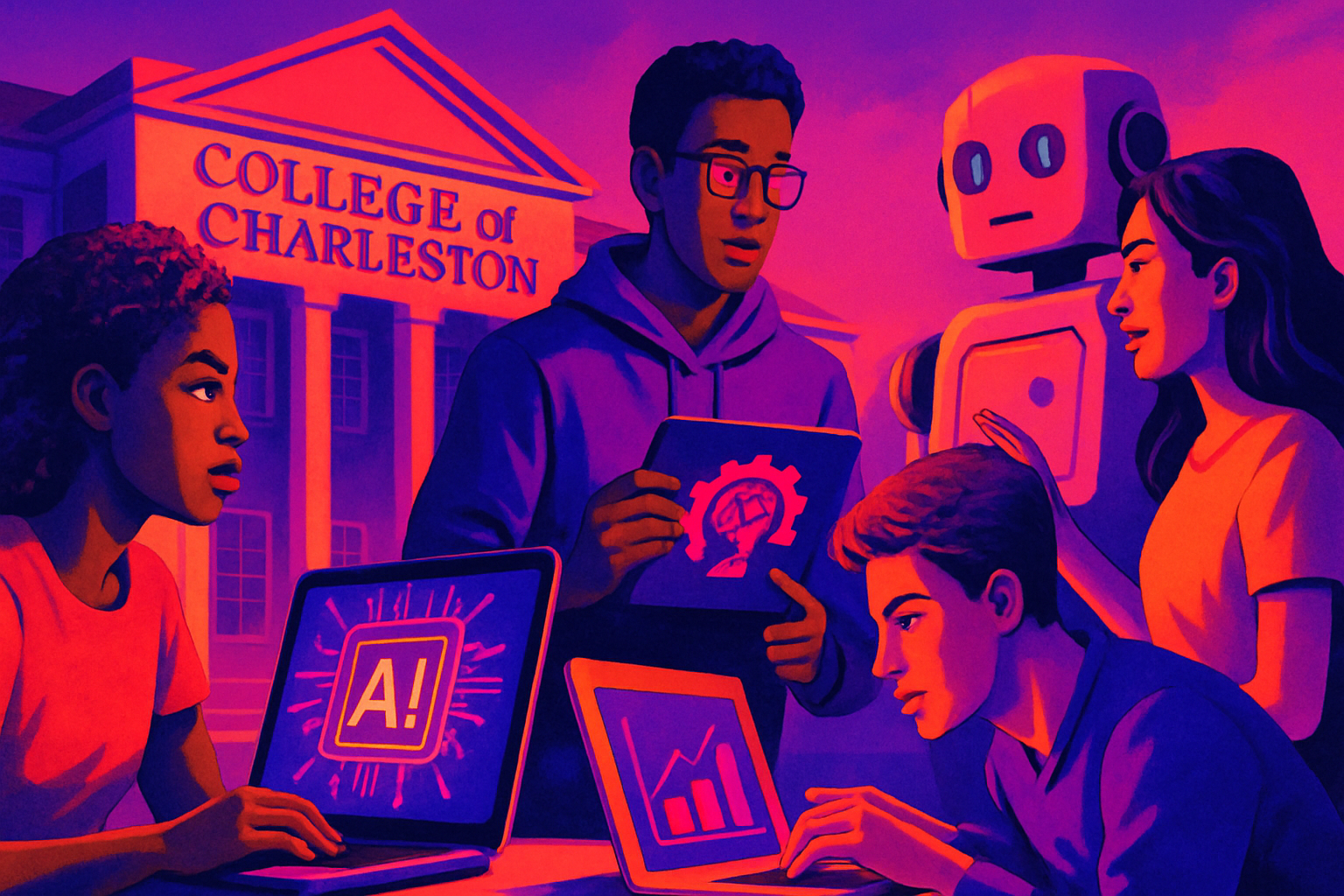
Recognizing this shift, the Center for Entrepreneurship at the College of Charleston has created the AI Innovation Challenge to enable students to leverage AI to address real societal issues.
This momentum is particularly strong among younger generations. Research indicates that 62% of Generation Z plans to start or could start their own business. At the same time, the barriers to entrepreneurship are evolving. Over the next five years, starting a business will likely require less initial capital, as founders utilize AI tools for coding, design, research, marketing, and customer service. Instead of building large teams from the outset, many startups will rely on small teams augmented by AI, capable of acting faster and more efficiently than ever before. The AI Innovation Challenge reflects this new reality.
AI Innovation Challenge: A Development and Presentation Experience
This year's challenge attracted 83 applications from students across various college disciplines. This diversity reflects the growing relevance of AI; students in environmental sciences, business, biology, and computer science all proposed bold ideas. Increasingly, the future of entrepreneurship belongs to interdisciplinary founders who combine sector expertise with AI capabilities to unlock new value. The competition was designed not only as a presentation event but as an experiential learning journey. Students were encouraged to integrate AI throughout their process—identifying problems, analyzing data, refining business models, and enhancing their presentations.
The path to the finals included competitive pitch sessions. These sessions created structured feedback loops that simulate the iterative nature of business development in the real world. Founders who can prototype quickly, test intelligently, and continuously refine will define the next generation of startups. In the end, seven finalists had the opportunity to present before the Advisory Board of the Center for Entrepreneurship. Each team delivered a focused four-minute pitch followed by rigorous questions from experienced entrepreneurial leaders who evaluated the projects in terms of innovation, feasibility, and impact.
Competition Winners Use AI to Solve Problems
The solutions presented at the final event not only showcased impressive creativity but also a strong commitment to addressing significant societal challenges. The first prize of $5,000 was awarded to Project HAB, developed by Sophia Mucci, Nikolai Sarlo, and Kami Beats. Their platform uses machine learning to analyze satellite images and environmental data to predict the occurrence of harmful algal blooms.
By enhancing public datasets with AI models, the team aims to provide real-time water quality monitoring without the high costs of constant physical testing. As climate volatility increases, predictive AI systems like Project HAB could become essential infrastructure, helping communities and public health officials anticipate risks rather than merely react to crises.
The second prize and a reward of $2,500 were awarded to Alexander Leporati for Classmate, an AI-powered academic organization platform. Designed around the lived experience of college students, Classmate consolidates courses, deadlines, and materials into a single streamlined interface.
By automatically extracting key dates and generating personalized study plans, the platform seeks to reduce stress and improve academic performance. Tools like Classmate herald a future where intelligent systems function as adaptive partners, enhancing human capabilities while freeing individuals to focus on higher-level thinking.
The third prize, amounting to $1,500, was awarded to NEXO, created by Brooke Madison Clapprood, Raquel Cross, and Grace Moffat. NEXO is a portable, AI-activated chemical scanning device that connects to a smartphone to detect harmful substances in drinks or powders. Beyond its social impact, NEXO reflects a broader entrepreneurial trend: the convergence of AI with smart hardware and sensors to provide immediate, actionable insights.
Additionally, the audience selected a winner for the People's Choice Award. NOLO, developed by Sarah Huys, Kate Seltzer, and Holly Worth, won $1,000 for its wellness mocktail brand integrating AI. The team demonstrated how AI-informed flavor development, branding, demand forecasting, and logistical optimization can enhance even consumer lifestyle-focused businesses.
The AI Innovation Challenge has reinforced the college's commitment to a forward-looking entrepreneurial education. Tomorrow's founders will need not only technical mastery but also judgment—understanding biases, privacy, governance, and the societal implications of using AI. Human creativity, empathy, and leadership will remain central, but they will increasingly reward mastery of AI as a key skill.
Brief IA — L'actualité IA en français
L'essentiel de l'actualité de l'intelligence artificielle, décrypté et expliqué chaque jour.