Warehouses: Gartner Maps 4 Levels of AI
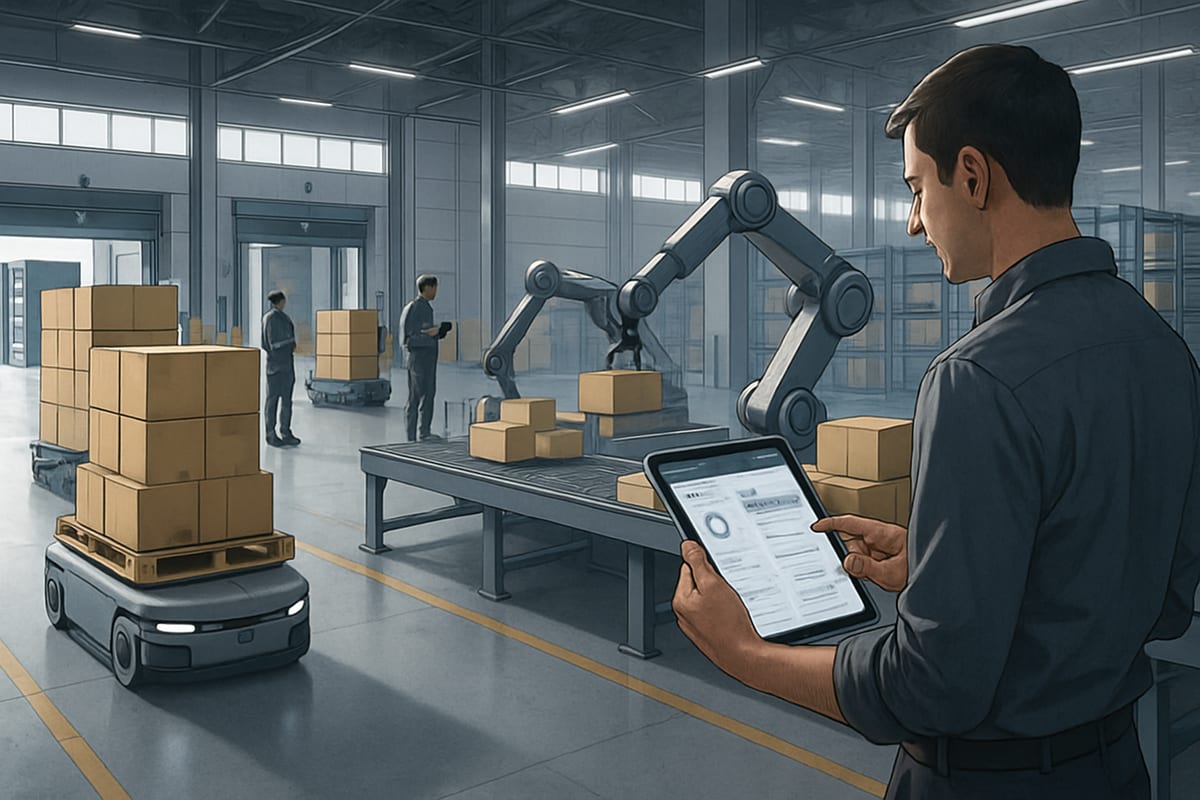
According to Gartner, warehouse automation has crossed an adoption threshold, with production deployments and four operational levels of AI. Ground effects are being reported, from maintaining robotic accuracy to reducing injuries, in a framework where humans retain control over critical decisions. The firm describes proven software building blocks and a gradual adoption path, from stock optimizations to agents and generative AI.
Measured Gains and Retained Human Supervision
Deployment teams report increased stability in item processing speed and a decrease in physical injuries in palletizing areas. Robotic platforms ensure positioning accuracy across schedules covering multiple shifts. Human managers retain the ability to manually intervene in high-stakes decisions. Software provides operational sequences, but supervisors validate the shipping order before execution. This model of shared supervision limits workflow interruptions and accelerates responses in case of dock congestion. Automation helps logistics managers meet volume commitments despite regional hiring difficulties.
Real-Time Driving and Exception Management on the Ground
To be implemented in a company, the system must offer sufficient transparency so that supervisors can grasp the automated operations on the ground. Instructions for exception management are transmitted in real-time to supervisors via portable devices. In the event of equipment failures, technicians access context-specific repair instructions generated from maintenance histories. Human staff collaborates with automated tools to address site-specific constraints.
Modern Computing Engines Leverage Real-Time Data
The mathematical models used now surpass rigid heuristics. Modern computing engines leverage real-time data to drive operations, replacing static spreadsheets or simple decision trees. Warehouse management suites apply these algorithms to four main areas: demand forecasting, shift planning, routing movements, and stock placement. Systems continuously adjust inventory movements based on order changes during a shift. This dynamic adaptation helps reduce operational costs and improve equipment productivity. The algorithmic logic maintains necessary audit trails for compliance. Machine learning models analyze both unstructured data and tabular logs. Generative systems utilize maintenance records, delivery receipts, and incident tickets to produce evolving documentation. Software agents instantly generate updated procedures and picking instructions in case of supplier delays.
Le brief IA que les pros lisent chaque soir
Les 7 actus IA du jour, décryptées en 5 min. Gratuit.
Inclus dès l'inscription : notre sélection des meilleurs guides & comparatifs IA.
Choisissez votre rythme
Gratuit · Pas de spam · Désabonnement en 1 clic
Autonomous Software Agents Manage Complex Processes
Autonomous software agents manage complex processes by combining analysis and human validation. They examine queues, reassign picking tasks, and redistribute machines between docks. Meanwhile, physical automation combines machine learning, industrial robotics, and spatial sensors. Autonomous systems handle picking, packing, parcel sorting, and pallet movement on loading docks.
Levels, Evaluation Criteria, and Deployment Trajectory
Warehouse automation revolves around four operational levels of AI, marking the transition from software trials to real-world deployments. Gartner evaluates these systems based on the sophistication of intelligence and their ability to guide operational action. According to the firm, logistics infrastructure has reached an adoption threshold, driven by persistent labor shortages, software business models requiring less initial capital, and increased reliability of algorithms and autonomous machines. Federica Stufano emphasizes that these trends are interconnected and reflect the evolution toward smarter, more adaptive, and resilient warehouses. She recommends starting with proven use cases such as workforce forecasting and stock placement, then expanding to generative AI and agents when it enhances decision-making and productivity. Distribution centers can first deploy stock optimization tools, then introduce software agents and autonomous forklifts as the workforce becomes familiar with these systems.
Brief IA — L'actualité IA en français
L'essentiel de l'actualité de l'intelligence artificielle, décrypté et expliqué chaque jour.