AI Summer: Mandatory Labeling, Ads in ChatGPT, and SEO
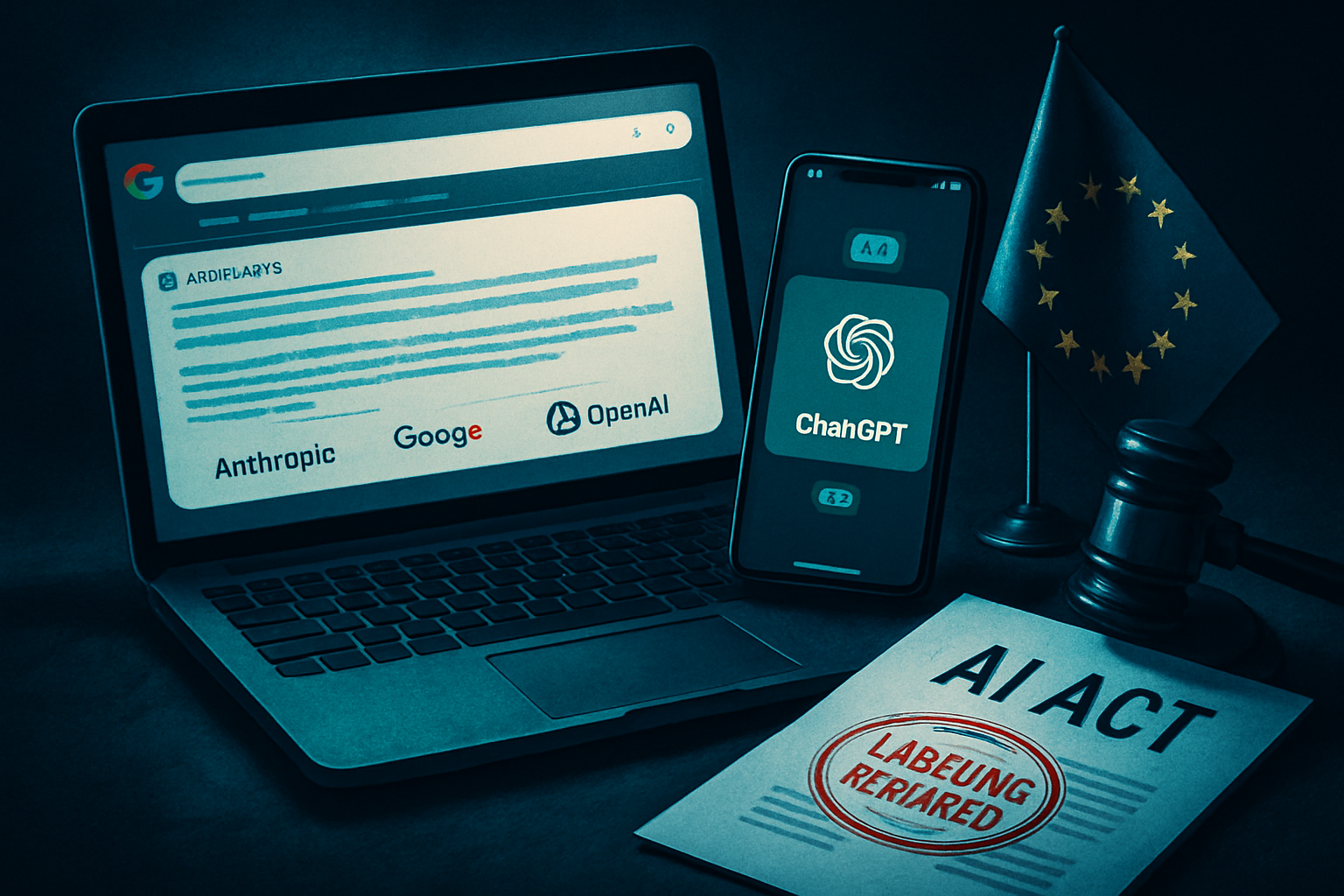
Summer has imposed a new framework for AI in Europe and reignited industrial tensions. Content marking, access restrictions to certain models, "chip" teams among key players, and the Apple–OpenAI proceedings have defined the season. Meanwhile, ChatGPT is opening up to advertising on its entry-level offerings, while agents are gaining traction outside the chat window, and Google is rolling out AI Overviews in France.
Chips, Restricted Access, and Legal Disputes: AI in Sovereignty Mode
On July 1, Anthropic launched Sonnet 5 and reopened access to Fable and Mythos after a three-week suspension related to U.S. export controls. At the same time, access to GPT-5.6 has been limited to partners approved by U.S. authorities. Anthropic officially announced the establishment of a team dedicated to developing its own chips, while OpenAI and Google are also pursuing this strategy, both aiming to reduce their dependence on a single computing provider. Legally, the hardware aspect has also led to a dispute: a lawsuit has been filed between Apple and OpenAI, with Apple accusing its rival of basing its hardware projects on industrial secrets obtained unlawfully.
The European Union Mandates Labeling of Generated Content
On August 2, an initial series of measures from the AI Act came into effect, making labeling of generated content mandatory within the European Union. Deepfakes, texts, and chatbots must now be explicitly identified, a requirement whose specific modalities are already fueling discussions among publishers. From the industrial players' side, Anthropic has indicated that its future models will incorporate an invisible watermark in the produced texts and origin metadata in the generated files. Four days after this announcement, the company detailed technical aspects, including the extent of the marking and the possibility of removing the watermark.
ChatGPT Changes Its Economy: Advertising and Capacity Expansion
OpenAI informed its European users that advertisements will appear in the conversations of Free and Go accounts, while Plus and Pro subscriptions are not affected for now. A few days earlier, the free version had lifted its message limit and transitioned to GPT-5.6 Luna with adjustable reasoning effort, positioning the Free account as an advertising inventory while broadening its usage. For businesses, OpenAI has also introduced Premium seats for ChatGPT Business, with increased usage limits priced at $125 per month, an offer aligned with Anthropic's for Claude.
Le brief IA que les pros lisent chaque soir
Les 7 actus IA du jour, décryptées en 5 min. Gratuit.
Inclus dès l'inscription : notre sélection des meilleurs guides & comparatifs IA.
Choisis ton rythme
Gratuit · Pas de spam · Désabonnement en 1 clic
Agents Settle into Operating Systems and Work Tools
Claude Cowork expanded to web and mobile in early July, then integrated into the sidebar of Claude in Chrome in August with its skills and connectors, before adding shared memory with the chat. OpenAI launched ChatGPT Work, powered by GPT-5.6, along with a voice feature allowing control of Codex and operations on macOS. Perplexity adapted its Personal Computer agent for Windows, with the ability to access local files. In terms of development, Anthropic extended the auto mode to all of Claude Code and introduced intersession messaging. Meta offered Muse Code in beta on macOS and Linux, integrating sub-agents operating in parallel and usage-based billing. Thanks to the open-source Hermes agent from Nous Research, the publisher reached a valuation of $1.5 billion by developing specific capabilities.
Google Search: AI Overviews Redistributes Clicks in France
Google has expanded AI Overviews to all search results in France, more than two years after its launch in the United States. The company has published a guide to adapt pages to AI Overviews and AI Mode, and has integrated a specific section in the Search Console to track AI-generated impressions, without currently providing data on clicks or queries. Publishers have the option to request that their site be excluded. Initial quantitative feedback is mixed: Ahrefs reports CTR drops of up to 23% for certain domains in 9 days, while The Black Room provided a snapshot of the visibility of French media. An organization representing nearly 300 daily newspapers has approached the Competition Authority. Le Temps has documented the impact on its traffic for over a year and shared its measurement method. For SEO professionals, two logics now coexist between traditional engines and generative responses, with distinct criteria, raising the question of control over the reformulation and redistribution of information.
Corporate Adoption: Appetite for Execution, Reluctance for Autonomous Control
Two studies from OpenAI describe an AI transitioning from assistance to execution, with a growing gap between advanced organizations and the median. At the same time, 61% of employees surveyed by TeamViewer refuse to allow AI to act without human validation, and a Notion survey indicates a disconnect between the optimism of leaders and that of teams. Functionally, OpenAI has proposed a Linux desktop application in pre-release (Ubuntu, Debian, Fedora), a ChatGPT for Teens for ages 13-17, Computer History on Mac to record events, clicks, and inputs, a Chrome extension to read tabs and summarize YouTube, GPT-Live for a bidirectional voice mode, and an Admin plugin to manage permissions and access. On Claude's side, the voice mode can now operate in Gmail or Slack, and a Reflect dashboard provides a retrospective of usage. Microsoft, for its part, has merged its Copilot applications.
Brief IA — L'actualité IA en français
L'essentiel de l'actualité de l'intelligence artificielle, décrypté et expliqué chaque jour.