Europe: US Army Accelerates AI Integration in Response to Threats
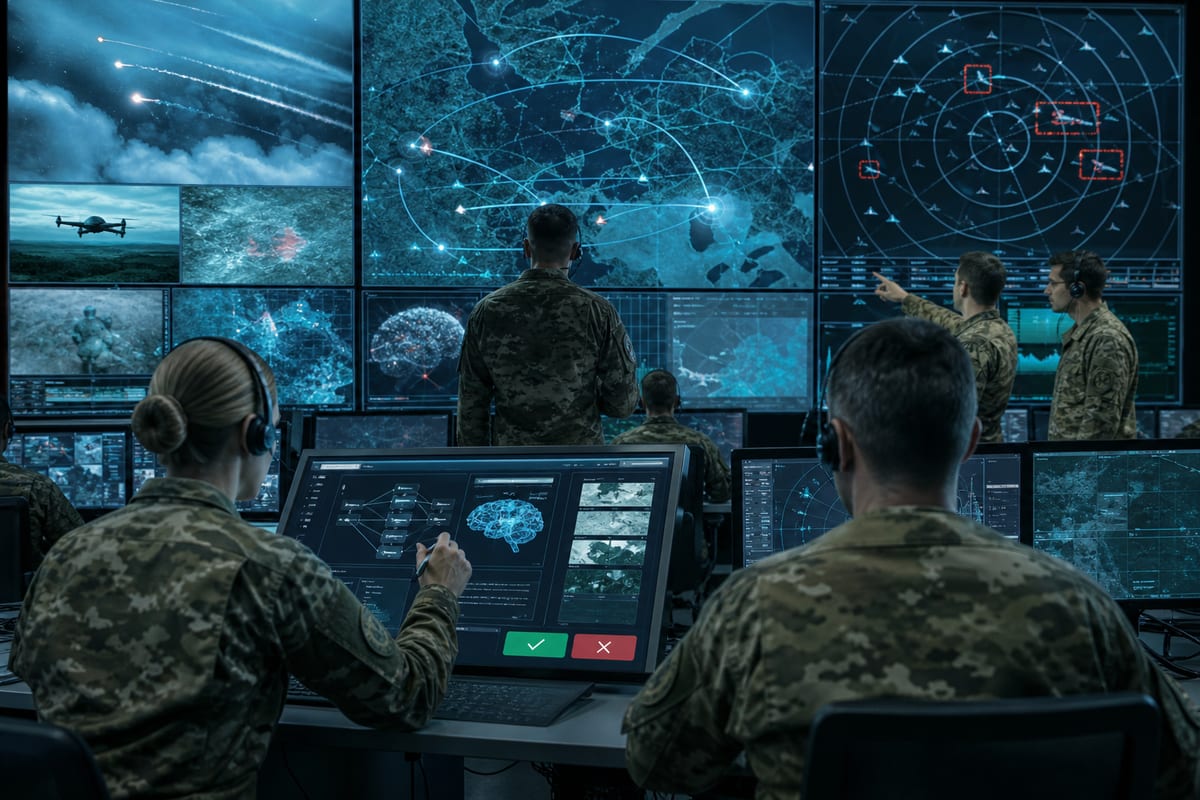
American units in Europe are testing AI tools to sort combat data and suggest responses, while keeping humans at the center. A new command set, NGC2, is designed to aggregate targeting, munitions, and intelligence in real-time. Officials mention scenarios involving over 1,500 targets per day and 1,200 missiles and drones to counter in an extreme situation inspired by Ukraine.
NGC2 and NATO Tests: AI Building Blocks Already Under Trial
Earlier this year in Europe, a joint exercise with NATO allowed troops to use an internally developed AI system to ingest and sort data. During this training, the AI was in beta testing, and Army officials indicated plans for a larger-scale trial in a future exercise. At the same time, the U.S. Army is integrating AI into its Next Generation Command and Control, the service's new combat system. This NGC2 relies on AI and machine learning to provide commanders and soldiers with real-time information on targeting, capabilities, ammunition levels, maintenance, intelligence flows, and simulated enemy attacks. This evolution is part of a rapid integration dynamic, from autonomous functions to agentic processes, and also involves institutional processes and workflows beyond the battlefield.
Tools Designed for Quick Decision-Making, Not to Displace Humans
Officials emphasize systems designed to accelerate decision-making, without making it the sole advantage. AI is presented as capable of recognizing patterns that humans might overlook and offering more options to commanders. It is also considered for speeding up target analysis, while remaining limited to recommendations, with the final decision still resting with humans. This approach accompanies the rapid integration of autonomous capabilities into unmanned systems and command and control chains.
Le brief IA que les pros lisent chaque soir
Les 7 actus IA du jour, décryptées en 5 min. Gratuit.
Inclus dès l'inscription : notre sélection des meilleurs guides & comparatifs IA.
Choisissez votre rythme
Gratuit · Pas de spam · Désabonnement en 1 clic
Conducting Operations: Assisted Targeting and a Range of Responses
In combat situations, soldiers could use AI to analyze data and targets based on objectives set by command and associated parameters. The envisioned systems would assess available military capabilities and propose options ranging from conventional strikes to electronic warfare, and even cyber operations. This approach relies on AI's ability to process large volumes of data from sensors and networks to formulate potential responses.
Safeguards: The Decision Remains Subject to the Law of War
Steven Carpenter clarifies that humans retain the final say in pursuing a valid target in accordance with the Law of War. He emphasizes that the goal is not to replace analysts but to relieve them so they can focus on the most complex cases. The same officer points out that the use of "super intelligence" aims for speed and scale, while reminding that it is not about sidelining humans from the process.
Scale of Threats: A Scenario Based on Ukraine's Worst Day
U.S. forces in Europe have been called to prepare for handling over 1,500 potential targets per day and defending against up to 1,200 missiles and drones. According to Steven Carpenter, such a volume could overwhelm human analysts, whom AI would assist in tracking. He notes that these figures correspond to what they refer to as "Ukraine's worst day." The war waged by Russia has been marked by repeated and massive strikes involving ballistic missiles, cruise missiles, and one-way attack drones, the latter increasingly equipped with jet engines, which increases their speed and complicates interception. In this context, some officials believe that future battlefields could generate data volumes capable of overwhelming operators, with thousands of targets and threats, leading the U.S. Army in Europe to prepare for large-scale confrontations where human intervention alone is no longer sufficient without support.
Brief IA — L'actualité IA en français
L'essentiel de l'actualité de l'intelligence artificielle, décrypté et expliqué chaque jour.