Feedzai launches Farol, an AI agent to speed up fraud investigations

Le brief IA que les pros lisent chaque soir
Les 7 actus IA du jour, décryptées en 5 min. Gratuit.
Inclus dès l'inscription : notre sélection des meilleurs guides & comparatifs IA.
Choisis ton rythme
Gratuit · Pas de spam · Désabonnement en 1 clic
Feedzai, the AI fraud detection specialist founded in Portugal, is launching Farol, an AI agent built into its RiskOps Studio platform. Unveiled on 23 September in London at its Feedzai Fusion event and available since 24 September, it targets banks' fraud teams, who spend much of their time gathering data before they can make a call.
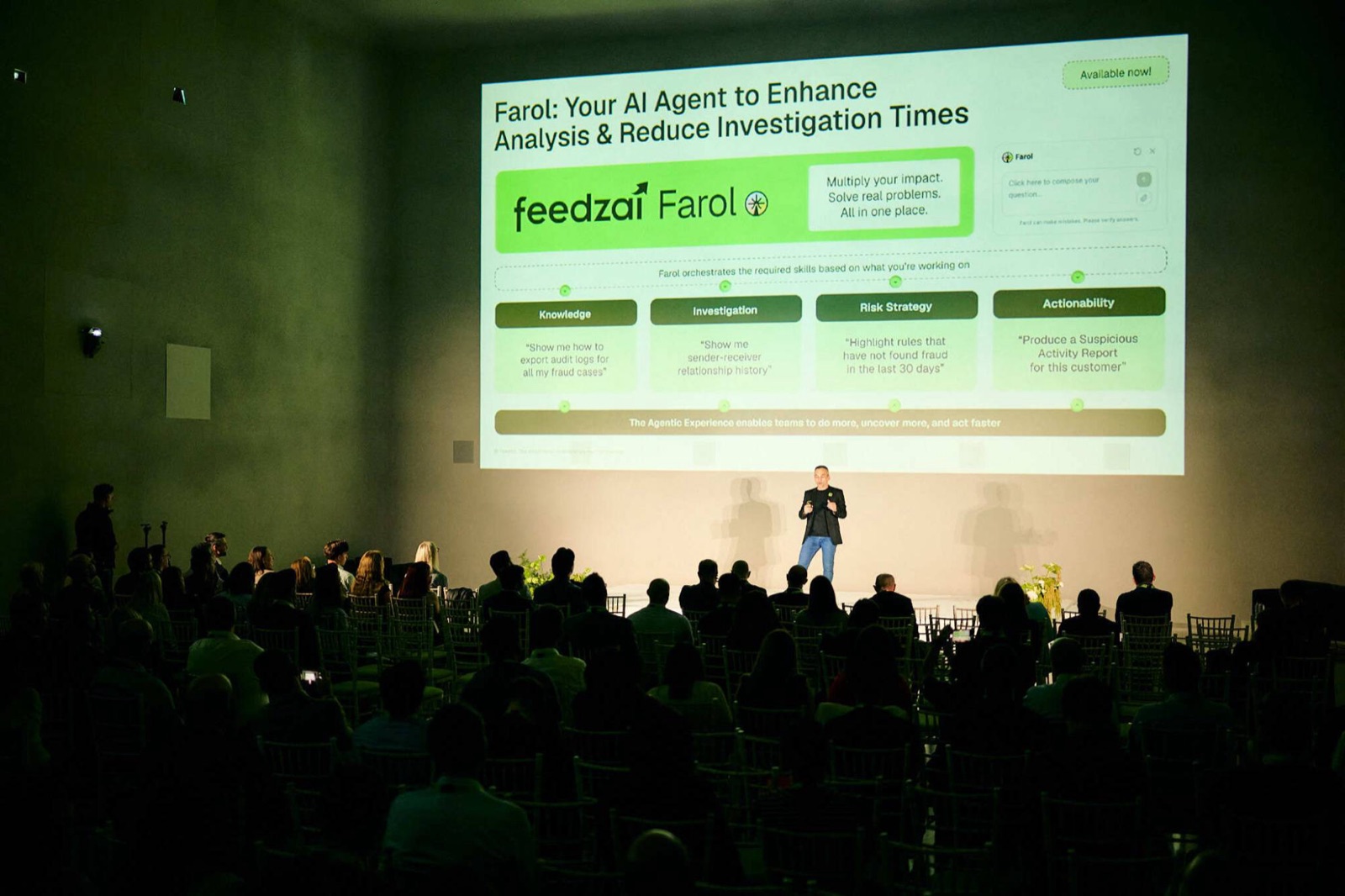 Farol on stage at Feedzai Fusion, London, 23 September 2026.
An agent inside the analysts' tool, not next to it
According to a Feedzai study, 68% of financial institutions are actively testing agentic AI. Yet most of these deployments deliver no efficiency gains: third-party AI models run apart from real-time transaction data, and analysts have to bridge the gap themselves.
Farol takes the opposite approach. The agent lives in the interface analysts already use, with the full context of each case and an audit trail of what it does. It runs inside each bank's own environment, so the insights it surfaces never leave the customer's estate.
Four use cases at launch
- Risk strategy: Farol analyses detection rules, flags the ones that generate alerts without ever catching fraud and suggests more precise thresholds. A rule review that used to take days takes minutes.
- Investigations: the agent gathers and summarises the data behind an alert in moments. Feedzai reports a 20% cut in alert handling time.
- Platform help: users can ask how to do anything in the tool and get the answer without leaving the interface.
- Suspicious activity reports: Farol drafts SARs, the equivalent of the reports French banks file with Tracfin, up to 12 times faster.
Why banks are paying attention
Fraud is getting more expensive to fight. In some countries, mandatory reimbursement of victims increases banks' exposure to losses, while technology spending and the cost of manual reviews keep rising.
For Sam Abadir, research director for risk, financial crime and compliance at IDC, fraud investigation is one of the most obvious near-term use cases for agentic AI: an agent with direct access to case data removes the manual work of gathering it. Longer term, he expects agents able to tune detection logic continuously rather than waiting for periodic reviews.
At SEB, one of Northern Europe's leading financial groups, Justinas Rekus, Fraud Prevention Business Owner, says a single intelligent interface that retrieves data, generates insights and recommends ready-to-deploy rules "fundamentally transforms" how the bank refines its fraud strategy.
What still needs to be proven
The announced gains, 20% less time on alerts and reports drafted 12 times faster, are Feedzai's own figures. They will have to hold up at the banks rolling out the agent. The audit trail Feedzai highlights will be closely watched: a suspicious activity report commits the bank, and every conclusion the agent reaches must be justifiable.
Further reading: our overview of 5 AI platforms tracking bank fraud in 2026 and our AI guide for finance, banking and insurance.
Brief IA — L'actualité IA en français
L'essentiel de l'actualité de l'intelligence artificielle, décrypté et expliqué chaque jour.