AI in Finance: The 2026 Reference Guide for CFOs, Banks, and Insurers

According to the Banque de France, 67% of French companies with at least 20 employees report using generative AI, but often in a limited and experimental manner. The finance function, however, is one of the areas where AI is rapidly changing the game: invoices, reconciliations, forecasts, fraud detection, and customer relations. This reference guide compiles what a finance department, an accounting firm, a bank, or an insurer needs to know: the successful use cases, the tools, the regulatory framework, the pitfalls, and a plan to get started.
What AI Really Changes in the Finance Function
For years, financial automation has involved writing rules. Generative AI changes the approach: it reads documents, understands requests made in French, and prepares a first draft that the finance professional reviews. The role shifts from data entry to verification, analysis, and advisory.
This shift is already visible in large institutions. At BNP Paribas, Charles Holive, head of AI for the bank's financing and investment division, refers to the race for AI consumption as a "vanity metric" and boils it down to one question: what have you done that you weren't doing before? This is the right compass for a finance department.
The limitations are equally well-documented. When 500 investment bankers assessed the outputs of several AIs, 41% of the results required major revision, and 27% were deemed unusable. AI saves time in preparation, but not in accountability.
 A finance team analyzes cash flow curves flagged by AI
AI flags the anomaly; the finance team interprets it.
Successful Use Cases Today
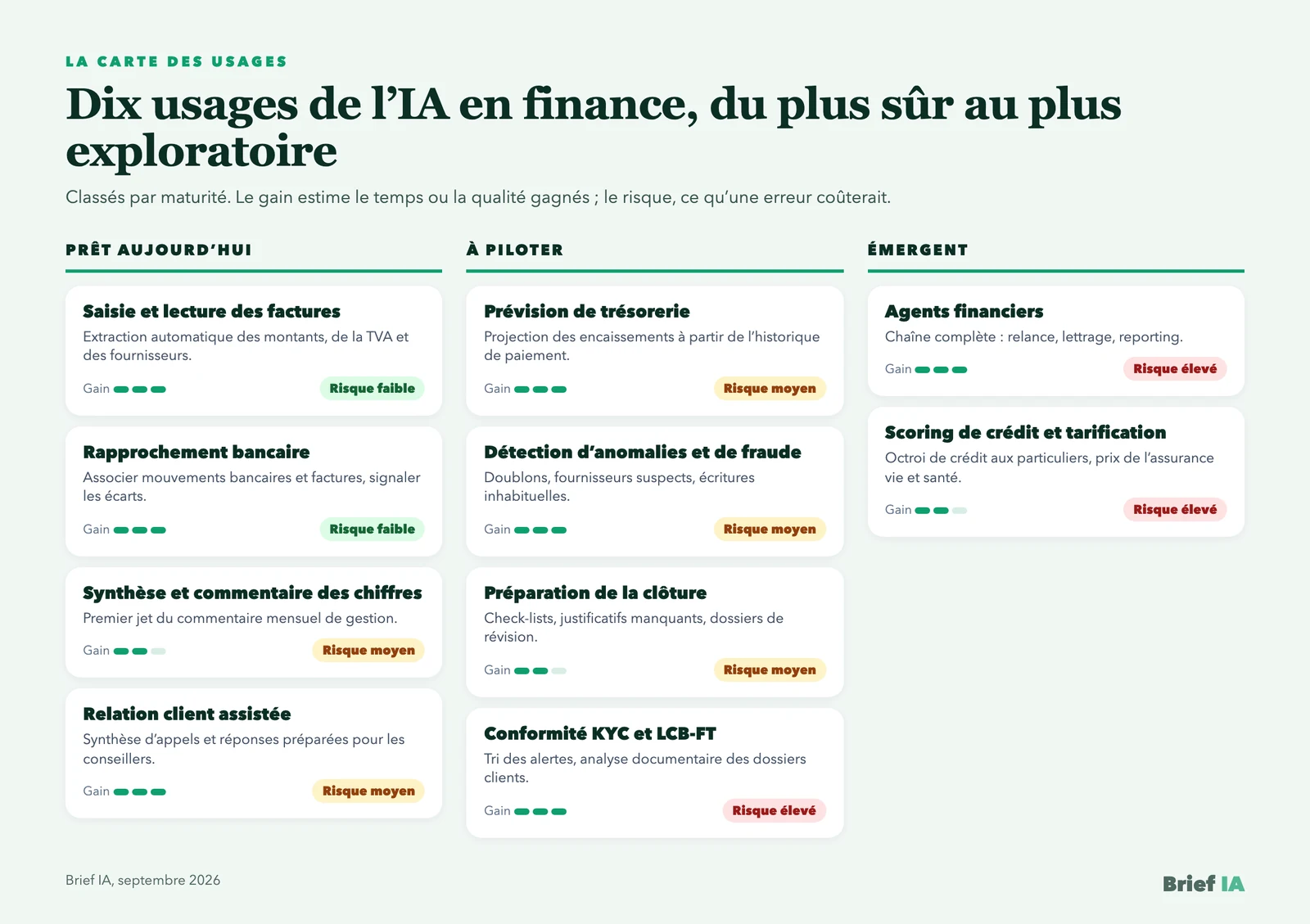 Map of AI use cases in finance
Ten use cases ranked by maturity, with expected gains and risks in case of error.
Ready-to-Use Applications
Invoice Reading. Extraction of amounts, VAT, supplier, and due date: this is the most widespread use case, and the generalization of electronic invoicing makes it even more reliable, as the data arrives structured.
Bank Reconciliation. Associating bank movements with invoices, flagging discrepancies and unjustified payments: pre-accounting tools now do this in real-time. The responsibility of the accountant remains unchanged.
Summary and Commentary on Figures. A first draft of the monthly management commentary, an explanation of budget variances, a note for the management committee: the gain is real, provided that every figure included is verified, as a model can confidently replicate an erroneous value.
Assisted Customer Relations. In banks and insurance companies, AI synthesizes calls and prepares responses for advisors. Hello bank! has launched a banking assistant with Mistral AI that handles over 350,000 conversations annually, and Revolut states that nearly 80% of its support conversations are resolved without human intervention.
Use Cases to Monitor
Cash Flow Forecasting. Projecting receipts based on historical customer payment patterns improves visibility, but models must be reconciled with reality each month.
Anomaly and Fraud Detection. Duplicates, suspicious suppliers, unusual entries: AI identifies what a sample control might miss. The British insurer Aviva uses it against claims fraud, which has cost it £230 million in fraudulent claims. The hidden cost is false positives: it’s better to think in terms of cost per useful alert.
Closing Preparation. Checklists, missing justifications, review files: publishers now offer specialized agents. For example, Anthropic has introduced ten agents for finance, including a monthly closing agent and a general ledger reconciliation agent.
KYC and AML Compliance. Sorting alerts, analyzing identification documents, preparing reports: the gain is significant, but explainability and audit trails are essential in the face of regulators.
Emerging Use Cases
Financial Agents handle follow-ups, matching, and reporting. Payment-triggering agents are on the way: Visa, Mastercard, and Ant have launched a joint initiative to regulate these agents, and Revolut has presented what it describes as the first payment of this type in France. Who is liable for a payment triggered by an agent is still undecided. Credit Scoring and Insurance Pricing fall into a separate category: the AI Act classifies them as high-risk.
Tools to Know
The market evolves every month. Rather than a ranking, here are the main categories of tools and what to demand from each.
- Pre-accounting and Accounting Software now integrate invoice reading and reconciliation, like Visma for SMEs. Requirements: compatibility with electronic invoices, audit log, human validation.
- Accounting Platforms Driven by Agents, such as Rillet, which raised $100 million. Requirements: traceability of each entry and a commitment not to train models on your data.
- Agents from Major AI Publishers. Anthropic offers agents dedicated to financial tasks, and OpenAI has a version of ChatGPT for finance with citations. Requirements: cited sources, control of figures, enterprise contract.
- Fraud Detection Platforms, like Mastercard's fundamental model. Requirements: measured false positive rates and explainable decisions.
- Conversational Banking Assistants, like Hello bank!'s, built with Mistral AI. Requirements: transparency towards the client, limited scope, compliance with payment regulations.
Le brief IA que les pros lisent chaque soir
Les 7 actus IA du jour, décryptées en 5 min. Gratuit.
Inclus dès l'inscription : notre sélection des meilleurs guides & comparatifs IA.
Choisissez votre rythme
Gratuit · Pas de spam · Désabonnement en 1 clic
The Framework: AI Act, DORA, and Electronic Invoicing
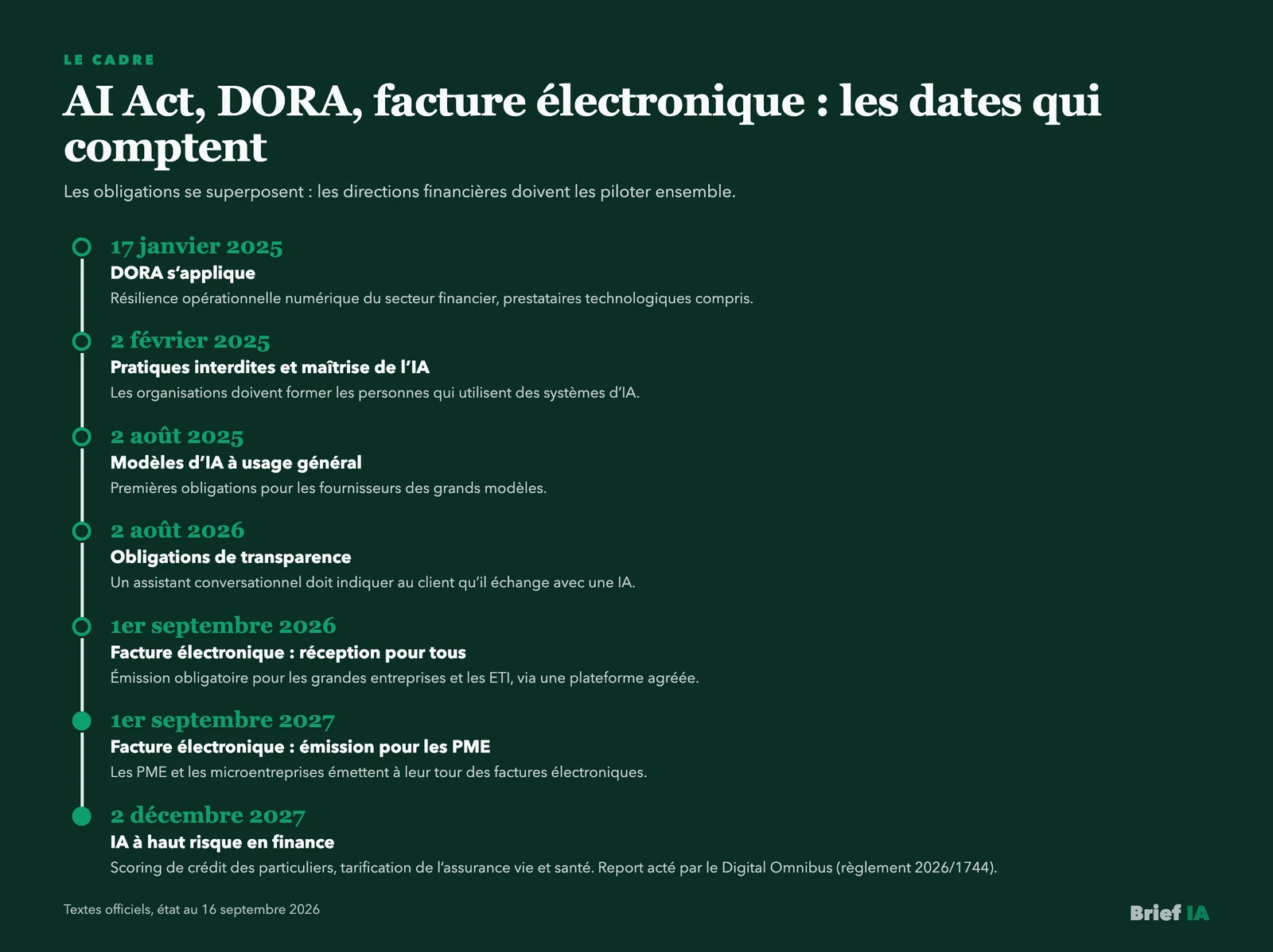 Regulatory timeline for AI in finance
Key dates, from DORA to the high-risk AI Act.
The AI Act, Without Misunderstandings
Much content in circulation is mistaken on this point: accounting, cash flow forecasting, and fraud detection are not high-risk AIs. The regulation targets the assessment of individual creditworthiness, except for fraud detection, and the assessment of risks and pricing in life and health insurance. These systems will be subject to their obligations starting December 2, 2027, following the postponement decided by the Digital Omnibus. Two obligations already apply to everyone: training users, starting February 2, 2025, and informing clients that they are interacting with AI, starting August 2, 2026. Fines can reach €35 million or 7% of global revenue for prohibited practices. Our complete overview of systems classified as high-risk by Brussels.
DORA
The European regulation on digital operational resilience applies from January 17, 2025, to banks, insurers, and management companies. An AI provider is a technology service provider like any other: it must be included in the entity's information register, and an exit strategy is required as soon as it supports a critical or important function. The Australian supervisor noted that few institutions have a substitution plan.
Electronic Invoicing
As of September 1, 2026, all companies must be able to receive electronic invoices, and large companies as well as mid-sized enterprises must issue them through an approved platform. SMEs and microenterprises will follow on September 1, 2027. This structured data is the best raw material for accounting AI.
Banking Data
Accessing a client's accounts requires authorization under the Payment Services Directive. This explains why OpenAI was able to connect ChatGPT to 12,000 banks, but none in France.
Pitfalls to Avoid
Invented Figures. A model can produce a plausible total, replicate a fixed value, or invent data. Every figure included in a report must be traced back to its source.
Missing Audit Trail. An auditor must be able to trace where an entry came from, who validated it, and on what basis. Demand a complete log from each tool: documents used, calculations, human validation, and a commitment not to train models on your data.
Increased CEO Fraud. At Arup, scammers obtained about $25 million in 15 transfers through a fake video conference. Double validation, reminders through a different channel, and hardware security keys are the most effective countermeasures.
Dependency on a Vendor. Concentration on a few models creates a risk that the Bank of England and supervisors are closely monitoring. Plan for a backup solution.
Consumption for Its Own Sake. Multiplying use cases without measuring their returns inflates the bill. A budget per team and performance indicators prevent drift.
Agents That Pay. Visa, Mastercard, and Ant have launched a joint initiative to regulate AI agents that trigger payments. As long as liability is not clarified, an agent should never be able to pay without a limit or validation.
Taking Action: The 90-Day Plan
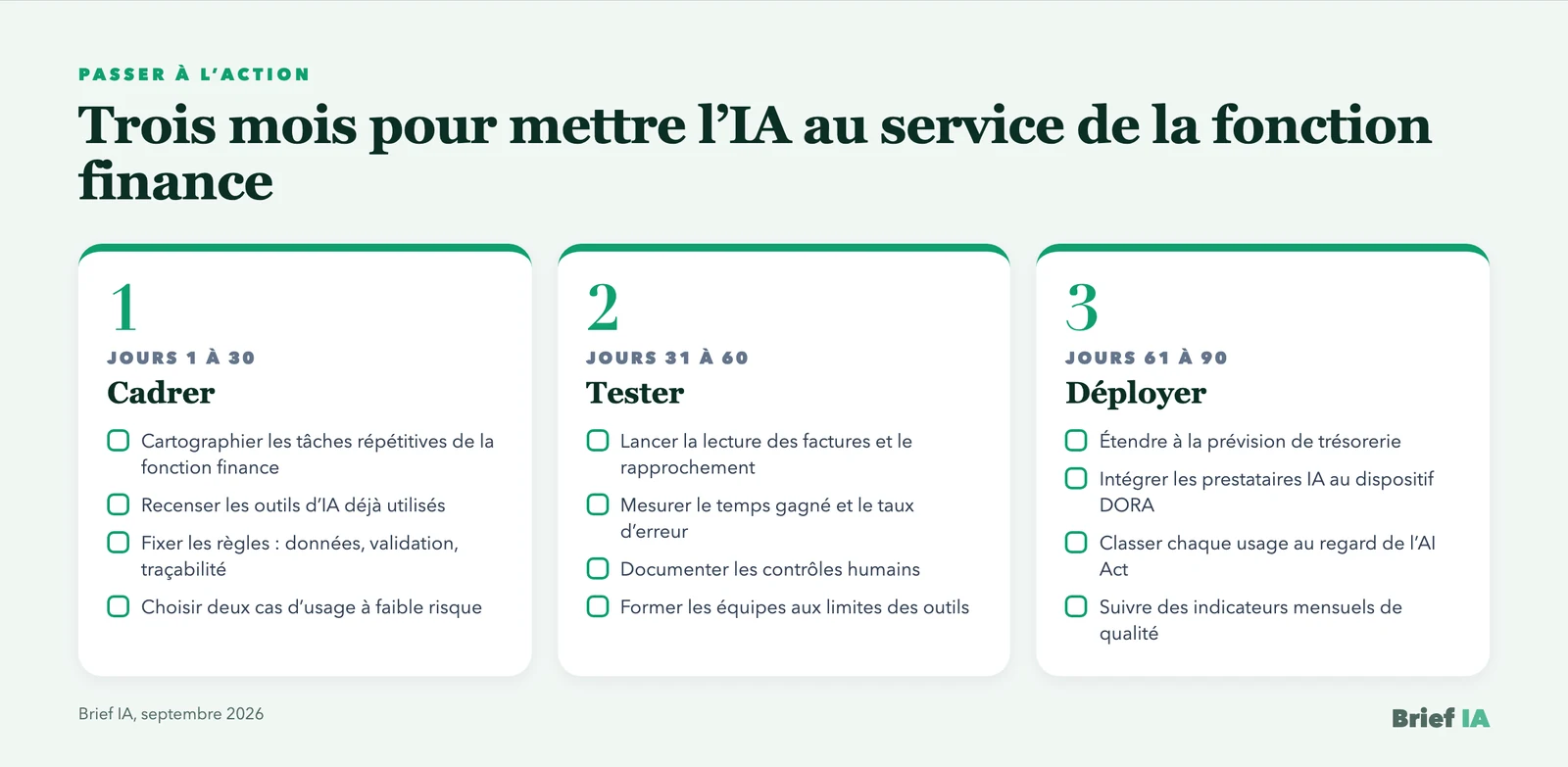 90-day plan to integrate AI into the finance function
Three steps: frame, test, deploy.
The most cost-effective starting point is accounting production: invoice reading and bank reconciliation. One month to map tasks and set rules, one month to test with clear indicators, and one month to extend to cash flow forecasting and integrate providers into the DORA framework.
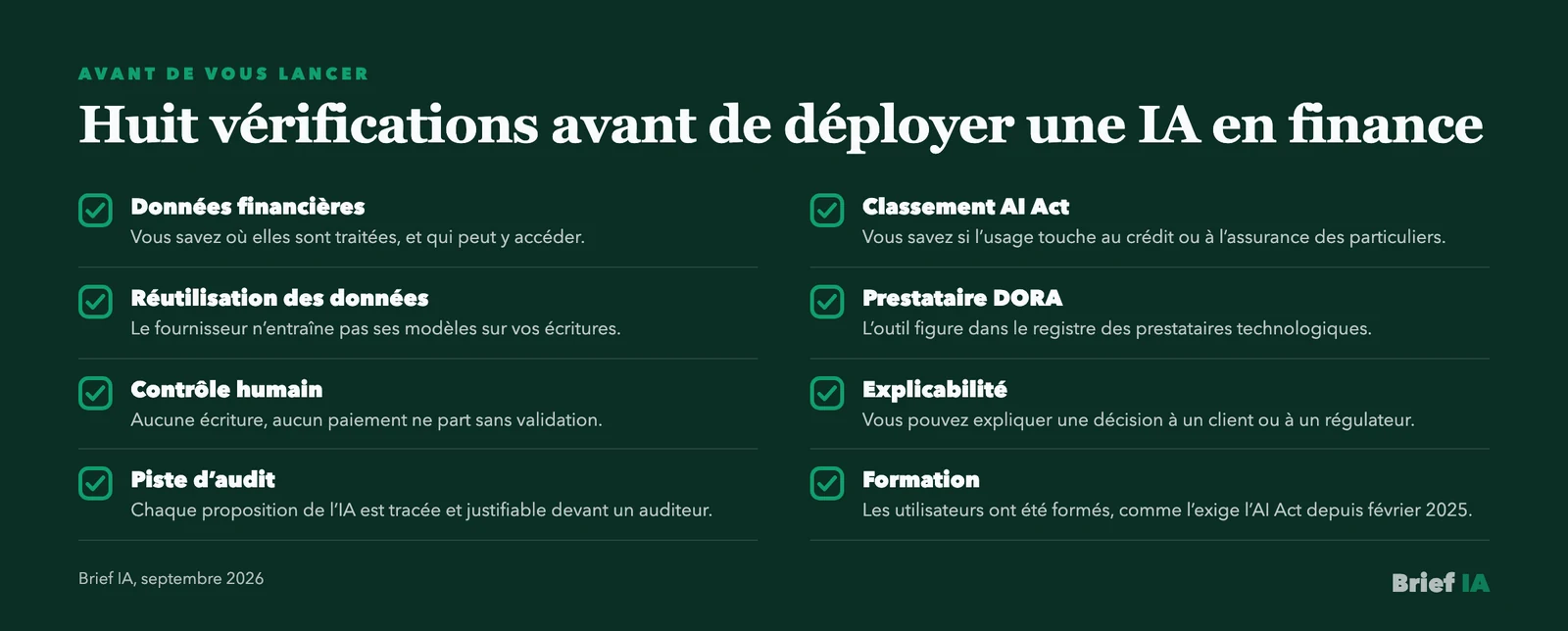 Checklist before deploying AI in finance
Eight checks to perform before each new use case.
Further Reading
Our analyses for finance professionals
- European AI Law: Concrete Impacts for Businesses. The timeline, penalties, and three priorities for the coming months.
- Rillet, Accounting Agents, and Governance. What to demand from an accounting agent: audit log, human validation, protected data.
- Revolutionizing Accounting with AI: The Field Guide. Combining electronic invoicing and pre-accounting without compromising accountability.
- AI Tools Against Banking Fraud. Thinking in terms of cost per avoided false positive.
- AXA Deploys Its AI Agents on a Large Scale. A common platform to industrialize agents in insurance.
Key News to Note
- 67% of French companies report using generative AI
- 500 investment bankers assess AI results
- Deepfakes: FIDO2 Keys and Passphrases to Secure Transfers
- OpenAI connects ChatGPT to 12,000 banks, but none in France
- Revolut details the role of AI in its customer support
- Aviva deploys AI against claims fraud
Do you provide a solution for finance departments?
This guide is read by CFOs, accountants, bankers, and insurers. Brief IA offers fintech and financial software publishers dedicated articles, slots in the evening brief, and promotion in the directory. Formats and rates at briefia.fr/partenaires.
The Essentials in Questions
What AI use cases are most profitable for a finance department?
Invoice reading, bank reconciliation, and closing preparation. These are repetitive tasks that are easy to control, with gains measurable in a few weeks.
Is AI-assisted accounting considered high-risk AI?
No. The AI Act classifies the assessment of individual creditworthiness and insurance pricing as high-risk, not accounting or cash flow forecasting. The obligations for high-risk systems apply starting December 2, 2027.
What is the link between electronic invoicing and AI?
Electronic invoicing provides structured data, which enhances automatic reading and reconciliation reliability. As of September 1, 2026, all companies must be able to receive them; SMEs will need to issue them starting September 1, 2027.
How can one protect against deepfake fraud?
By imposing double validation for transfers, reminders through a different channel than the request, and hardware security keys for sensitive operations.
Must a bank integrate its AI providers into DORA?
Yes, as long as they provide a technological service to a financial entity: they must be included in the information register, and an exit strategy is required if they support a critical or important function.
Brief IA — L'actualité IA en français
L'essentiel de l'actualité de l'intelligence artificielle, décrypté et expliqué chaque jour.