Five GitHub Resources for Creating Specialized AI Agents
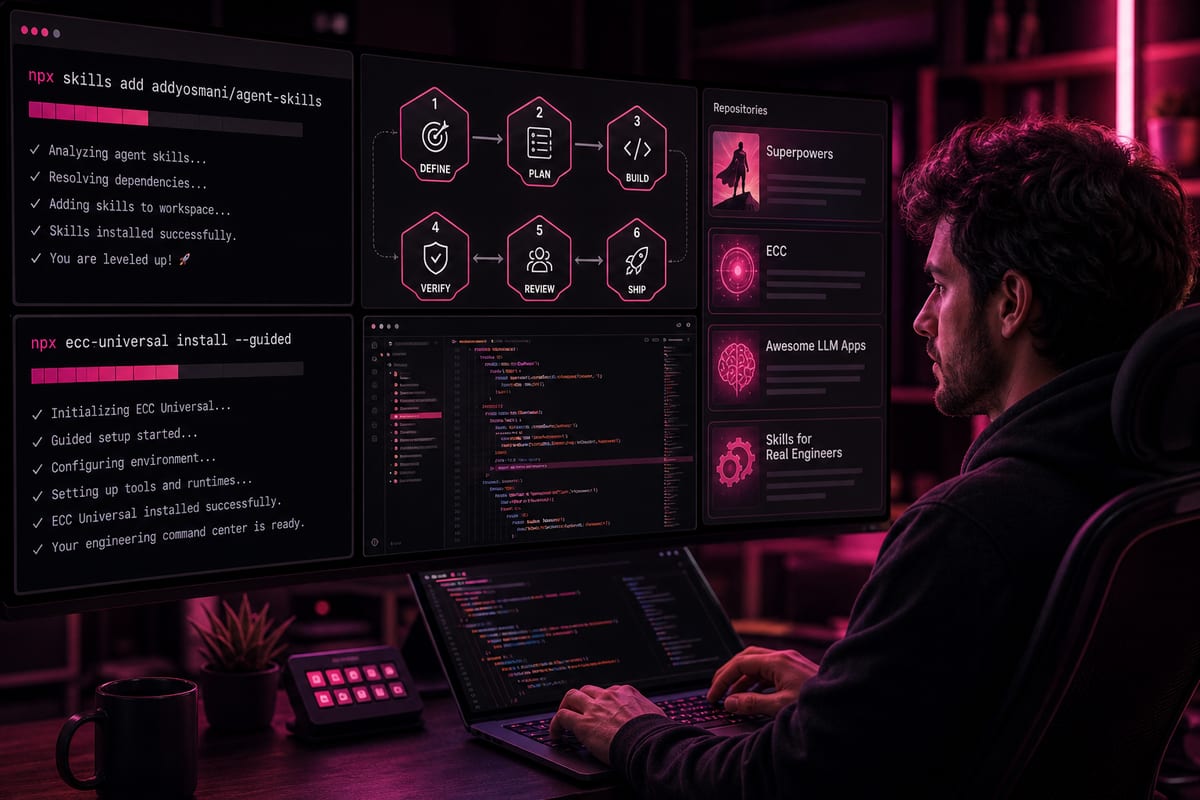
Five open-source collections offer ready-to-use skills for guiding coding agents, from specification to delivery. On the agenda: methods, testing, structured debugging, multi-session memory, security, and installation commands. Here’s a numerical and operational overview, without mixing approaches.
Addy Osmani structures DEFINE to SHIP with 24 skills
The Agent Skills collection targets production use and organizes workflows into six steps: DEFINE, PLAN, BUILD, VERIFY, REVIEW, and SHIP. It currently includes 24 skills covering requirements, planning, TDD, frontend, API design, debugging, security, performance, code review, CI/CD, observability, documentation, and delivery. Lifecycle commands (/spec, /plan, /build, /test, /review, /ship) load the appropriate sequences for each phase. The focus is on quality gates: a constraint-driven development skill sets the requirements for testing, linting, security, coverage, and performance, placing costly checks later in the flow. Installation is done via npx skills add addyosmani/agent-skills, with an option --list to explore and --skill to install only a specific capability. The Skills CLI announces support for over 70 coding agents, including Claude Code, Cursor, Codex, Copilot, and Cline.
ECC combines 68 agents, 94 shims, memory, and AgentShield
ECC is described as the most extensive collection in terms of overall capabilities, combining skills, expert agents, rules, hooks, persistent memory, continuous learning, security devices, and integrations. The repository offers 68 specialized agents as well as 94 command shims, covering areas such as TDD, research, frontend, machine learning, security, operations, architecture, testing, and agent orchestration. Affaan Mustafa details a sequence of planning → testing → implementation → review → verification → memorization → improvement; the latter steps allow for maintaining usable context and integrating recurring patterns like acquired behaviors. The AgentShield tool performs an analysis of secrets, permissions deemed risky, hooks, MCP parameters, and security vulnerabilities related to prompts. Installation is done via npx ecc-universal@2.2.1 setup or in guided mode. The best current integration is mentioned on the Claude Code side, with support for Codex and, at varying levels, Cursor, OpenCode, Kimi Code, Gemini, and others. ECC is presented as potentially oversized for a simple better debugging prompt, but as an ambitious option for those aiming for an integrated engineering platform with memory, security, and specialized workers.
Le brief IA que les pros lisent chaque soir
Les 7 actus IA du jour, décryptées en 5 min. Gratuit.
Inclus dès l'inscription : notre sélection des meilleurs guides & comparatifs IA.
Choisissez votre rythme
Gratuit · Pas de spam · Désabonnement en 1 clic
Two paths to guide the agent: complete methodology or composable blocks
Superpowers, created by Jesse Vincent and the Prime Radiant team, presents itself as a methodology for agents, with skills covering planning, TDD, and systematic debugging. To deliver a feature, the agent chains brainstorming, design validation, planning, implementation via sub-agents or execution of the plan, TDD, review, checks, and branch finalization. Debugging relies on a structured cause analysis. Installation for Claude Code is done via /plugin install superpowers@claude-plugins-official, with announced compatibility for Codex, Cursor, Gemini CLI, OpenCode, GitHub Copilot CLI, Kimi Code, Antigravity, and other environments. In contrast, Skills for Real Engineers by Matt Pocock offers small, adaptable, and composable capabilities. Matt says he uses them daily for real engineering. The skills include improve-codebase-architecture, grill-with-docs (questioning, shared domain model, updating CONTEXT.md and ADRs), tdd (red-green-refactor loop), and diagnosing-bugs (structured process). A possible sequence grill-with-docs → to-spec → to-tickets → implement → code-review is documented as the main multi-session chain. Installation via npx skills@latest add mattpocock/skills allows for choosing skills and agents; files are copied into the project for adaptation. Matt recommends running setup-matt-pocock-skills once per repository.
An expanded directory: over 100 agents, skills, and RAG apps
Awesome LLM Apps by Shubham Saboo aggregates over 100 open-source projects combining agents, agent skills, and RAG applications around GPT, Claude, Gemini, DeepSeek, Llama, and Qwen. This breadth shows how agents, tools, retrieval, multiple models, and skills combine into usable applications. Among the referenced skills are Project Graveyard, Scope Creep Detector, Commit Archaeologist, Self-Improving Agent Skills, and Advisor Orchestrator Worker. Project Graveyard installs via npx skills add with the URL of the dedicated folder; it explores local Git repositories, reads their history, identifies reasons for abandonment, and suggests projects to relaunch.
Practical benchmarks, scope, and adoption choices
Beyond code, engineering involves requirements, planning, testing, debugging, review, and delivery criteria; agent skills encapsulate these operating modes and avoid the need to re-explain everything. Five repositories are highlighted: Superpowers (285.5K stars), Skills for Real Engineers (260.1K), ECC (256.7K), Awesome LLM Apps (137.3K), and Agent Skills (93.6K), each with a specific approach. Superpowers claims a methodology and a way to approach development more than isolated prompts. The summarized positions are as follows: complete methodology (Superpowers), small and composable blocks (Matt Pocock), platform with memory (ECC), broad-spectrum experimentation (Awesome LLM Apps), production focus (Addy Osmani). A proposed guideline is to select suitable workflows, test them on concrete projects, and gradually customize the SKILL.md files. The general idea is to teach the agent how to build software, in a context where agents like Claude Code, Codex, Cursor, and OpenCode are already described as effective for producing code.
Brief IA — L'actualité IA en français
L'essentiel de l'actualité de l'intelligence artificielle, décrypté et expliqué chaque jour.