Google Launches Nano Banana 2 Lite and Unveils Gemini Omni Flash
Le brief IA que les pros lisent chaque soir
Les 7 actus IA du jour, décryptées en 5 min. Gratuit.
Inclus dès l'inscription : notre sélection des meilleurs guides & comparatifs IA.
Choisis ton rythme
Gratuit · Pas de spam · Désabonnement en 1 clic
Google Unveils Nano Banana 2 Lite and Opens Gemini Omni Flash to Developers
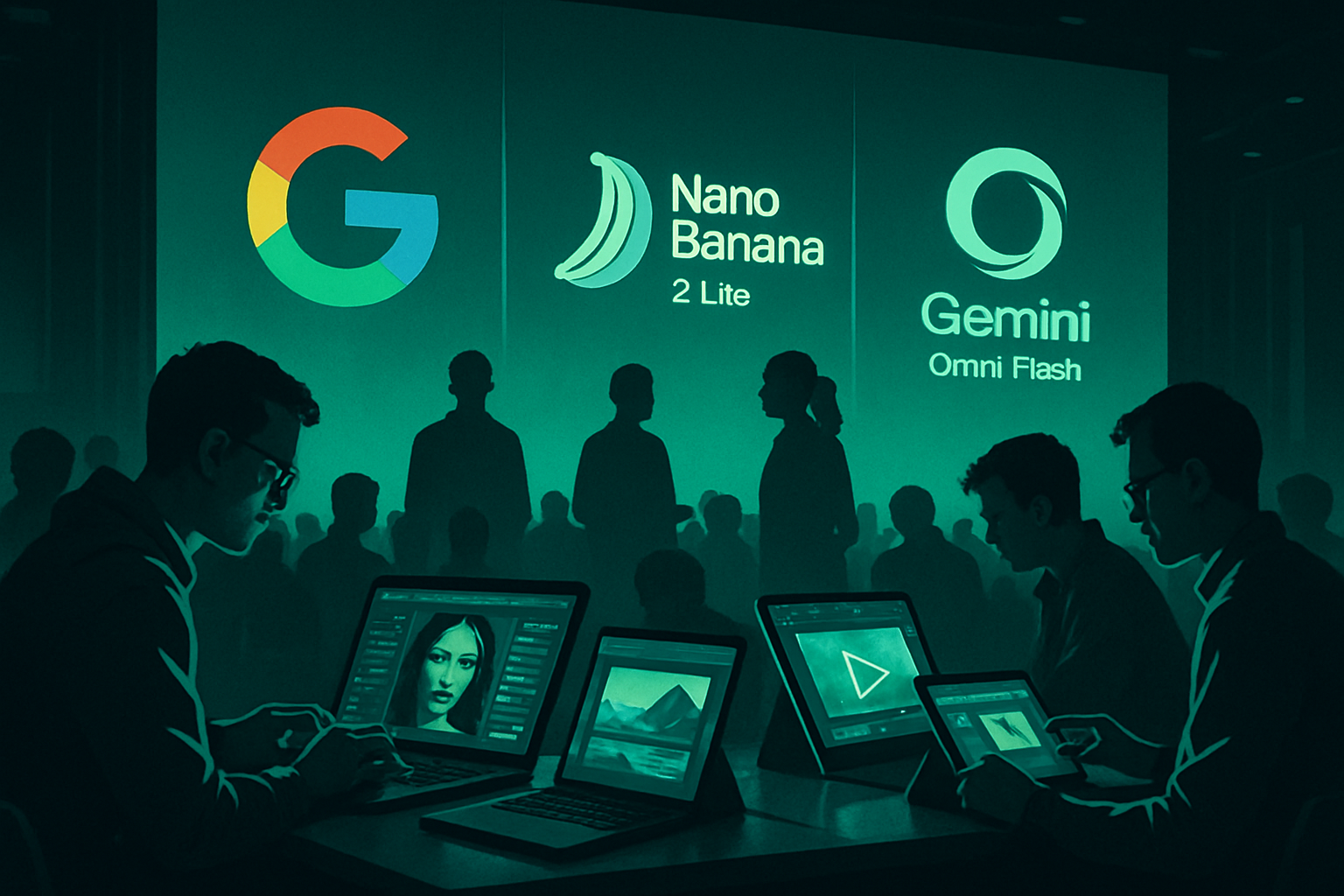
In an announcement made on Tuesday, June 30, 2026, Google revealed the release of Nano Banana 2 Lite, a new version of its image generation model, initially launched in February. This version is described as significantly faster and more cost-effective than its predecessors. Simultaneously, Google has also opened access to developers for Gemini Omni Flash, a multimodal model designed for video generation and editing, which was showcased in May during the company's annual conference.
Nano Banana 2 Lite: Designed for Speed and Volume
Available now in Google AI Studio, Nano Banana 2 Lite is specifically designed for environments where speed and cost take precedence over maximum quality. Google encourages developers still using the first version of Nano Banana to adopt this new model, which offers improved performance across all aspects.
The Nano Banana 2 Lite model stands out for its low latency and reduced cost. It can generate images from text in just 4 seconds, making it a valuable tool for interactive prototyping and rapid visual sketching. The pricing is also very competitive, at $0.034 for 1,000 images. Google claims, based on benchmarks, that the model produces results faithful to the given instructions, with coherent characters and readable text.
Choosing the Right Nano Banana Model Based on Needs
- Nano Banana 2 Lite: Optimized for workflows requiring very low latency and high volume.
- Nano Banana 2: A general-purpose model that balances quality and speed.
- Nano Banana Pro: Designed for complex and professional use cases, offering greater control and deeper reasoning capabilities.
- Nano Banana: The historical model that Google recommends replacing with Nano Banana 2 Lite.
Nano Banana 2 Lite is not limited to Google AI Studio. It is also integrated into several Google services, such as the Gemini app, NotebookLM, Google Photos, and Google Ads.
This initiative from Google comes as the company continues to lag behind OpenAI in the field of image generation. According to the June ranking from the Text-to-Image Arena by Artificial Analysis, the GPT Image 2 and GPT Image 1.5 models significantly outperform Nano Banana 2 and Nano Banana Pro in terms of performance.
Gemini Omni Flash: Conversational Video Editing for Developers
Introduced at the Google I/O conference last May, Gemini Omni Flash combines the multimodal reasoning of Gemini with video generation and editing capabilities. Already available for Google AI Plus, Pro, and Ultra subscribers, it is now accessible via the Gemini API and Google AI Studio in public beta.
The model features several notable characteristics:
- A conversational approach to video editing, allowing users to refine and modify videos produced by Gemini Omni Flash using multiple successive instructions.
- A multimodal referencing capability, able to combine inputs such as images, text, and video to create coherent scenes.
- A deep understanding of the real world, utilizing Gemini's knowledge in history or biology to generate compelling videos.
The cost of Gemini Omni Flash is $0.10 per second of generation, a rate comparable to that of Veo 3.1 Fast. However, some limitations remain: generated videos are currently limited to ten seconds, and audio file imports as well as scene extension are not yet supported by the API. Additionally, reference sequences imported for more than 3 seconds are not well processed by the model at this time. Google also acknowledges that character consistency still has limitations during scene changes or panning movements, but is actively working to improve these aspects.
Brief IA — L'actualité IA en français
L'essentiel de l'actualité de l'intelligence artificielle, décrypté et expliqué chaque jour.