Google Launches Gemini 4 Argon for Simulated Robotics
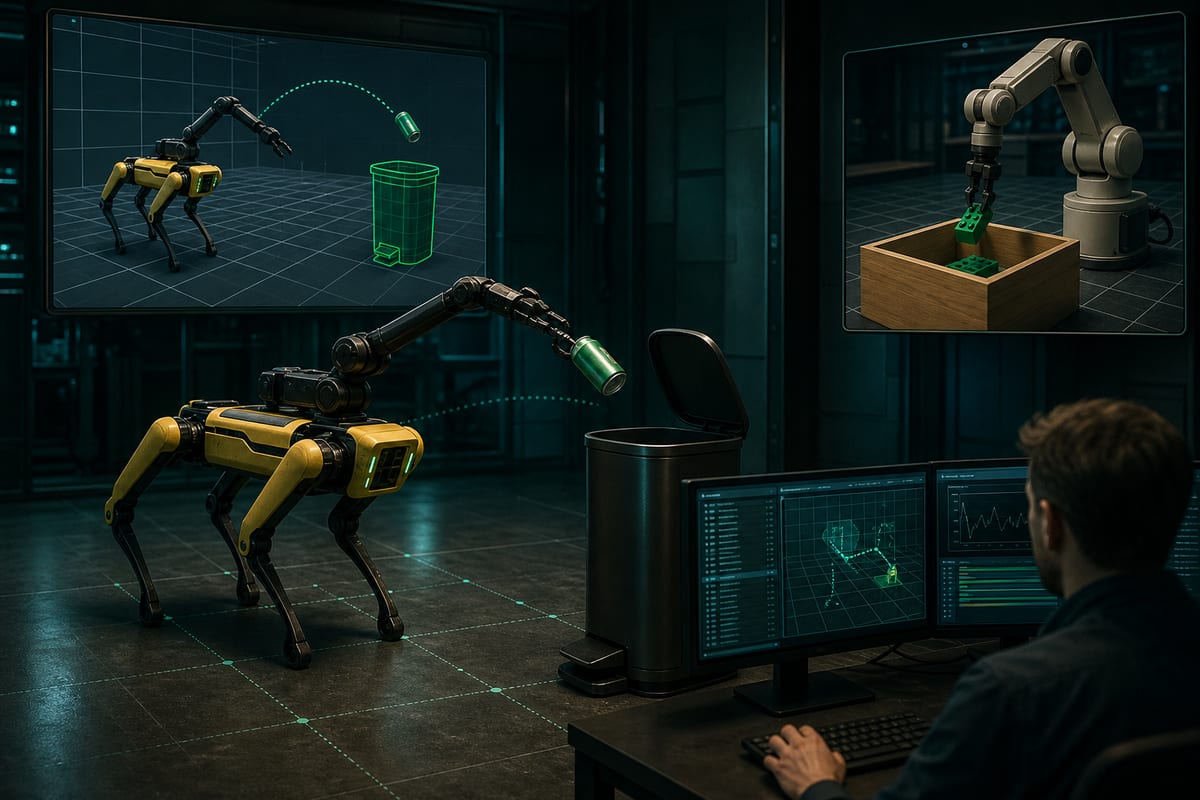
Google introduces Gemini 4 Argon, an AI model designed to integrate simulation, control, and data evaluation in robotics. Demonstrations show measured improvements after virtual training, while benchmarks deliver varying rankings. Access is currently limited to paid offerings within the Google ecosystem.
Benchmarks and Measurements: 87% on ERQA, 55/100 on AA-Robotics
According to Google, Gemini 4 Argon achieves 87% on the ERQA benchmark, a test consisting of 400 questions on physical and spatial reasoning without any aids. In the same evaluation, Claude Opus 5.5 scores 82.3%, GPT-6 Astra scores 81%, and Claude Fable 5.1 scores 74%. Another test, AA-Robotics by Artificial Analysis, published a day later and based on eight real tasks with a robotic arm, ranks Argon third with 55 points out of 100, behind GPT-6 Astra (69) and GPT-6.1 Sol (65).
Beyond the rankings, measurements from the demonstrations are provided. After generating training episodes, a test on a real robot sees the success rate increase from 56% to 75%, and execution time decrease from 35 to 24 seconds. In another sequence, sorting letters to form "ARGON" takes 33 steps. For a task involving placing a Lego brick, the first attempt takes just under a minute, the second 23 seconds, and the third about 17 seconds. The 75% success rate is not accompanied by the total number of attempts.
What Argon Covers: Simulation, Control, Data Evaluation
Gemini 4 Argon is presented by Google as a unique model covering the entire robotics pipeline, including the creation of virtual environments, writing control code, and interpreting videos in terms of physics. Google describes it as a step towards physical AGI. Beyond control, the model is supposed to evaluate the quality of training data: in a video over two minutes long of a robot folding origami, it segments the sequence and marks pauses and failed attempts to weigh them less during training. In another video of a human sorting rings, it traces phases of progress, stagnation, and regression. The model also solved a weighing puzzle in simulation with two robotic arms and a scale, identifying the different ball in three weighings or less by only reading the tilt on the camera. Google indicates that it has already built 68 environments to reproduce published experiments, executable in the browser.
Le brief IA que les pros lisent chaque soir
Les 7 actus IA du jour, décryptées en 5 min. Gratuit.
Inclus dès l'inscription : notre sélection des meilleurs guides & comparatifs IA.
Choisissez votre rythme
Gratuit · Pas de spam · Désabonnement en 1 clic
Illustrated Use Cases: From a Photo to Thousands of Episodes
Starting from a simple photo of a birthday table, the model built a virtual replica, proposed 77 tasks, and generated over 4,500 training episodes, before being validated on a real robot with gains in success rate and execution time. It can also take a recording of a teleoperated robot to obtain a similar simulation, including force readings at the fingertips, or map gestures from a first-person video onto a five-fingered virtual humanoid. A simple sketch serves to calculate a throwing trajectory to knock over six boxes without destabilizing the robot.
In a fully video demonstration, Gemini 4 Argon produces timestamped instructions, and Gemini Omni generates the clips, while Argon controls the loop by checking frame by frame until it aligns five tiles spelling "ARGON" in 33 steps. Another sequence, with a robotic arm and a Lego brick to place, uses self-review of logs and images before successive corrections, with decreasing execution times. Finally, the scenario with Spot shows preparation in a virtual double of a foot-pedal trash can, a balance training on three legs, and a double check by two AI agents before the release.
Access and Positioning in the Google Ecosystem
Gemini 4 Argon is available in Google AI Studio and in the Antigravity development environment, with access limited to subscribers of Google AI Ultra. The model can also be called via the paid tier of the Gemini API. The global launch occurred a few days earlier. For robotics, Google had already offered Gemini Robotics-ER 1.6 for spatial perception and planning. Other players are also working on virtual training, such as World Labs for converting real scenes into training worlds and Nvidia's DreamDojo for video simulation of robotic actions. The specificity advanced by Google lies in the ambition to combine simulation, control, and evaluation into a single model, based on simple inputs like photos or sketches.
Results Dependent on Detailed Prompts
The published demonstrations rely on precise human instructions. Google has released examples of detailed prompts that strongly frame the tasks. A case presented as zero-shot for righting a tipped cup relies on an image with a metric grid and predefined commands like "grasp" or "lower until contact." To avoid shortcuts in simulation, lists of prohibitions specifically forbid direct copying of sensor measurements. Google does not disclose the failure rates of individual demonstrations, and the 75% success rate is not accompanied by the number of attempts.
Brief IA — L'actualité IA en français
L'essentiel de l'actualité de l'intelligence artificielle, décrypté et expliqué chaque jour.